%20--%3e%3cdefs%3e%3cstyle%3e%20.st0%20{%20fill:%20%23a5d028;%20}%20.st1%20{%20fill:%20%23fff;%20}%20.st2%20{%20fill:%20%231de2db;%20}%20.st3%20{%20fill:%20%2341bdf9;%20}%20%3c/style%3e%3c/defs%3e%3cg%20id='logo-unaice-line'%3e%3cpath%20class='st1'%20d='M143.3,36.1c-1.2,0-2.1-.9-2.1-2.1V12.2c0-1.2.9-2.1,2.1-2.1s2.1.9,2.1,2.1v21.8c0,1.2-.9,2.1-2.1,2.1ZM143.2,6.2c-1.3,0-2.4-1-2.4-2.4v-.8c0-1.3,1-2.4,2.4-2.4s2.4,1.1,2.4,2.4v.8c0,1.3-1.1,2.4-2.4,2.4Z'/%3e%3cpath%20class='st3'%20d='M23.7,36.1H2c-.5,0-1-.4-1-1V2.3c0-.5.4-1,1-1h21.7c.5,0,1,.4,1,1v32.9c0,.5-.4,1-1,1'/%3e%3cpath%20class='st2'%20d='M41.8,36.1h-14.4c-.5,0-1-.4-1-1v-14.5c0-.5.4-1,1-1h14.4c.5,0,1,.4,1,1v14.5c0,.5-.4,1-1,1'/%3e%3cpath%20class='st0'%20d='M41.8,17.9h-14.4c-.5,0-1-.4-1-1V2.2c0-.5.4-1,1-1h14.4c.5,0,1,.4,1,1v14.7c0,.5-.4,1-1,1'/%3e%3c/g%3e%3cpath%20class='st1'%20d='M196.4,29.2c-2.1,2.1-3.6,3.2-7.1,3.2s-7.4-2.3-8.2-7.4h16.7c2.7,0,2.9-1.9,2.7-4-.7-6.2-5.3-11.2-11.6-11.2s-12.3,5.1-12.3,13.4,5.4,13.3,12.6,13.3,8.3-2.6,10-4.3c1.8-2.1-1.2-4.7-2.8-3ZM188.9,13.7c4.7,0,7.3,4.1,7.6,7.3h-15.3c.7-4.3,3.4-7.3,7.7-7.3Z'/%3e%3cpath%20class='st1'%20d='M132.1,12.9c-1.9-1.9-5.4-2.9-8.2-2.9s-5.3.5-8.2,1.8c-2.4,1-.9,5,1.6,3.7,2.1-1,3.3-1.5,6.3-1.5s6.7,1.1,6.8,6.1c-1.8-.5-2.7-.8-6.9-.8-6.8,0-11.3,3.3-11.3,8.8s4.1,8.4,10.1,8.4,5.4-.6,8.3-2.9v.5c0,2.8,4.2,2.6,4.2,0v-13.8c0-3.1-.8-5.5-2.7-7.4ZM130.4,26.2c0,3.6-3.4,6.3-8,6.3s-5.9-1.7-5.9-4.6,2.5-4.6,6.8-4.6c0,0,4.8,0,7.1,1v1.9Z'/%3e%3cpath%20class='st1'%20d='M80,36.1c-1.2,0-2.1-.9-2.1-2.1V3.4c0-1.2,1-2.2,2.2-2.2h.4c.8,0,1.4.4,2,1.1l20.2,25.7V3.4c0-1.2.9-2.1,2.1-2.1s2.1.9,2.1,2.1v30.7c0,1.1-.5,2-1.9,2s-1.9-.8-2.2-1.2l-20.7-26.2v25.3c0,1.2-.9,2.1-2.1,2.1Z'/%3e%3cpath%20class='st1'%20d='M60.2,36.5c-5.1,0-10.5-4.3-10.5-10.7v-13.5c0-1.2.9-2.1,2.1-2.1s2.1.9,2.1,2.1v13.1c0,4.5,2.5,7.1,6.6,7.1s7.3-3.2,7.3-7.5v-12.7c0-1.2.9-2.1,2.1-2.1s2.1.9,2.1,2.1v21.8c0,2.8-4.2,2.7-4.2,0v-.5c-1.5,1.6-3.3,2.9-7.6,2.9Z'/%3e%3cpath%20class='st1'%20d='M163.8,36.5c-7.1,0-13.1-6-13.1-13.3s4.8-13.5,13.5-13.5c4.4,0,6.9,2,8.8,3.7,1.8,1.5-.8,5.1-2.8,3.3-.8-.8-3.3-3-6.4-3-4.8,0-8.6,4-8.6,9.2s3.8,9.3,8.6,9.4c3.7,0,4.9-1,7-3.1,1.6-1.8,4.6,1,3,2.8-3,3-5.7,4.5-10,4.5h0Z'/%3e%3c/svg%3e)
Practical Application of Structured Data: A Guide for Various Industries
Data management and the use of structured data are already virtually mandatory in most industries. But what does data management look like in practice, and how is it concretely implemented across different e-commerce sectors? In the following article, we show you some examples of structured data usage, focusing on the individual challenges and specifics.
Whether you run an online shop, work in tourism, or in publishing – by the end of this article, you will have a comprehensive understanding of the benefits that well-thought-out data management and structured data can bring to your business.

Data Management in Practice – Industry Examples
In the following chapter, we will use examples from various industries to show you how successful data management and the resulting structured data positively impact your sales performance. By optimally adapting data to the different "data languages" of the platforms, their potential is used ideally and to your advantage.
Platform-Specific Data Optimization: Automotive Case Study
Especially in the automotive sector, product designations are often not platform-compliant (e.g., on eBay), keywords are missing or not optimized, and the text conveys only minimal information.
The Text Robot algorithm also converts data from automotive providers, making it data model-compatible, improving it to clearly highlight the added value, and ultimately formulating informative text – all in seconds and with the highest precision.
For more information on structured data and automated content production, check out this podcast.
In the automotive sector, the motto is: Prepared, structured data in their uniform and structured form are 100% sales platform-optimized, automatically and future-proof scalable.
By increasing the information content of a text, structured data also promote conversion and leave satisfied customers who return because they find exactly what they are looking for. As you can see, semantic search engines as well as filter and comparison options can be implemented in your shop.
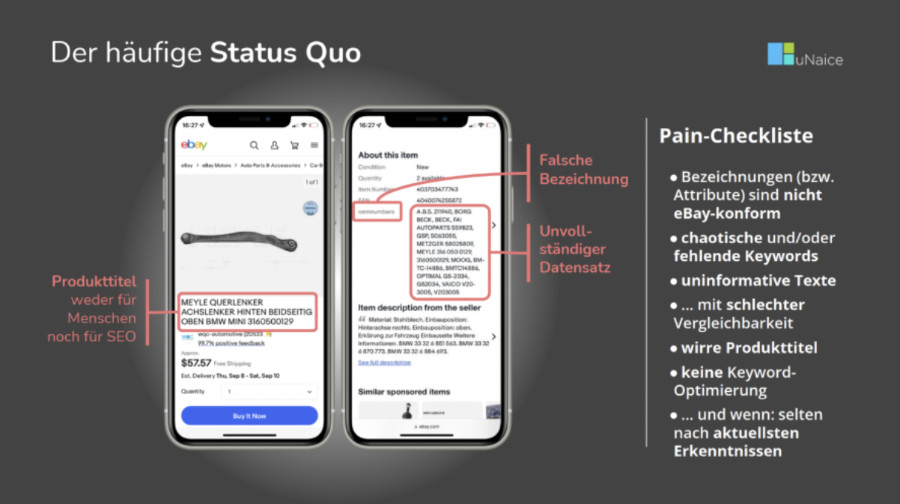
The Automotive Aftermarket typically uses the international industry standard TecDoc to designate its products, which usually does not meet the linguistic requirements of the various sales platforms. That's where the Text Robot steps in, transforming TecDoc data into platform-optimized, structured data. Different units are converted as needed, designations are simplified and summarized per platform, errors are corrected, attributes are supplemented from additional sources, and gaps in values are closed.
We Optimize Data for eBay
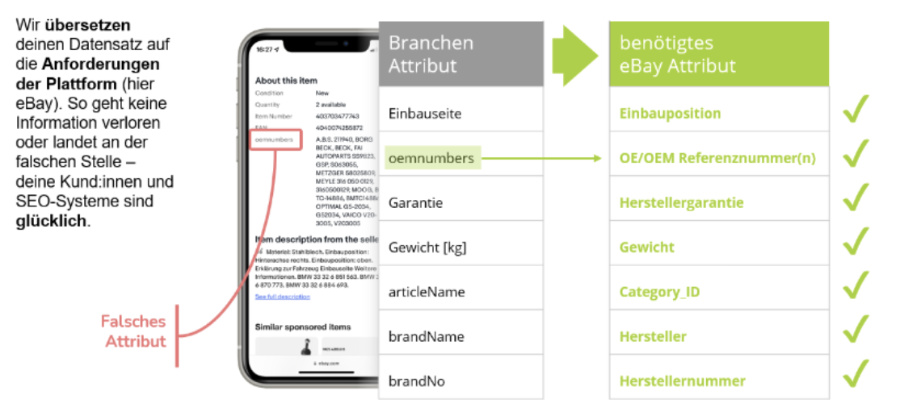
Equally important is highlighting each product's unique added value, which makes the crucial difference as it ultimately leads to more conversion.
It should also be noted that automatically generated text and structured data adapt to the different shopping platforms and their requirements for optimal visibility as follows:
➡️ Shop: concise, holistic text with high information density
➡️ Additional shops: additional text variants with identical information density to optimize SEO performance
➡️ Meta Title/Description: short, concise text for Google search results
➡️ Newsletter or product blogs: detailed, editorial text with narrative guidance and good structure
➡️ Twitter: strong focus on bold statements, as the platform is characterized by character limits
➡️ Instagram/Facebook: images are key – the text must be brief and concise
Platform-Specific Data Optimization with Structured Data: Travel Case Study
When we switch to another industry, namely the travel and tourism sector, the question once again arises as to why optimized, structured data are so valuable here as well.
Tour operators and hotel operators know the pain points of the industry and are well aware of how quickly they can be pushed to page 2 or into unfavorable niches by the major players of the sector. Through text automation and precise data management with structured data, unique, correct, and complete content is also guaranteed in the travel industry – even for hotel or travel options with very many similar details. The indispensable added value in the tourism industry is delivered through the integration of geo data.
The data foundation in the tourism and hotel sector is the industry standard GIATA and Global Type, but here too, available data must be prepared, cleaned, and converted into structured data in order to subsequently create appealing and meaningful product descriptions through automated text generation.
We Optimize Data for eBay
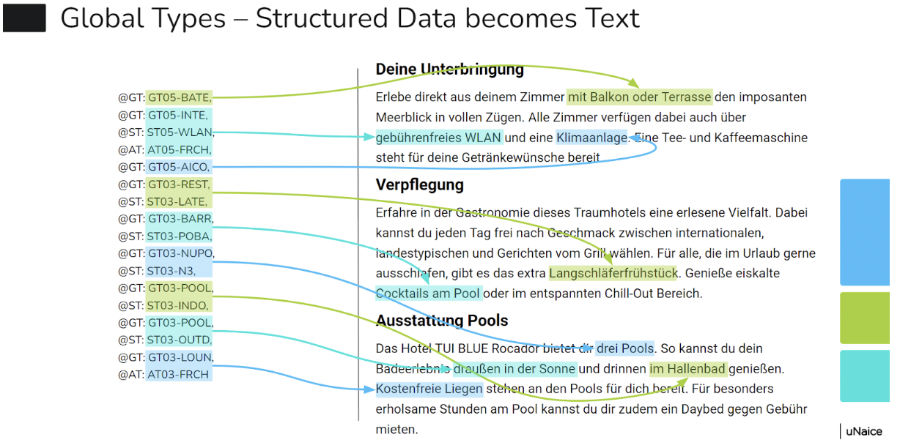
The tour operator only provides the data – the Text Robot optimizes it and creates first-class, unique, platform-compliant, SEO-relevant, and customer-specific hotel descriptions.
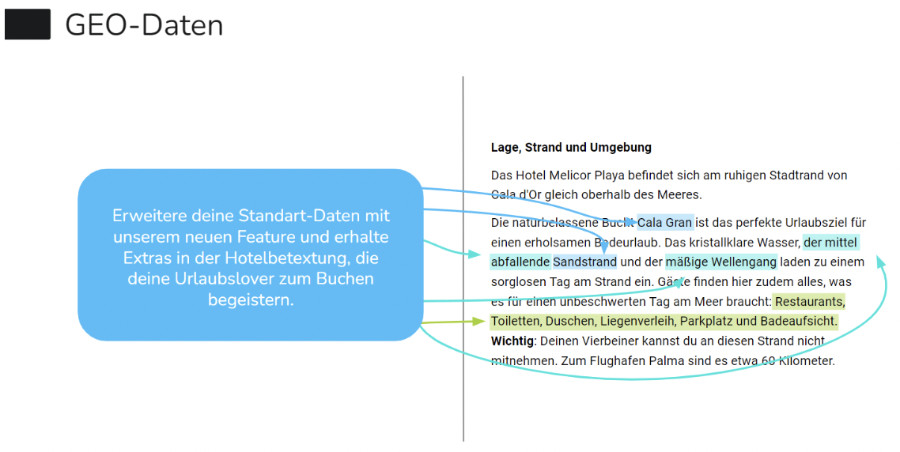
For the hotel industry, structured data, geo data, and surrounding area descriptions from various reputable sources are fundamental, as they ensure content relevance and enrich existing data. This is precisely what makes the added value in the tourism industry, going far beyond the customer reviews commonly used in the industry.
It is essential to integrate important content about sights, excursion options, beaches, restaurants, etc., which definitely help with visibility on Google. The more informative your travel offering is described, the better informed potential customers feel – and the more likely a purchase action becomes.
This also includes indirect access through alternative search phrases that don't directly ask for hotels but for information about the surrounding area. This way, attention is drawn to your hotel offerings indirectly.
This is exactly what optimization with structured data is all about: automatically enriching data in a targeted way so that the added value of your travel or hotel offering is clearly highlighted.
Data Optimization with Structured Data: Football Case Study
Many publishers often complain that detailed match reporting down to the lower regional and district leagues is simply not possible due to insufficient resources, even though amateur league games are predominantly relevant for fans and readers of media with a regional focus. But that's exactly what the Text Robot can do: cover all games of all leagues down to the lowest divisions with comprehensive pre- and post-match reports, taking into account the various course of play a football match can take. You can probably already guess what it needs for this comprehensive, fully automated reporting. That's right! An optimized data foundation thanks to well-thought-out data management with structured data.
But how do you get from the data to a complete football report that also guarantees increased visibility and a larger readership?
After the initial data acquisition and analysis, where data can be provided per day, per match, per week, etc. as required, the special features are also highlighted in football reporting. This is achieved through the integration of statistical information that creates additional relevance and interprets certain data constellations.
Of course, the time freed up for editors, who no longer need to attend every game and can instead focus on other content (comments, analyses, interviews, etc.), is also a significant gain.
What's important in the football example are the standardized, classifying parameters for match results, point progressions, and intervals between events, which are precisely defined and played out at the right place and the right moment. By the way, these parameters are also transferable to other sports and projects.
What do these look like? For example:
- the goal type by minute
- the number of previous goals
- the interval since the last goal
- the type of goal
In football, it is naturally extremely important to adequately highlight the uniqueness of each goal.
Equally important are the different perspectives, to ensure the right tone and appropriate word choice are maintained. At the push of a button, thanks to a pre-defined, data-based rule, the report can be written either from the winner's or the loser's perspective. Here too, optimization with structured data is decisive!
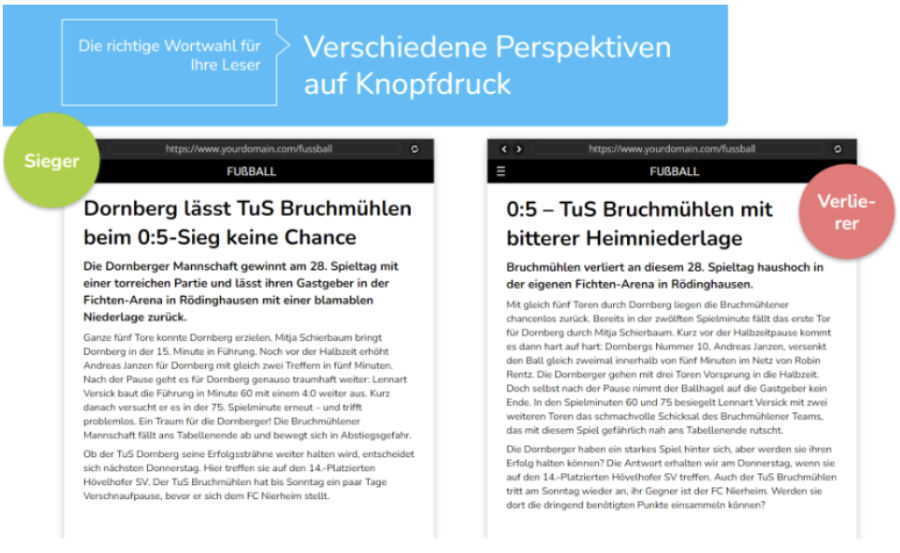
In the end, media receive a fully automatic, detailed, and natural-language report that contains far more information than just the match result – plus, staff no longer need to watch every game themselves, which represents an enormous time saving and significant reduction in personnel costs. If there was no reporting before, you can now look forward to a rising conversion rate. Also not to be underestimated is maintaining editorial authority, which remains with the individual journalists who ultimately sign the articles and want to shine with good text.
An additional plus is the customized content that we offer, unlike other competitors. Thanks to automated football reporting and structured data management, your content world will multiply exponentially.
Would you like to learn more about data management and automated football reporting? Let's talk!
Data Management and Seasonal Content
The optimization of data with structured data also plays a decisive role in the time-controlled delivery of text.
Data updates lead to a conversion boost through new, seasonally influenced text thanks to structured data
With the Text Robot software, text can be regularly revised and updated with minimal effort. Once the project is set up, only the data needs to be updated. Then the existing text is revised in real-time, or new and unique text is generated immediately.
Competition on Google or Amazon is fierce, making it difficult to make your products optimally visible.
Individually designed text needs to be generated for the seasonal period (be it Carnival, Christmas, Halloween, etc.) that not only help you be found instantly on Google but also emotionally trigger your potential customers so that they ultimately take purchasing action. These copies are also delivered and removed or replaced by the Text Robot at the desired time.
Why it's worth seasonally pushing products thanks to structured data ⬇️
Example: Earrings
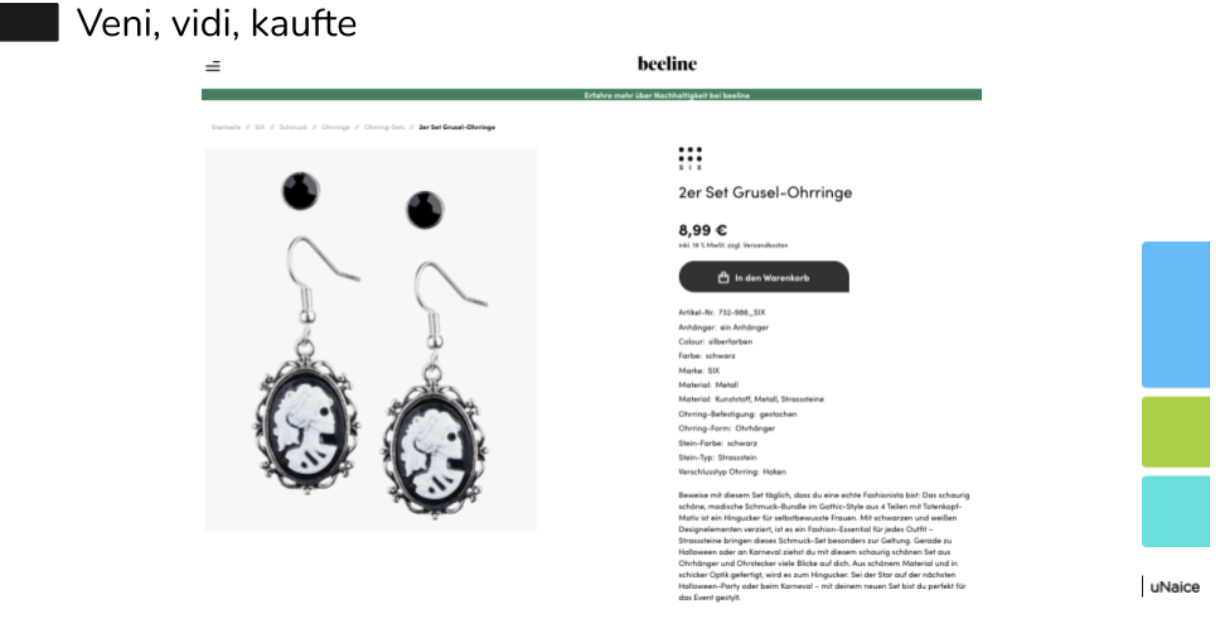
Sure, this product is particularly suitable for Carnival or Halloween. However, it can be sold all year round, which is why it stays in the range. Through careful data management and sorting/inserting certain structured data, the text will sound different in different seasons, as the search terms will likely be different too (e.g., "scary earrings" at Halloween and "gothic earrings" during the rest of the year).
Here is a comparison with a product text that has been seasonally revised (marked in red). Important keywords (or entire sentences) are inserted at appropriate points. This inspires customers and provides solid purchasing arguments!
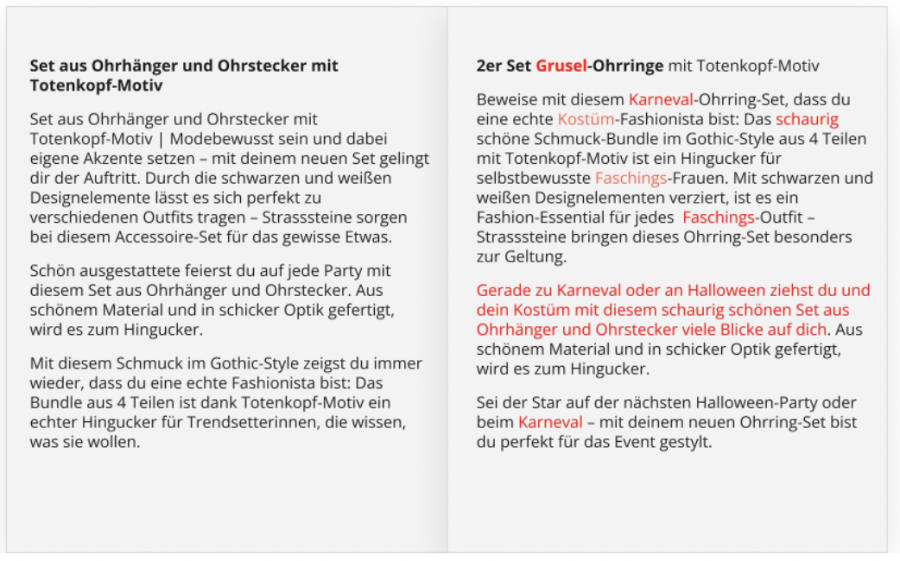
When the entire text – not just the title – is adapted to the respective occasion, the relevance and ranking of these earrings on Google naturally increases.
Thematic text generation is achieved using the right structured data, because your product data contains the connection between your seasonal text and the products. If these are cleanly structured in detail, the Text Robot can derive which products are relevant in each season (for each event) and need to be textually adapted. Occasion attributes, in which all events are listed, are particularly well suited for this. They are "spiced" with appropriate keywords, sentences, and synonyms that are automatically inserted into the copies at the right time.
This could look as follows:
| Product | Occasion |
|---|---|
| Skull Motif Earrings | Halloween, Carnival |
| Balloons | New Year's Eve, Halloween, Carnival |
| Raclette | New Year's Eve, Black Friday |
| Poinsettia | Advent Season |
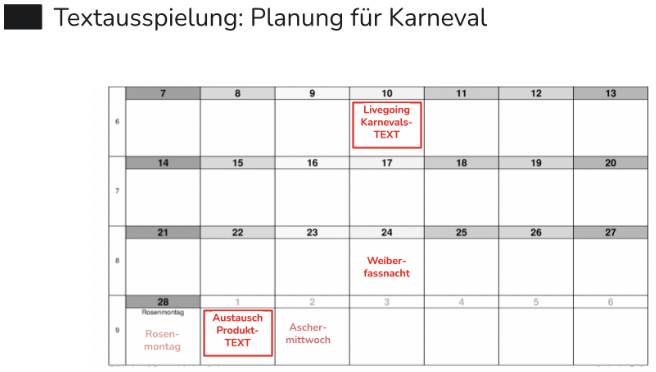
The human intervention remains manageable and one-time for each occasion. Simply search for the right keywords, find suitable synonyms, formulate individual sentences, and thereby create a high-quality data foundation with structured data once and for all. Then set up the calendar that tells the software when which occasion-based texting should automatically take place, be published, or be removed and replaced. This will only affect products that have the right attribute under "occasion." All other products remain unaffected by this change.
Seasonal text without structured data – what to do when no data is available?
Even without an optimal data structure, seasonal text can be generated, even if no trigger elements like “occasion” are present. A one-time preparation is worthwhile in any case. We then work at the category level and ask ourselves which product categories can be relevant for one or more occasions: e.g., party dresses suitable for both New Year's Eve and prom, or costumes suitable for both Carnival and Halloween.
What data preparation can do: natural language search queries, automatic text generation, product recommendations, filter and comparison options. All for the benefit of your customers.
Low Return Rate Even with Seasonal Text
Especially clothing items, such as costumes, show a high return rate after the Carnival season or Halloween. That's why seasonal text must also focus on informative product descriptions that draw on structured data (images alone are often not sufficient or can even be misinterpreted). Is the material skin-friendly? What is the quality of the fabric? Can the carpet be vacuumed easily? A good product description should answer questions like these.
In our webinar on seasonal texting, we dedicated ourselves to this topic. It's worth checking out.
Structured Data and SEO Relevance
SEO is known to aim at aligning your own website or online shop so that your pages are relevant enough for the desired search results to appear as high as possible in the SERPs.
We know that the Google algorithm is adjusted weekly, but these regular changes usually don't have a major impact on rankings. More significant algorithm updates occur several times a year (at irregular intervals) – and these can indeed massively influence rankings.
The current on-page factors for high rankings always include high content quality, meaning above all that structure, links, and language must be precisely defined and cleanly integrated. Updates, text length, deduplicated uniqueness, images, videos, and the correct placement of keywords are also evaluated by Google.
Google also rewards a good User Experience (UX) on your site, which can be achieved through real added value. This means – and here we are back to data management and data optimization through structured data – that high-quality and meaningful product descriptions must be delivered. Informative content should also be regularly updated. Since this updating should happen at least quarterly, automatic content generation is extremely helpful. However, as we have already learned, this requires a clear and enriched data structure from which SEO-relevant and SEO-proof text can be created.
Here is a video on this topic. Copywriter and SEO expert Stefanie Reinhold explains all the details about SEO and Automated Content.
How Structured Data Also Influence Internationalization
Many online retailers naturally place great emphasis on the topic of internationalization.
And here too, data optimization can significantly support your business.
Copies automatically generated with the Text Robot can be provided in the desired languages, noting that these are not simple translations from one language to another. Rather, they are versions and localizations by native speakers, where text is created from scratch in each language, taking into account the respective linguistic and cultural characteristics. The advantage: the effort is 90% less than manual translation of each individual language. Of course, structured data are also cleaned and optimized in other languages.
Learn more about internationalization in our webinar. How can this be automated and what role do structured data and localization play?
Conclusion
Data management and structured data open up incredible opportunities for companies across a wide range of industries to increase business profitability. It is therefore important for online shop operators to keep up with the latest developments in data management and have a clear understanding of how structured data can make their business more profitable.
Here once again in brief are all the advantages of successful data management:
Data management plays a decisive role in the digital age. We hope this article has made clear what requirements and benefits it brings and how you can implement it in practice. Whether outsourced or done in-house, with improved data management and a solid data foundation, you are guaranteed to extract maximum profit from your data, as they simply represent a strategic competitive advantage that should be leveraged.