%20--%3e%3cdefs%3e%3cstyle%3e%20.st0%20{%20fill:%20%23a5d028;%20}%20.st1%20{%20fill:%20%23fff;%20}%20.st2%20{%20fill:%20%231de2db;%20}%20.st3%20{%20fill:%20%2341bdf9;%20}%20%3c/style%3e%3c/defs%3e%3cg%20id='logo-unaice-line'%3e%3cpath%20class='st1'%20d='M143.3,36.1c-1.2,0-2.1-.9-2.1-2.1V12.2c0-1.2.9-2.1,2.1-2.1s2.1.9,2.1,2.1v21.8c0,1.2-.9,2.1-2.1,2.1ZM143.2,6.2c-1.3,0-2.4-1-2.4-2.4v-.8c0-1.3,1-2.4,2.4-2.4s2.4,1.1,2.4,2.4v.8c0,1.3-1.1,2.4-2.4,2.4Z'/%3e%3cpath%20class='st3'%20d='M23.7,36.1H2c-.5,0-1-.4-1-1V2.3c0-.5.4-1,1-1h21.7c.5,0,1,.4,1,1v32.9c0,.5-.4,1-1,1'/%3e%3cpath%20class='st2'%20d='M41.8,36.1h-14.4c-.5,0-1-.4-1-1v-14.5c0-.5.4-1,1-1h14.4c.5,0,1,.4,1,1v14.5c0,.5-.4,1-1,1'/%3e%3cpath%20class='st0'%20d='M41.8,17.9h-14.4c-.5,0-1-.4-1-1V2.2c0-.5.4-1,1-1h14.4c.5,0,1,.4,1,1v14.7c0,.5-.4,1-1,1'/%3e%3c/g%3e%3cpath%20class='st1'%20d='M196.4,29.2c-2.1,2.1-3.6,3.2-7.1,3.2s-7.4-2.3-8.2-7.4h16.7c2.7,0,2.9-1.9,2.7-4-.7-6.2-5.3-11.2-11.6-11.2s-12.3,5.1-12.3,13.4,5.4,13.3,12.6,13.3,8.3-2.6,10-4.3c1.8-2.1-1.2-4.7-2.8-3ZM188.9,13.7c4.7,0,7.3,4.1,7.6,7.3h-15.3c.7-4.3,3.4-7.3,7.7-7.3Z'/%3e%3cpath%20class='st1'%20d='M132.1,12.9c-1.9-1.9-5.4-2.9-8.2-2.9s-5.3.5-8.2,1.8c-2.4,1-.9,5,1.6,3.7,2.1-1,3.3-1.5,6.3-1.5s6.7,1.1,6.8,6.1c-1.8-.5-2.7-.8-6.9-.8-6.8,0-11.3,3.3-11.3,8.8s4.1,8.4,10.1,8.4,5.4-.6,8.3-2.9v.5c0,2.8,4.2,2.6,4.2,0v-13.8c0-3.1-.8-5.5-2.7-7.4ZM130.4,26.2c0,3.6-3.4,6.3-8,6.3s-5.9-1.7-5.9-4.6,2.5-4.6,6.8-4.6c0,0,4.8,0,7.1,1v1.9Z'/%3e%3cpath%20class='st1'%20d='M80,36.1c-1.2,0-2.1-.9-2.1-2.1V3.4c0-1.2,1-2.2,2.2-2.2h.4c.8,0,1.4.4,2,1.1l20.2,25.7V3.4c0-1.2.9-2.1,2.1-2.1s2.1.9,2.1,2.1v30.7c0,1.1-.5,2-1.9,2s-1.9-.8-2.2-1.2l-20.7-26.2v25.3c0,1.2-.9,2.1-2.1,2.1Z'/%3e%3cpath%20class='st1'%20d='M60.2,36.5c-5.1,0-10.5-4.3-10.5-10.7v-13.5c0-1.2.9-2.1,2.1-2.1s2.1.9,2.1,2.1v13.1c0,4.5,2.5,7.1,6.6,7.1s7.3-3.2,7.3-7.5v-12.7c0-1.2.9-2.1,2.1-2.1s2.1.9,2.1,2.1v21.8c0,2.8-4.2,2.7-4.2,0v-.5c-1.5,1.6-3.3,2.9-7.6,2.9Z'/%3e%3cpath%20class='st1'%20d='M163.8,36.5c-7.1,0-13.1-6-13.1-13.3s4.8-13.5,13.5-13.5c4.4,0,6.9,2,8.8,3.7,1.8,1.5-.8,5.1-2.8,3.3-.8-.8-3.3-3-6.4-3-4.8,0-8.6,4-8.6,9.2s3.8,9.3,8.6,9.4c3.7,0,4.9-1,7-3.1,1.6-1.8,4.6,1,3,2.8-3,3-5.7,4.5-10,4.5h0Z'/%3e%3c/svg%3e)
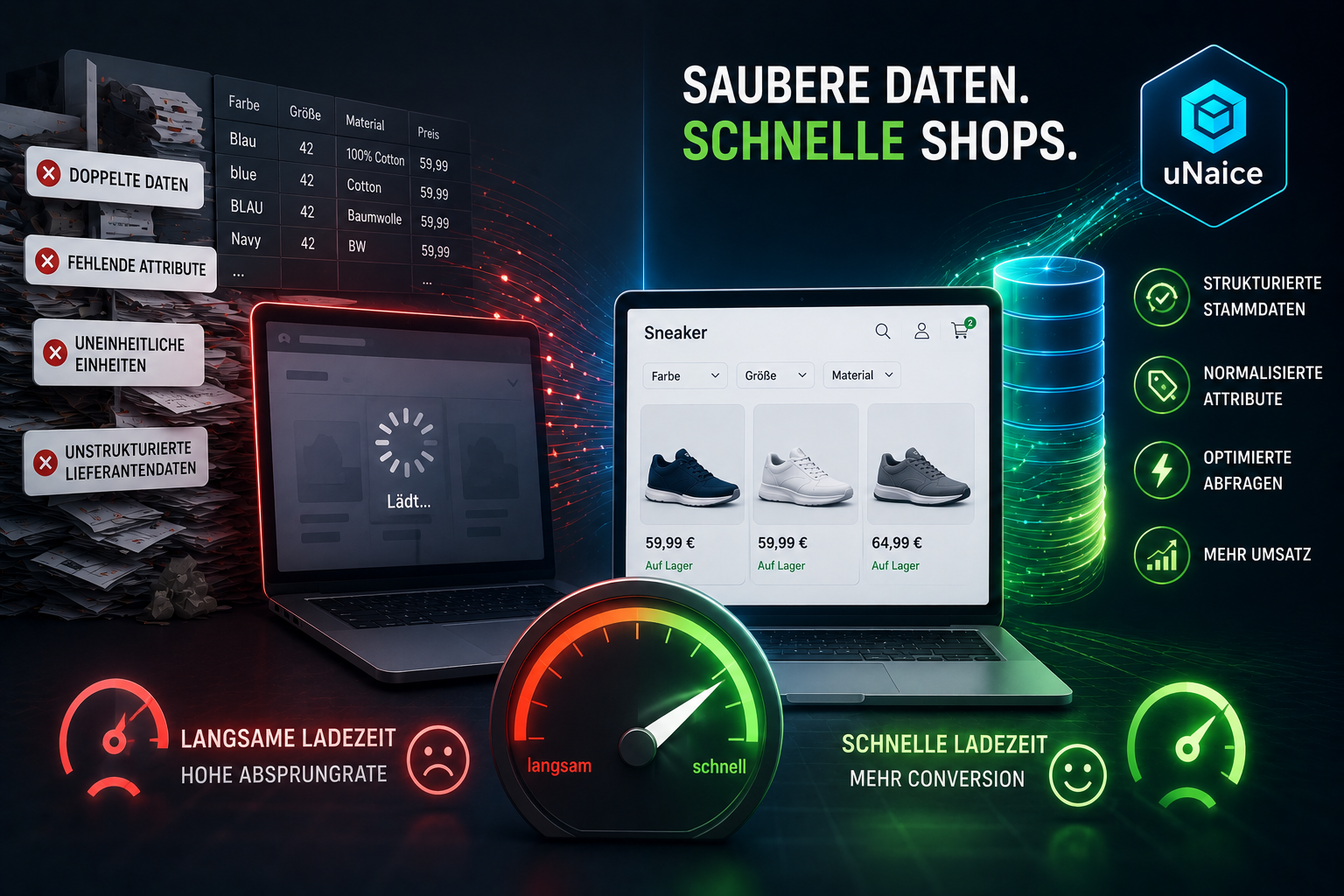
Imagine investing a large budget in the design and marketing of your e-commerce platform, only to have visitors abandon their carts just before checkout. The reason is often hidden deep within the database. As their product range grows, many retailers suddenly realize how large volumes of product data are slowing down their store’s loading times. Every additional filter, every new variant, and every high-resolution image brings the server to its knees. The result is a slow user interface that frustrates users and costs you money.
At our agency, uNaice, we see every day that companies underestimate the challenges of data architecture. The impact of loading large volumes of product data is often overlooked. They try to speed up the front end with caching plugins, while in the background, millions of unstructured attributes are clogging up database queries. If you understand how large volumes of product data slow down loading times in your store, you can apply the right solution. In this post, we’ll show you why clean data assets are the key to performance and how you can permanently resolve the bottleneck in your system.
What is the connection between product data and store performance?
Shop performance refers to the measurable loading speed of an e-commerce platform, from the server request to the complete display in the browser. It is a critical factor, as a loading time of just one second results in an average conversion rate of 27%, according to data from Unbounce. When a user selects a category or sets a search filter, the system must search through, filter, and display thousands of data records in real time.
This is exactly where we see how large volumes of product data can slow down loading times in an online store. In practice, it’s clear that fast loading times for product data are crucial. If product information is redundant, incomplete, or stored in inefficient table structures, the database takes precious milliseconds longer to process each query. These delays add up. An analysis by RedStag Fulfillment shows that a loading time delay of just one second reduces the conversion rate by an average of 7%. With an annual turnover of 5 million euros, this single second costs you around 350,000 euros.
Why large volumes of product data slow down loading times in the store
Large volumes of product data consist of millions of attributes, variants, and media files that must be loaded from the database and processed every time a page is viewed. The more complex the product range, the slower the system becomes. When a customer searches for “blue sneakers in size 43” in a fashion store, the system checks countless parameters. Without the systematic data structuring provided by uNaice, large volumes of product data prolong loading times in online stores.
The architecture of traditional e-commerce platforms quickly reaches its limits as product ranges expand. The main technical hurdles include:
Studies by Google show that the bounce rate increases by 32% when page load time rises from one to three seconds. It is therefore essential to clean up the database before investing in expensive server upgrades.
The Devastating Impact on Mobile Users
Fast mobile loading times lead to significantly higher revenue, as mobile devices now account for 75% of global internet traffic, according to Statista. On smartphones, inefficient data structures have an even more dramatic impact than on desktops. Processor power and network connections are often weaker, causing complex filter logic to literally freeze the browser.
Research findings from Google show that improving load times by just 0.1 seconds can increase mobile conversion rates by up to 8%. Conversely, 57% of consumers leave a mobile website if it takes longer than three seconds to load. Long store loading times caused by large volumes of product data increase the bounce rate; uNaice structures this data to reduce loading times.
How unstructured data creates a bottleneck
Unstructured data consists of erroneous, inconsistent, or redundant product information that generates complex database queries and overloads servers. In many companies, product data is still manually maintained in endless Excel spreadsheets. Supplier catalogs in different formats are laboriously copied together. This “human bottleneck” inevitably leads to errors that slow down the shop system when delivering pages.
We have seen in numerous projects that large volumes of product data slow down loading times in the store because the system tries to compensate for the disorganization in the background. It is important to take the right steps. If a filter searches for “Material: Cotton,” but the data is stored as “100% Cotton,” “BW,” or “Cotton,” the database has to expend a disproportionate amount of processing power. By using our software DataNaicer, customers have been able to save up to 75% of manual labor time while simultaneously raising data quality to a level that drastically speeds up server queries.
Unlike tables, an ontology provides structure
Unlike rigid table structures, an ontology logically links data points together, thereby drastically reducing the database load. An ontology is a knowledge graph that understands that “sneakers” is a subcategory of “shoes” and “navy” is a synonym for “dark blue.” This AI method enables search engines and e-commerce platforms to respond to queries instantly and accurately.
Instead of searching through millions of text fields for a query, the system navigates efficiently through logical nodes. That’s why market leaders like adidas, TUI, and Otto rely on smart data structures. With our Validation Station, we guarantee a 100% error-free quality pipeline in conjunction with our AI. This allows us to proactively prevent large volumes of product data from slowing down loading times in the store.
How to optimize large volumes of product data and reduce loading times
Systematic product data optimization reduces server response times by cleaning up redundant information and streamlining database queries. If you want to prevent large amounts of product data from slowing down your store’s loading time, you need to address the root of the problem: the quality of your master data.
A high-performance online store requires a strict separation of raw data and processed content. The key steps for optimization include:
Once you’ve established this foundation, even categories with thousands of items will load in a fraction of a second. Want to know how this optimization works for your business? Get in touch!
Our AI-powered data preparation involves the automatic extraction, normalization, and enrichment of product master data without any manual effort. We extract semantic data from PDFs, Excel lists, or supplier catalogs and transform unstructured raw data into perfect master data. This not only solves the problem of large product data volumes slowing down loading times in the store, but also makes your data capital efficiently usable.
What sets our approach apart: Our solution grows with you. Whether you’re processing 10,000 or 5 million data records—thanks to our flat-rate pricing, we don’t charge per SKU. You can scale your product range indefinitely without having to hire new staff or worry about performance drops.
Conclusion: Free Your Store’s Performance from the Data Burden
Clean, structured product data is the technical foundation for load times under two seconds and a scalable, high-revenue online store. In this article, we’ve examined in detail how large volumes of product data slow down your store’s loading time and why manually managing Excel lists poses a massive business risk today. As the often-cited example of Amazon shows, even an additional latency of 100 milliseconds costs a measurable 1% of revenue.
You don’t have to accept that growing product ranges are slowing down your systems. With the right technology, you can release the handbrake and free your team from repetitive tasks. Our “Made in Germany” software solution offers you GDPR-compliant security and the expertise of a passionate team of specialists.
Let’s work together to unlock the full potential of your data. Book your free online demo now, or try our no-obligation 100-data-record trial to see the quality for yourself using your own products. Schedule your free initial consultation today!
Frequently Asked Questions (FAQ)
Ready for the next step?
Contact us for a no-obligation consultation about your data project.
Contact us nowSources