%20--%3e%3cdefs%3e%3cstyle%3e%20.st0%20{%20fill:%20%23a5d028;%20}%20.st1%20{%20fill:%20%23fff;%20}%20.st2%20{%20fill:%20%231de2db;%20}%20.st3%20{%20fill:%20%2341bdf9;%20}%20%3c/style%3e%3c/defs%3e%3cg%20id='logo-unaice-line'%3e%3cpath%20class='st1'%20d='M143.3,36.1c-1.2,0-2.1-.9-2.1-2.1V12.2c0-1.2.9-2.1,2.1-2.1s2.1.9,2.1,2.1v21.8c0,1.2-.9,2.1-2.1,2.1ZM143.2,6.2c-1.3,0-2.4-1-2.4-2.4v-.8c0-1.3,1-2.4,2.4-2.4s2.4,1.1,2.4,2.4v.8c0,1.3-1.1,2.4-2.4,2.4Z'/%3e%3cpath%20class='st3'%20d='M23.7,36.1H2c-.5,0-1-.4-1-1V2.3c0-.5.4-1,1-1h21.7c.5,0,1,.4,1,1v32.9c0,.5-.4,1-1,1'/%3e%3cpath%20class='st2'%20d='M41.8,36.1h-14.4c-.5,0-1-.4-1-1v-14.5c0-.5.4-1,1-1h14.4c.5,0,1,.4,1,1v14.5c0,.5-.4,1-1,1'/%3e%3cpath%20class='st0'%20d='M41.8,17.9h-14.4c-.5,0-1-.4-1-1V2.2c0-.5.4-1,1-1h14.4c.5,0,1,.4,1,1v14.7c0,.5-.4,1-1,1'/%3e%3c/g%3e%3cpath%20class='st1'%20d='M196.4,29.2c-2.1,2.1-3.6,3.2-7.1,3.2s-7.4-2.3-8.2-7.4h16.7c2.7,0,2.9-1.9,2.7-4-.7-6.2-5.3-11.2-11.6-11.2s-12.3,5.1-12.3,13.4,5.4,13.3,12.6,13.3,8.3-2.6,10-4.3c1.8-2.1-1.2-4.7-2.8-3ZM188.9,13.7c4.7,0,7.3,4.1,7.6,7.3h-15.3c.7-4.3,3.4-7.3,7.7-7.3Z'/%3e%3cpath%20class='st1'%20d='M132.1,12.9c-1.9-1.9-5.4-2.9-8.2-2.9s-5.3.5-8.2,1.8c-2.4,1-.9,5,1.6,3.7,2.1-1,3.3-1.5,6.3-1.5s6.7,1.1,6.8,6.1c-1.8-.5-2.7-.8-6.9-.8-6.8,0-11.3,3.3-11.3,8.8s4.1,8.4,10.1,8.4,5.4-.6,8.3-2.9v.5c0,2.8,4.2,2.6,4.2,0v-13.8c0-3.1-.8-5.5-2.7-7.4ZM130.4,26.2c0,3.6-3.4,6.3-8,6.3s-5.9-1.7-5.9-4.6,2.5-4.6,6.8-4.6c0,0,4.8,0,7.1,1v1.9Z'/%3e%3cpath%20class='st1'%20d='M80,36.1c-1.2,0-2.1-.9-2.1-2.1V3.4c0-1.2,1-2.2,2.2-2.2h.4c.8,0,1.4.4,2,1.1l20.2,25.7V3.4c0-1.2.9-2.1,2.1-2.1s2.1.9,2.1,2.1v30.7c0,1.1-.5,2-1.9,2s-1.9-.8-2.2-1.2l-20.7-26.2v25.3c0,1.2-.9,2.1-2.1,2.1Z'/%3e%3cpath%20class='st1'%20d='M60.2,36.5c-5.1,0-10.5-4.3-10.5-10.7v-13.5c0-1.2.9-2.1,2.1-2.1s2.1.9,2.1,2.1v13.1c0,4.5,2.5,7.1,6.6,7.1s7.3-3.2,7.3-7.5v-12.7c0-1.2.9-2.1,2.1-2.1s2.1.9,2.1,2.1v21.8c0,2.8-4.2,2.7-4.2,0v-.5c-1.5,1.6-3.3,2.9-7.6,2.9Z'/%3e%3cpath%20class='st1'%20d='M163.8,36.5c-7.1,0-13.1-6-13.1-13.3s4.8-13.5,13.5-13.5c4.4,0,6.9,2,8.8,3.7,1.8,1.5-.8,5.1-2.8,3.3-.8-.8-3.3-3-6.4-3-4.8,0-8.6,4-8.6,9.2s3.8,9.3,8.6,9.4c3.7,0,4.9-1,7-3.1,1.6-1.8,4.6,1,3,2.8-3,3-5.7,4.5-10,4.5h0Z'/%3e%3c/svg%3e)
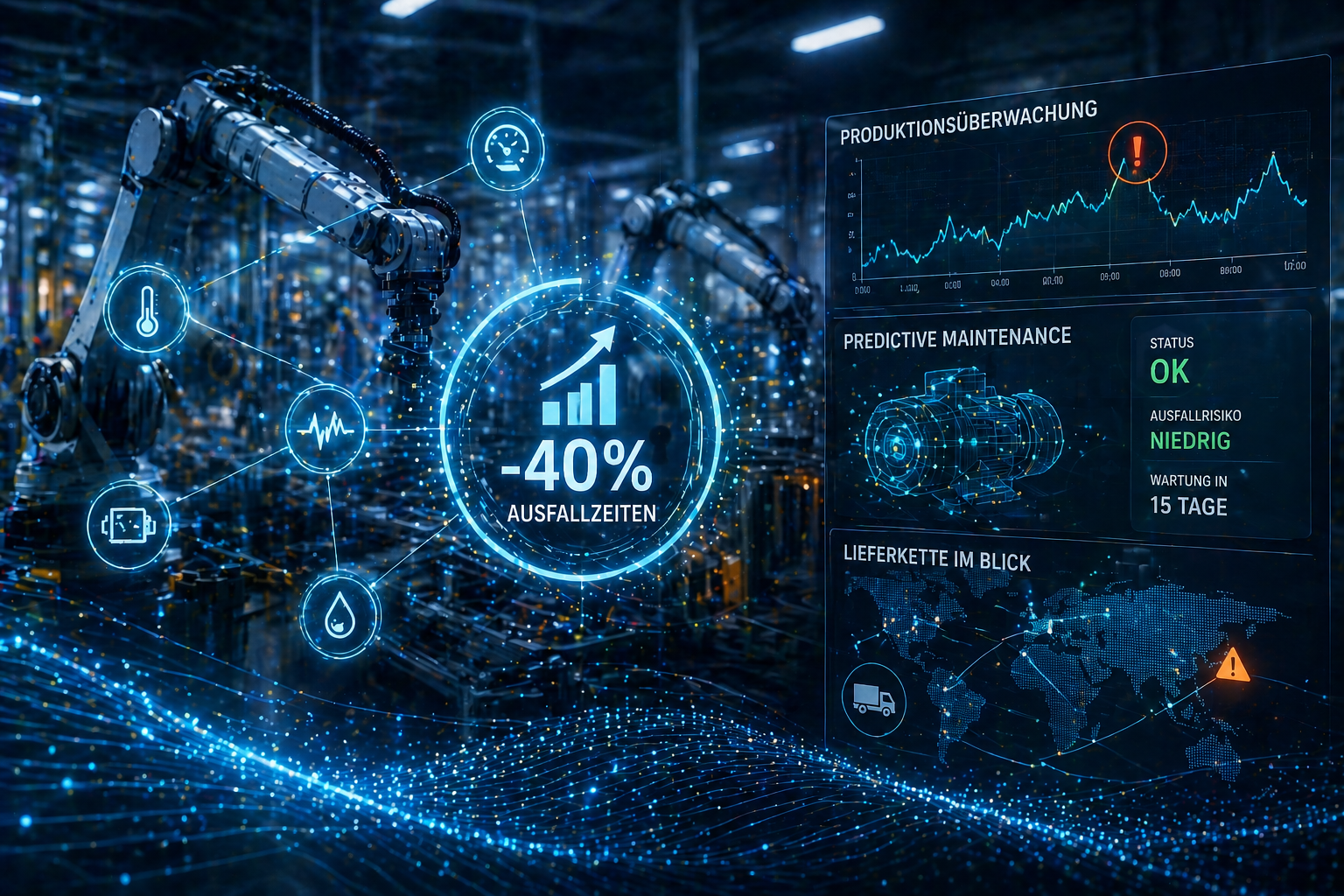
A benchmarking study from 2023 reveals a remarkable finding: Comprehensive coverage of production facilities with smart sensors reduces unplanned downtime by a whopping 40%. While many companies invest heavily in machinery, they often overlook the true potential that lies dormant in the data streams they generate. By the time you realize that a supply chain is stalling, it’s usually too late with manual monitoring.
Today, the biggest challenge no longer lies in data collection alone, but in efficiently leveraging this data capital. Excellent data management in industry has become an absolute prerequisite for remaining competitive. If you’re wondering how to circumvent the notorious “human bottleneck” in data maintenance, this guide provides concrete answers. uNaice processes raw machine data into structured master data and enables the predictive detection of bottlenecks.
How can impending production bottlenecks be identified early through the intelligent analysis of sensor data?
Real-time detection of anomalies on the production line
The intelligent analysis of sensor data enables continuous monitoring of machine vibrations and temperatures to detect deviations within milliseconds. Research findings from industrial automation experts show that production facilities with networked sensor networks spend about one-third less on manual inspections. Furthermore, these systems detect problems nearly ten times faster than conventional methods.
In our practice at uNaice, we repeatedly see that while companies collect data, they fail to link it logically. For example, a European automaker generates approximately 2.3 million data records daily through floor sensors and RFID tracking devices. It was only through the systematic analysis of these enormous data volumes that a consistent delay of exactly 22 minutes in the paint shop was uncovered. When we ask: How can impending production bottlenecks be identified early through the intelligent analysis of sensor data?, this real-time transparency is the first crucial step.
Predictive Analytics to Prevent Downtime
Condition-based maintenance is a data-driven approach that uses machine learning algorithms to transition from fixed maintenance intervals to on-demand maintenance. A study from 2023 shows that this transition extends the service life of equipment by 30% and reduces labor costs by 22%. Random equipment failures are thus transformed into planned maintenance measures.
The response time for making process adjustments has been drastically reduced in factories equipped with modern sensors—from about 42 hours to just 23 minutes. Anomaly detection algorithms instantly convert raw vibration signals into actionable maintenance alerts. Would you like to know how to implement such predictive models in your company? Feel free to contact us for an initial potential analysis.
Why do many industrial companies struggle to seamlessly integrate MES and supply chain data?
The Problem of Unstructured Supplier Data
Unlike standardized internal ERP processes, external supplier data often consists of an unstructured jumble of PDF documents, error-prone Excel lists, and inconsistent free-text fields. Traditional quality assurance still relies on manual inspections, which, according to an analysis by Ponemon (2023), means that 15 to 20% of errors remain undetected before shipment. This data gap costs automotive and electronics manufacturers over $740,000 annually.
In most companies, this leads to a massive manual Excel battle. Employees spend hours converting units or correcting typos. Delayed feedback forces management to make decisions based on outdated information. When logistics managers want to put the question “How can impending production bottlenecks be identified early through the intelligent analysis of sensor data?” into practice, they usually fail precisely because of this poor quality of the underlying master data.
The transition from rigid tables to dynamic ontologies
An ontology is a method of artificial intelligence that organizes data not in rigid tables, but as logically linked knowledge graphs. Unlike pure text generation or so-called “black-box AIs,” an ontology understands the actual semantics and relationships between different data points. For example, it independently recognizes that “mm” and “millimeter” are identical.
At uNaice, we’ve specialized in exactly this kind of transformation. We standardize units, correct typos, and automatically enrich missing attributes using external sources. This semantic processing is essential for intelligent data management in industry. Companies such as adidas, TUI, and Otto use uNaice’s technology to manage millions of items.
uNaice connects the shop floor to the ERP system via bidirectional interfaces and synchronizes machine data in real time
Semantic data extraction as the connecting link
Semantic data extraction enables the fully automated transformation of unstructured raw data from a wide variety of sources into perfect, immediately usable master data. Modern IoT platforms consolidate the isolated inputs from various machine sensors into unified dashboards, thereby bridging the gap between data collection and operational action.
Our solution, DataNaicer, scales effortlessly from 10,000 to over 5 million records without requiring you to hire new staff for data maintenance. A major advantage for our customers is the fair pricing model: Thanks to our transparent flat-rate pricing, the system grows with your needs without incurring costs per individual SKU. This allows you to remove the handbrake on your teams and free your specialists from repetitive, error-prone routine tasks.
Automated quality pipelines instead of manual effort
A modern quality pipeline consists of 99% AI automation and a downstream human final check to guarantee 100% accuracy of the process data.
To achieve this impressive level of precision in your commercial and logistics master data, we at uNaice rely on the Integrated Validation Station. A survey of 120 manufacturers in 2024 showed that such data-driven approaches reduce verification times for workers by 41%.
What architectural requirements does a digital twin of the supply chain entail?
Real-time integration and dynamic energy management
A digital twin is the virtual representation of a physical production facility, fed by continuous real-time pressure measurements and machine data. Quality management staff can use these digital representations to test various scenarios directly on screen before making changes to physical plant components. This leads to faster decisions based on actual data rather than mere assumptions.
Conclusion: Data Capital as the Key to Resilient Production
The intelligent analysis of sensor data is far more than a technical upgrade—it is the foundation for resilient, future-proof production. Anyone who wants to reduce unplanned downtime by 40% and shorten response times from days to minutes must consistently break down data silos. The key to success lies in transforming unstructured raw data into logically linked ontologies that are machine-readable and absolutely error-free.
Let’s work together to eliminate the “human bottleneck” in your data maintenance and free your teams from time-consuming Excel spreadsheets. We’d be happy to demonstrate the quality of our software using your own data. Book your free 100-record trial now or schedule a no-obligation initial consultation to see our DataNaicer in action.
Frequently Asked Questions (FAQ)
Ready for the next step?
Contact us for a no-obligation consultation about your data project.
Contact us nowSources