%20--%3e%3cdefs%3e%3cstyle%3e%20.st0%20{%20fill:%20%23a5d028;%20}%20.st1%20{%20fill:%20%23fff;%20}%20.st2%20{%20fill:%20%231de2db;%20}%20.st3%20{%20fill:%20%2341bdf9;%20}%20%3c/style%3e%3c/defs%3e%3cg%20id='logo-unaice-line'%3e%3cpath%20class='st1'%20d='M143.3,36.1c-1.2,0-2.1-.9-2.1-2.1V12.2c0-1.2.9-2.1,2.1-2.1s2.1.9,2.1,2.1v21.8c0,1.2-.9,2.1-2.1,2.1ZM143.2,6.2c-1.3,0-2.4-1-2.4-2.4v-.8c0-1.3,1-2.4,2.4-2.4s2.4,1.1,2.4,2.4v.8c0,1.3-1.1,2.4-2.4,2.4Z'/%3e%3cpath%20class='st3'%20d='M23.7,36.1H2c-.5,0-1-.4-1-1V2.3c0-.5.4-1,1-1h21.7c.5,0,1,.4,1,1v32.9c0,.5-.4,1-1,1'/%3e%3cpath%20class='st2'%20d='M41.8,36.1h-14.4c-.5,0-1-.4-1-1v-14.5c0-.5.4-1,1-1h14.4c.5,0,1,.4,1,1v14.5c0,.5-.4,1-1,1'/%3e%3cpath%20class='st0'%20d='M41.8,17.9h-14.4c-.5,0-1-.4-1-1V2.2c0-.5.4-1,1-1h14.4c.5,0,1,.4,1,1v14.7c0,.5-.4,1-1,1'/%3e%3c/g%3e%3cpath%20class='st1'%20d='M196.4,29.2c-2.1,2.1-3.6,3.2-7.1,3.2s-7.4-2.3-8.2-7.4h16.7c2.7,0,2.9-1.9,2.7-4-.7-6.2-5.3-11.2-11.6-11.2s-12.3,5.1-12.3,13.4,5.4,13.3,12.6,13.3,8.3-2.6,10-4.3c1.8-2.1-1.2-4.7-2.8-3ZM188.9,13.7c4.7,0,7.3,4.1,7.6,7.3h-15.3c.7-4.3,3.4-7.3,7.7-7.3Z'/%3e%3cpath%20class='st1'%20d='M132.1,12.9c-1.9-1.9-5.4-2.9-8.2-2.9s-5.3.5-8.2,1.8c-2.4,1-.9,5,1.6,3.7,2.1-1,3.3-1.5,6.3-1.5s6.7,1.1,6.8,6.1c-1.8-.5-2.7-.8-6.9-.8-6.8,0-11.3,3.3-11.3,8.8s4.1,8.4,10.1,8.4,5.4-.6,8.3-2.9v.5c0,2.8,4.2,2.6,4.2,0v-13.8c0-3.1-.8-5.5-2.7-7.4ZM130.4,26.2c0,3.6-3.4,6.3-8,6.3s-5.9-1.7-5.9-4.6,2.5-4.6,6.8-4.6c0,0,4.8,0,7.1,1v1.9Z'/%3e%3cpath%20class='st1'%20d='M80,36.1c-1.2,0-2.1-.9-2.1-2.1V3.4c0-1.2,1-2.2,2.2-2.2h.4c.8,0,1.4.4,2,1.1l20.2,25.7V3.4c0-1.2.9-2.1,2.1-2.1s2.1.9,2.1,2.1v30.7c0,1.1-.5,2-1.9,2s-1.9-.8-2.2-1.2l-20.7-26.2v25.3c0,1.2-.9,2.1-2.1,2.1Z'/%3e%3cpath%20class='st1'%20d='M60.2,36.5c-5.1,0-10.5-4.3-10.5-10.7v-13.5c0-1.2.9-2.1,2.1-2.1s2.1.9,2.1,2.1v13.1c0,4.5,2.5,7.1,6.6,7.1s7.3-3.2,7.3-7.5v-12.7c0-1.2.9-2.1,2.1-2.1s2.1.9,2.1,2.1v21.8c0,2.8-4.2,2.7-4.2,0v-.5c-1.5,1.6-3.3,2.9-7.6,2.9Z'/%3e%3cpath%20class='st1'%20d='M163.8,36.5c-7.1,0-13.1-6-13.1-13.3s4.8-13.5,13.5-13.5c4.4,0,6.9,2,8.8,3.7,1.8,1.5-.8,5.1-2.8,3.3-.8-.8-3.3-3-6.4-3-4.8,0-8.6,4-8.6,9.2s3.8,9.3,8.6,9.4c3.7,0,4.9-1,7-3.1,1.6-1.8,4.6,1,3,2.8-3,3-5.7,4.5-10,4.5h0Z'/%3e%3c/svg%3e)
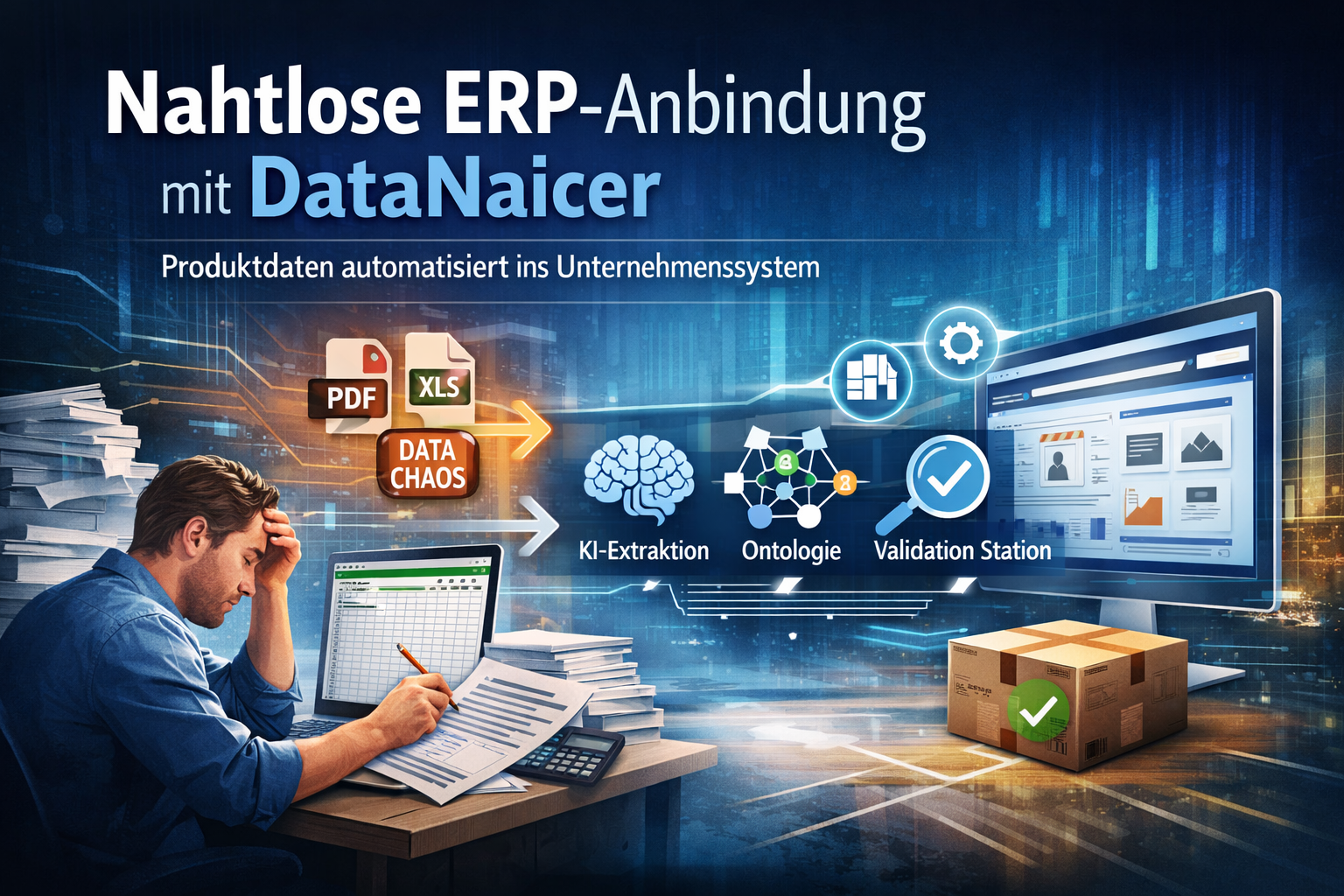
The DataNaicer ERP integration enables the rapid transfer of product data into your business system. Many companies invest millions in modern ERP systems. Yet employees still spend hours every week working with Excel spreadsheets, manually cleaning up unstructured supplier data. This costs a lot of time and money. People become the bottleneck here. They slow down the entire data maintenance process. Inaccurate data and typos delay the launch of sales. They significantly reduce the value of your data. This is exactly where the DataNaicer software comes in as an intelligent solution.
This article walks you through the technical steps of the integration. You’ll learn all the key requirements for getting started. We explain the transition from rigid spreadsheets to intelligent AI. This will drastically reduce your manual workload.
What does a seamless DataNaicer ERP integration mean?
A seamless DataNaicer ERP integration is the automated, bidirectional data exchange between your ERP system and our AI software. The software automatically converts unstructured raw data into clean master data. The global market for ERP software is growing rapidly. According to Research Nester (2025), it is growing by 12.6% annually. By 2035, it will reach a volume of $267.77 billion. AI and automation are the primary drivers of this growth.
Seamless integration means completely eliminating manual intermediate steps. The software pulls raw data directly via interfaces. This can include PDFs, Excel spreadsheets, or catalogs. The AI corrects errors and standardizes units. It then sends the perfect data back to your ERP system. This direct connection offers the following advantages:
Why do many ERP integrations fail when it comes to product data?
Unlike modern AI solutions, manual data maintenance processes cause ERP integration problems for 57% of companies. This is confirmed by a study by the CFO Club (2026). While many companies are modernizing their technology, they ignore the quality of the data being delivered. An ERP system is only as good as its master data.
The main problem is traditional data maintenance. Employees cram unstructured information into rigid tables. This leads to many errors. Once the number of items reaches a certain threshold, this approach simply stops working. According to CFO Club, 22% of companies view data verification as their biggest technical hurdle. The DataNaicer software solves exactly this problem. It automates verification using AI. This frees your ERP system from the tedious task of data cleansing.
How does the DataNaicer ERP integration work seamlessly in practice?
The technical DataNaicer ERP integration enables the fully automated processing of up to 5 million data records via modern API interfaces. Cloud systems are the standard today. This is confirmed by a report from Innowise (2026). Modern systems require networked processes. Our software fits perfectly into this structure. It is not an isolated tool. It acts as an intelligent filter directly in front of your ERP system.
The integration process follows clear steps. We set up secure interfaces. Your supplier data flows directly into our verification process. Security is of the utmost importance. According to IBM (2025), a data breach costs an average of $4.4 million. That’s why we adhere to the highest security standards. Our servers are located in Germany and are strictly GDPR-compliant. We’d be happy to analyze your IT landscape during an initial consultation.
Step 1: Semantic Data Extraction and Ontology Development
Unlike rigid table structures, the DataNaicer software uses an ontology for the logical understanding of data content. This is the core of our technology. An ontology works like an intelligent knowledge network. The AI doesn’t just read the word red; it understands 100% that it refers to a color for a specific shoe.
During the integration process, we define these terms for your industry. Whether it’s bicycles, fashion, or machinery, the software learns your industry-specific terminology. The interface then automatically extracts all product attributes from PDFs or catalogs. It converts units of measurement and fills in missing values. This pre-filter protects your system. Your ERP receives only perfect master data.
Step 2: The Validation Station as a Quality Filter
The Validation Station consists of a fully automated AI check and targeted human approval for exceptional cases. It is our most important tool for ensuring the highest quality. Major companies like adidas and Otto don’t compromise on data. That’s why we rely on this secure system.
Every data record passes through this stage before being imported into the ERP system. The software cleans up 99% of the data completely automatically. The system only flags illogical values. For example: A supplier enters 500 kg for a T-shirt. Only then does an employee review this specific case and manually approve the value. This guarantees you 100% error-free data. At the same time, you save up to 75% of your working time.
How much does the DataNaicer software cost, including ERP integration?
The flat-rate model of the DataNaicer software features a transparent pricing structure with no variable costs per item. This predictability offers you a significant economic advantage. According to CFO Club (2026), a standard ERP implementation costs approximately $9,000 per user. In such cases, 38% of companies exceed their budget. Our flat-rate model prevents such cost traps in data maintenance.
Your monthly costs always stay the same. It doesn’t matter whether you process 10,000 or 5 million records. The software scales with your business. You don’t need to hire new staff for larger product ranges. You also don’t pay higher license fees. We charge a fair fee for the initial setup based on your current system. The investment usually pays for itself within 6 months thanks to the enormous time savings.
How long does it take to implement the DataNaicer software?
The implementation of the DataNaicer software consists of three main phases
The entire process usually takes between 4 and 8 weeks. This depends on your IT infrastructure and the start dates. Startupdock (2025) shows that modern ERP systems now operate in the cloud. This makes integrating new programs very fast. We leverage this advantage for you.
We start with a joint meeting. There, we review your data. Afterward, the AI gets to know your products. We connect our software to your ERP system via interfaces. Finally, we test everything thoroughly with real data. Our German team of experts supports you every step of the way. The most important thing for you: Your normal day-to-day operations continue without interruption during setup.
Conclusion: Leverage data capital through the right ERP integration
A successful DataNaicer ERP integration enables a reduction in manual work time of up to 75%. It securely transforms unstructured raw data into valuable data capital. Employees no longer have to manually enter data. The intelligent AI and our Validation Station take care of that. They remove the roadblocks in sales and create seamless processes.
We’d love to work with you to figure out the best way to integrate our solution into your operations. Take advantage of our experience working with major market leaders. We’ll automate your data processes. Test our AI with your own data. Use our free 100-record trial. Book a no-obligation consultation now. We’ll put an end to your data chaos.
Frequently Asked Questions (FAQ)
Ready for the next step?
Contact us for a no-obligation consultation about your data project.
Contact us nowSources