%20--%3e%3cdefs%3e%3cstyle%3e%20.st0%20{%20fill:%20%23a5d028;%20}%20.st1%20{%20fill:%20%23fff;%20}%20.st2%20{%20fill:%20%231de2db;%20}%20.st3%20{%20fill:%20%2341bdf9;%20}%20%3c/style%3e%3c/defs%3e%3cg%20id='logo-unaice-line'%3e%3cpath%20class='st1'%20d='M143.3,36.1c-1.2,0-2.1-.9-2.1-2.1V12.2c0-1.2.9-2.1,2.1-2.1s2.1.9,2.1,2.1v21.8c0,1.2-.9,2.1-2.1,2.1ZM143.2,6.2c-1.3,0-2.4-1-2.4-2.4v-.8c0-1.3,1-2.4,2.4-2.4s2.4,1.1,2.4,2.4v.8c0,1.3-1.1,2.4-2.4,2.4Z'/%3e%3cpath%20class='st3'%20d='M23.7,36.1H2c-.5,0-1-.4-1-1V2.3c0-.5.4-1,1-1h21.7c.5,0,1,.4,1,1v32.9c0,.5-.4,1-1,1'/%3e%3cpath%20class='st2'%20d='M41.8,36.1h-14.4c-.5,0-1-.4-1-1v-14.5c0-.5.4-1,1-1h14.4c.5,0,1,.4,1,1v14.5c0,.5-.4,1-1,1'/%3e%3cpath%20class='st0'%20d='M41.8,17.9h-14.4c-.5,0-1-.4-1-1V2.2c0-.5.4-1,1-1h14.4c.5,0,1,.4,1,1v14.7c0,.5-.4,1-1,1'/%3e%3c/g%3e%3cpath%20class='st1'%20d='M196.4,29.2c-2.1,2.1-3.6,3.2-7.1,3.2s-7.4-2.3-8.2-7.4h16.7c2.7,0,2.9-1.9,2.7-4-.7-6.2-5.3-11.2-11.6-11.2s-12.3,5.1-12.3,13.4,5.4,13.3,12.6,13.3,8.3-2.6,10-4.3c1.8-2.1-1.2-4.7-2.8-3ZM188.9,13.7c4.7,0,7.3,4.1,7.6,7.3h-15.3c.7-4.3,3.4-7.3,7.7-7.3Z'/%3e%3cpath%20class='st1'%20d='M132.1,12.9c-1.9-1.9-5.4-2.9-8.2-2.9s-5.3.5-8.2,1.8c-2.4,1-.9,5,1.6,3.7,2.1-1,3.3-1.5,6.3-1.5s6.7,1.1,6.8,6.1c-1.8-.5-2.7-.8-6.9-.8-6.8,0-11.3,3.3-11.3,8.8s4.1,8.4,10.1,8.4,5.4-.6,8.3-2.9v.5c0,2.8,4.2,2.6,4.2,0v-13.8c0-3.1-.8-5.5-2.7-7.4ZM130.4,26.2c0,3.6-3.4,6.3-8,6.3s-5.9-1.7-5.9-4.6,2.5-4.6,6.8-4.6c0,0,4.8,0,7.1,1v1.9Z'/%3e%3cpath%20class='st1'%20d='M80,36.1c-1.2,0-2.1-.9-2.1-2.1V3.4c0-1.2,1-2.2,2.2-2.2h.4c.8,0,1.4.4,2,1.1l20.2,25.7V3.4c0-1.2.9-2.1,2.1-2.1s2.1.9,2.1,2.1v30.7c0,1.1-.5,2-1.9,2s-1.9-.8-2.2-1.2l-20.7-26.2v25.3c0,1.2-.9,2.1-2.1,2.1Z'/%3e%3cpath%20class='st1'%20d='M60.2,36.5c-5.1,0-10.5-4.3-10.5-10.7v-13.5c0-1.2.9-2.1,2.1-2.1s2.1.9,2.1,2.1v13.1c0,4.5,2.5,7.1,6.6,7.1s7.3-3.2,7.3-7.5v-12.7c0-1.2.9-2.1,2.1-2.1s2.1.9,2.1,2.1v21.8c0,2.8-4.2,2.7-4.2,0v-.5c-1.5,1.6-3.3,2.9-7.6,2.9Z'/%3e%3cpath%20class='st1'%20d='M163.8,36.5c-7.1,0-13.1-6-13.1-13.3s4.8-13.5,13.5-13.5c4.4,0,6.9,2,8.8,3.7,1.8,1.5-.8,5.1-2.8,3.3-.8-.8-3.3-3-6.4-3-4.8,0-8.6,4-8.6,9.2s3.8,9.3,8.6,9.4c3.7,0,4.9-1,7-3.1,1.6-1.8,4.6,1,3,2.8-3,3-5.7,4.5-10,4.5h0Z'/%3e%3c/svg%3e)
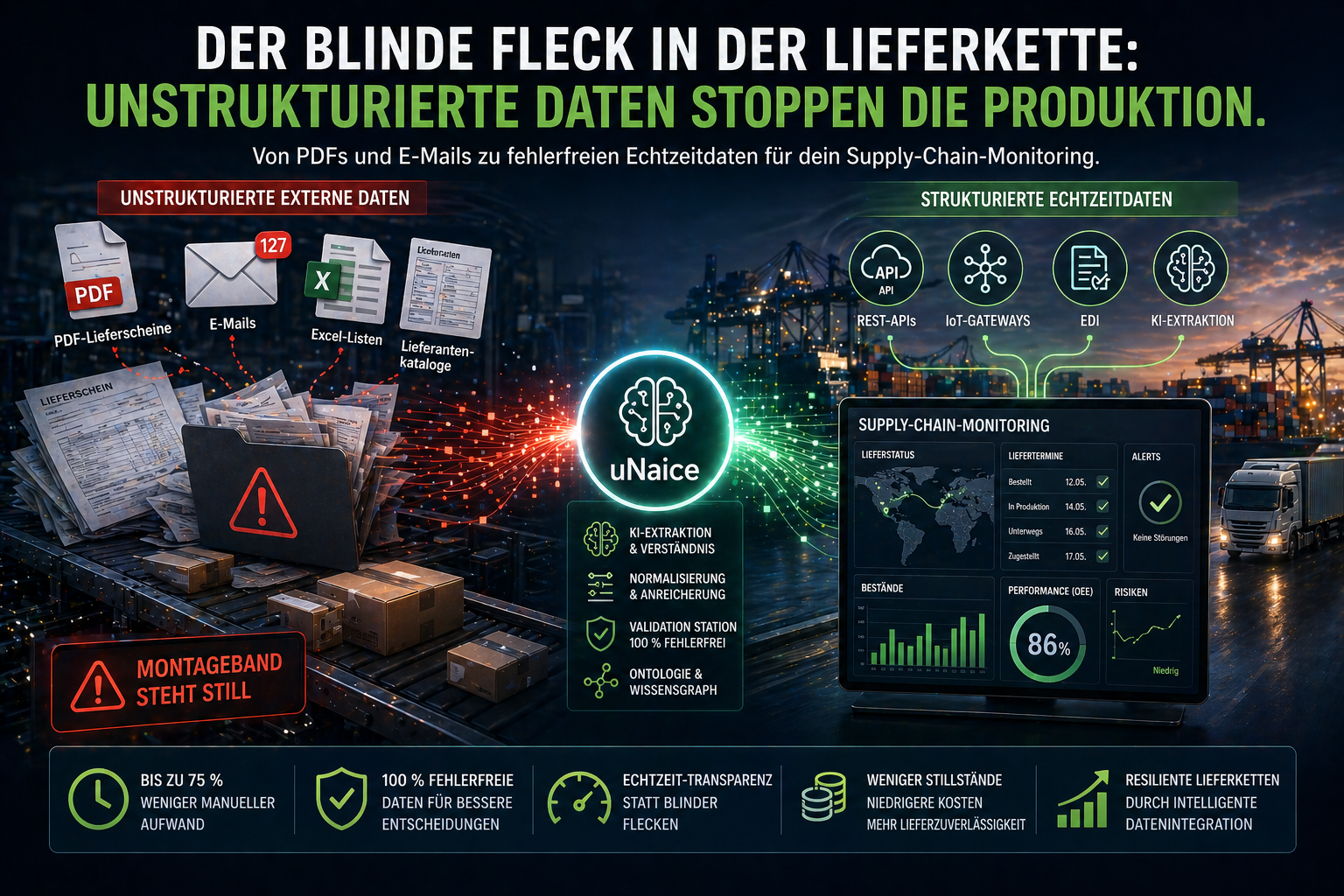
The Blind Spot in the Supply Chain: When PDFs and Emails Bring Production to a Halt
Your ERP system shows all systems go, the production lines are running on schedule, and capacity is being utilized optimally. Yet the next morning, an assembly line comes to a standstill. The reason is simple: An external supplier sent an email with a different delivery date and an attached PDF delivery note, which simply got lost in a dispatcher’s inbox. If you’re asking yourself: How can unstructured external logistics data be meaningfully integrated into existing supply chain monitoring?, you’re facing the exact same challenge as much of the industry.
Modern logistics suffers from a massive media disconnect. While internal systems are highly optimized, external partners continue to communicate via Excel spreadsheets, unformatted text, or supplier catalogs in a wide variety of formats. This unstructured information constitutes the most dangerous blind spot in global value chains. Manually typing and verifying this data not only costs valuable time but is also extremely error-prone.
In this guide, we’ll show you in practical terms how to eliminate the “human bottleneck” in data maintenance. You’ll learn what architectural foundations are necessary to automatically extract external supplier data, understand it semantically, and transform it into error-free data assets for your monitoring system.
Which interface concepts are best suited for the real-time integration of external supplier data?
Real-time connectivity enables the continuous and delay-free transmission of relevant supplier information to central monitoring systems. According to the Global Supply Chain Leader Survey by McKinsey (2024), 9 out of 10 logistics managers faced massive challenges in the supply chain. A key reason for this is the lack of speed in data processing. Modern supply chains no longer rely on simple status updates but require continuous data streams.
Hybrid architectures are best suited for integrating external data. These combine centralized computing power in the cloud with distributed nodes located directly at production or transportation sites. A technical report by Trans.info (2025) demonstrates that critical sensor data can thus be processed locally in milliseconds, while strategic analyses are orchestrated globally. This is essential when, for example, temperature data for sensitive goods or precise location data must be monitored.
The key interface concepts include:
uNaice integrates production data from the shop floor into the ERP system via bidirectional API interfaces
A data silo is an isolated data set used by a specific department that is inaccessible to other business units or IT systems. The study series by the BVL and LogU (2025) identifies incompatibility with existing systems and limited data quality as the biggest hurdles in digital transformation. When shop floor machines store their performance data in isolated MES systems while the ERP system accesses outdated inventory data from logistics, catastrophic miscalculations occur.
Breaking down these silos in a sustainable way requires a shift away from rigid table structures toward flexible knowledge graphs. This is exactly where ontologies come into play. An ontology logically links data points so that the system understands the context. If a sensor on the shop floor reports a 45-minute delay, the system automatically recognizes the semantic connection to the delivery date in the ERP and alerts the responsible Supply Chain Manager.
Building such a networked infrastructure requires powerful tools. Processing this complex master data requires specialized solutions such as DataNaicer, which fully automates the transformation of unstructured raw data into perfect, cross-system data sets. This reduces the integration effort for new data sources by an average of 60%.
How do you establish reliable data governance for extremely heterogeneous machine data in manufacturing?
Data governance refers to the strategic framework for ensuring consistently high data quality, availability, and security across the entire enterprise. A recurring problem in day-to-day operations is poor data quality. Incomplete or inconsistent master data inevitably leads to stock shortages and incorrect decisions in production planning.
To establish reliable governance, you need to minimize manual intervention. In practice, teams often spend hundreds of hours each month battling with Excel to correct typos or standardize units. An automated quality pipeline handles these repetitive tasks. It normalizes units of measurement (e.g., from “inches” to “cm”), corrects typos, and enriches missing attributes using external sources.
The key steps for implementation include:
This systematic approach can reduce manual data maintenance time by up to 75%, while bringing the error rate down to near zero.
Why modern supply chains can no longer function without powerful data ecosystems
A digital data ecosystem consists of interconnected IT infrastructures that centrally consolidate and analyze structured and unstructured information from various sources. According to Deloitte’s Supply Chain Pulse Check (2025), supply chains remain vulnerable because many companies lack comprehensive data analytics. Only a tiny minority have already integrated functioning early warning systems into their supply chains.
The expectations of markets and producers are rising rapidly. To avoid bottlenecks and anticipate risks, you need the most precise data in real time. The introduction of digital twins, as recommended by Detecon (2025), enables effective risk management. A digital twin virtually simulates the entire supply chain and immediately reveals the impact of disruptions.
However, this level of transparency can only be achieved if unstructured information from suppliers is also incorporated. When external logistics data is seamlessly integrated into your existing supply chain monitoring system, it transforms from a purely reactive tool into a proactive control instrument.
The Role of AI and Ontologies in Data Processing
Unlike traditional rule-based systems, ontology-based AI offers the ability to logically understand the business context of logistics data. Studies by LogU (2025) show that 68% of the companies surveyed will be working on implementing or scaling AI over the next 5 years. However, the critical mistake many companies make is the use of “black-box AI,” whose decisions cannot be traced retrospectively.
When it comes to critical supply chain data, you need absolute reliability. This is where the quality pipeline principle comes into play: 99% of data extraction and cleansing is handled by specialized AI models trained on industry-specific terminology. The remaining 1% is validated by an intelligent Validation Station. This synergy guarantees 100% accuracy in the import of supplier data.
Market leaders such as adidas, TUI, and Otto rely on this methodology to efficiently leverage their data assets. The major advantage: The software scales with your needs. Whether you’re processing 10,000 or 5 million records—scaling happens at the click of a button, without the need to hire additional staff.
How can unstructured external logistics data be effectively integrated into existing supply chain monitoring?
The integration of unstructured logistics data enables seamless end-to-end transparency through the automated extraction and structuring of information from heterogeneous sources. To effectively incorporate this data into your monitoring, you must fundamentally digitize the data intake process. Simply saving PDFs is not enough; the values they contain must be made machine-readable.
The process of meaningful integration comprises four key phases:
By establishing this workflow, you’ll remove the roadblocks in your logistics department. A key business advantage of modern solutions like those from uNaice is the flat-rate model. There are no costs per SKU (Stock Keeping Unit), which makes scaling data processing extremely cost-effective.
Conclusion: Resilience Through Error-Free Quality Pipelines
Clean data capital is the fundamental prerequisite for any resilient and responsive supply chain in modern industry. As current studies show, many optimization projects fail not because of hardware, but because of inconsistent, unstructured information that blocks the flow of data. Manually processing this data is an expensive bottleneck that is no longer sustainable in times of skilled labor shortages.
By leveraging ontology-based AI and automated quality pipelines, you transform unstructured supplier information into reliable real-time data. This strengthens your resilience, reduces process costs, and gives your teams the time to focus on strategic tasks.
Want to see firsthand how you can put an end to your manual Excel battles and seamlessly integrate external data? Take advantage of our 100-data-record trial and let us process your unstructured logistics data with no obligation. Book your free initial consultation now, and together we’ll analyze your specific automation potential.
Frequently Asked Questions
Ready for the next step?
Contact us for a no-obligation consultation about your data project.
Contact us nowSources