%20--%3e%3cdefs%3e%3cstyle%3e%20.st0%20{%20fill:%20%23a5d028;%20}%20.st1%20{%20fill:%20%23fff;%20}%20.st2%20{%20fill:%20%231de2db;%20}%20.st3%20{%20fill:%20%2341bdf9;%20}%20%3c/style%3e%3c/defs%3e%3cg%20id='logo-unaice-line'%3e%3cpath%20class='st1'%20d='M143.3,36.1c-1.2,0-2.1-.9-2.1-2.1V12.2c0-1.2.9-2.1,2.1-2.1s2.1.9,2.1,2.1v21.8c0,1.2-.9,2.1-2.1,2.1ZM143.2,6.2c-1.3,0-2.4-1-2.4-2.4v-.8c0-1.3,1-2.4,2.4-2.4s2.4,1.1,2.4,2.4v.8c0,1.3-1.1,2.4-2.4,2.4Z'/%3e%3cpath%20class='st3'%20d='M23.7,36.1H2c-.5,0-1-.4-1-1V2.3c0-.5.4-1,1-1h21.7c.5,0,1,.4,1,1v32.9c0,.5-.4,1-1,1'/%3e%3cpath%20class='st2'%20d='M41.8,36.1h-14.4c-.5,0-1-.4-1-1v-14.5c0-.5.4-1,1-1h14.4c.5,0,1,.4,1,1v14.5c0,.5-.4,1-1,1'/%3e%3cpath%20class='st0'%20d='M41.8,17.9h-14.4c-.5,0-1-.4-1-1V2.2c0-.5.4-1,1-1h14.4c.5,0,1,.4,1,1v14.7c0,.5-.4,1-1,1'/%3e%3c/g%3e%3cpath%20class='st1'%20d='M196.4,29.2c-2.1,2.1-3.6,3.2-7.1,3.2s-7.4-2.3-8.2-7.4h16.7c2.7,0,2.9-1.9,2.7-4-.7-6.2-5.3-11.2-11.6-11.2s-12.3,5.1-12.3,13.4,5.4,13.3,12.6,13.3,8.3-2.6,10-4.3c1.8-2.1-1.2-4.7-2.8-3ZM188.9,13.7c4.7,0,7.3,4.1,7.6,7.3h-15.3c.7-4.3,3.4-7.3,7.7-7.3Z'/%3e%3cpath%20class='st1'%20d='M132.1,12.9c-1.9-1.9-5.4-2.9-8.2-2.9s-5.3.5-8.2,1.8c-2.4,1-.9,5,1.6,3.7,2.1-1,3.3-1.5,6.3-1.5s6.7,1.1,6.8,6.1c-1.8-.5-2.7-.8-6.9-.8-6.8,0-11.3,3.3-11.3,8.8s4.1,8.4,10.1,8.4,5.4-.6,8.3-2.9v.5c0,2.8,4.2,2.6,4.2,0v-13.8c0-3.1-.8-5.5-2.7-7.4ZM130.4,26.2c0,3.6-3.4,6.3-8,6.3s-5.9-1.7-5.9-4.6,2.5-4.6,6.8-4.6c0,0,4.8,0,7.1,1v1.9Z'/%3e%3cpath%20class='st1'%20d='M80,36.1c-1.2,0-2.1-.9-2.1-2.1V3.4c0-1.2,1-2.2,2.2-2.2h.4c.8,0,1.4.4,2,1.1l20.2,25.7V3.4c0-1.2.9-2.1,2.1-2.1s2.1.9,2.1,2.1v30.7c0,1.1-.5,2-1.9,2s-1.9-.8-2.2-1.2l-20.7-26.2v25.3c0,1.2-.9,2.1-2.1,2.1Z'/%3e%3cpath%20class='st1'%20d='M60.2,36.5c-5.1,0-10.5-4.3-10.5-10.7v-13.5c0-1.2.9-2.1,2.1-2.1s2.1.9,2.1,2.1v13.1c0,4.5,2.5,7.1,6.6,7.1s7.3-3.2,7.3-7.5v-12.7c0-1.2.9-2.1,2.1-2.1s2.1.9,2.1,2.1v21.8c0,2.8-4.2,2.7-4.2,0v-.5c-1.5,1.6-3.3,2.9-7.6,2.9Z'/%3e%3cpath%20class='st1'%20d='M163.8,36.5c-7.1,0-13.1-6-13.1-13.3s4.8-13.5,13.5-13.5c4.4,0,6.9,2,8.8,3.7,1.8,1.5-.8,5.1-2.8,3.3-.8-.8-3.3-3-6.4-3-4.8,0-8.6,4-8.6,9.2s3.8,9.3,8.6,9.4c3.7,0,4.9-1,7-3.1,1.6-1.8,4.6,1,3,2.8-3,3-5.7,4.5-10,4.5h0Z'/%3e%3c/svg%3e)
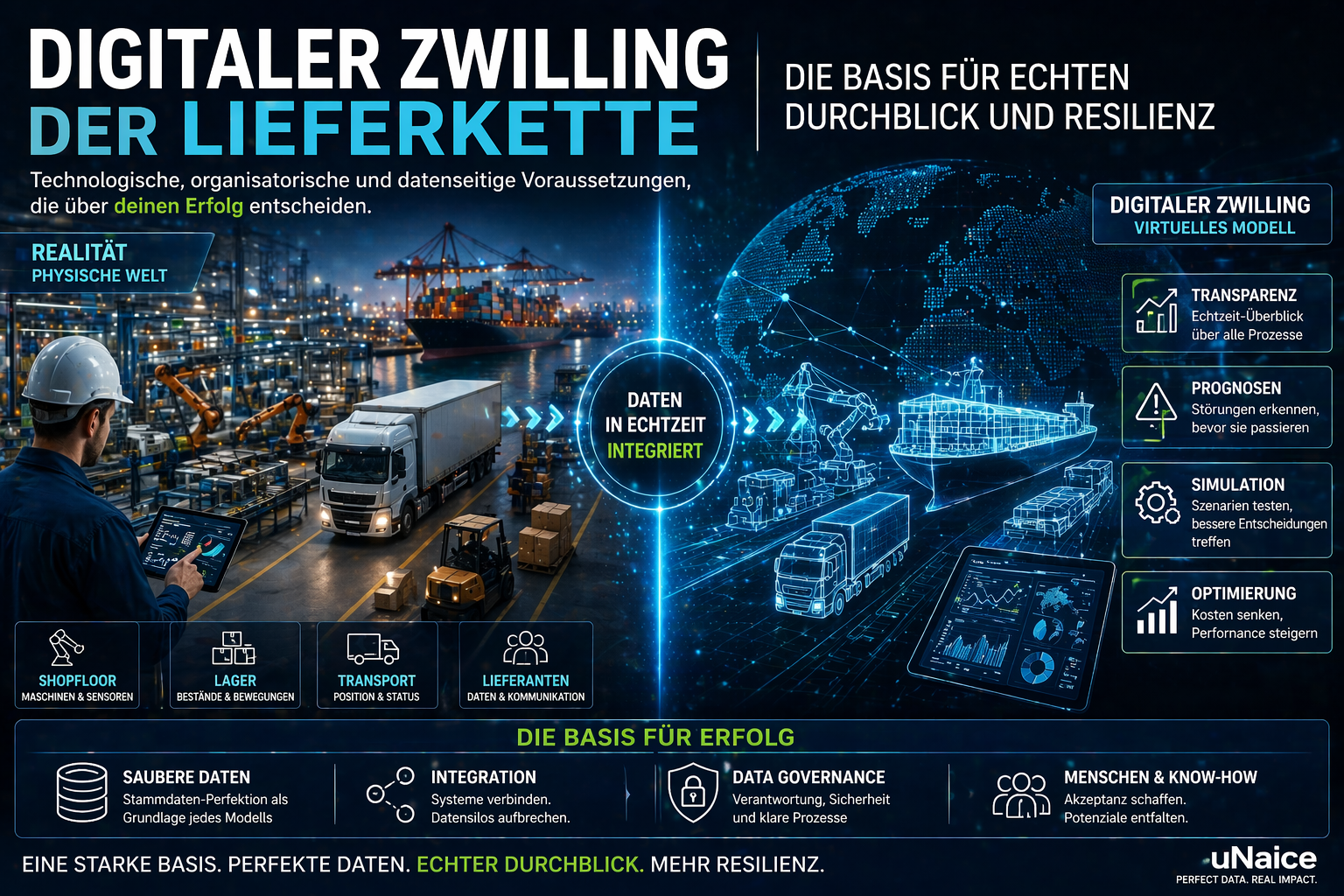
Three months of work, a modern system implemented—and yet the hoped-for results still haven’t materialized. Why? When the implementation of modern supply chain technologies fails, it’s rarely due to the grand vision, but almost always down to the basics. The systems are in place, but performance is disappointing because the underlying data structure can’t meet the requirements.
At uNaice, we observe this phenomenon regularly, especially in industrial settings. Companies invest in state-of-the-art dashboards, only to fail due to inaccurate supplier data and manual Excel battles. The hoped-for transparency in the value chain remains an illusion as long as isolated data silos block the flow of information.
In this guide, you’ll learn firsthand what technological, organizational, and data-related foundations you absolutely need. We’ll show you how to overcome the “human bottleneck” in data maintenance and prepare your data assets so that your digital model truly reflects reality.
What technological prerequisites are crucial for a digital twin of the supply chain?
An adequate IT infrastructure enables the cost-effective use and appropriate deployment of a digital twin. According to a report by Fraunhofer IML (2025), ERP, WMS, and TMS systems must be capable of seamlessly exchanging real-time data. APIs and direct connections are essential to ensure this seamless communication between different business units. Without these technological prerequisites, your valuable information remains trapped in isolated silos.
We have seen in many projects that it is precisely this lack of integration that prevents seamless traceability of installed components. If machine data from the shop floor cannot be linked to the supply chain data in the ERP system, the virtual model loses its value. A well-designed architecture ensures that all systems speak the same language and that data is synchronized without delay.
The Role of IoT Sensors and Real-Time Data Collection
IoT sensors enable the continuous collection of real-time data such as temperature and location along the supply chain. These physical data points form the nervous system of your virtual model. Studies by Industry 4.0 Science (2025) show that this real-time visualization enables companies to predict potential disruptions and simulate preventive alternative scenarios. Precisely structured sensor data is essential for calculating Overall Equipment Effectiveness (OEE) in real time.
If you want to effectively use historical machine data for predictive maintenance, seamless IoT integration is essential. Especially in industrial settings, it has become clear that edge computing for the extremely fast processing of production data is often preferable to a pure cloud solution. This minimizes latency and allows for the early identification of impending production bottlenecks through the intelligent analysis of sensor data.
Cloud Computing for Highly Available Scaling
Unlike local servers, cloud computing offers flexible scalability for fluctuating data volumes. Analyses by Global Market Insights (2024) show that cloud-based solutions significantly reduce the burden of IT infrastructure management and make systems future-proof. They enable real-time access from any location, which is an absolute success factor for distributed global supply chains. When you integrate unstructured external logistics data into your supply chain monitoring, the cloud handles peak loads with ease.
Our experience shows that this flexibility enables companies to reduce their IT costs while increasing reliability. A well-configured cloud architecture is essential for processing millions of records efficiently. With our software solution, for example, you can effortlessly scale from 10,000 to 5 million data records without your infrastructure reaching its limits or having to hire new staff for maintenance.
Why is data quality the most important foundation for virtual replicas?
A digital twin is a digital representation of real-world objects, resources, or processes according to ISO/IEC 30173:2023-11. Flawless data quality is essential for this model to make accurate predictions. The “human bottleneck” in manual data maintenance inevitably leads to errors, which compound in the virtual model and result in incorrect business decisions. Inconsistent master data in materials management is the main reason why many industrial companies fail to link their supply chain data.
The solution lies in a fully automated quality pipeline that systematically eliminates sources of error. With our DataNaicer solution, we automatically transform unstructured raw data from PDFs, Excel spreadsheets, or supplier catalogs into perfect master data. This allows you to remove the roadblock in your data maintenance, free your team from repetitive tasks, and create a reliable foundation for your digital representation.
Ontologies Instead of Rigid Tables for Master Data Perfection
Unlike rigid tables, ontologies organize data as logical knowledge graphs to capture semantic relationships. This advanced form of data structuring enables natural search queries and a genuine understanding of the information’s content. At uNaice, we use exactly this technology instead of simply shuffling disjointed text blocks like a black-box AI. Through the automated normalization of entities and the correction of typos, companies save up to 75 percent of their manual labor time.
Missing attributes are intelligently enriched using external sources. Market leaders such as adidas, TUI, and Otto rely on this methodology to manage extremely large product ranges without errors. In our Validation Station, we combine 99 percent AI automation with targeted human oversight. This symbiosis guarantees 100 percent accuracy and delivers exactly the master data perfection that a digital twin absolutely requires.
Data Governance and Accountability in an Industrial Environment
Data governance is the strategic framework for ensuring data quality and accountability within the company. Establishing reliable governance for extremely heterogeneous machine data in manufacturing is a key challenge. Strategic responsibility for the quality of captured process data lies with a Chief Data Officer or Supply Chain Data Manager.
To ensure data security during direct exchanges with external suppliers, strict access rights and encryption protocols must be established. A functional governance structure ensures that sensitive production data remains protected while the digital twin simultaneously receives all necessary real-time information. Without these clear guidelines, any data project will inevitably descend into chaos.
How do you overcome the economic and organizational hurdles?
Studies show that the market for digital supply chain twins is growing by over 12.5 percent annually through 2032. According to Global Market Insights (2024), however, the high cost of implementation poses a significant barrier. In addition to the software itself, budgets must be allocated for sensors, data analytics, and the development of IT infrastructure. A clear ROI calculation is therefore essential for every company.
A key advantage of our solution is our transparent flat-rate pricing. Unlike many competitors, we do not charge per SKU (Stock Keeping Unit). For you, this means absolute cost certainty, regardless of how much your product range grows. This predictability greatly helps industrial companies justify the initial investment in the digital twin from a business perspective.
Building Training and Acceptance Within the Team
Targeted employee training enables rapid knowledge acquisition and increases acceptance of new tools. Industry 4.0 Science (2025) emphasizes that budgets must be allocated not only for technology but explicitly for building the necessary expertise. If your team does not understand the new systems or perceives them as a threat, the technology’s full potential will be wasted.
We advise our customers: Get your employees on board early in the process. Show them specifically how AI-powered data preparation frees them from tedious Excel copy-and-paste tasks. When the team realizes that the technology is a valuable tool in their daily work, the implementation will go smoothly. Would you like to experience for yourself just how intuitive perfect data maintenance can be? Use our free 100-data-record trial and see for yourself using your own product data.
Conclusion: The foundation determines success
A digital twin of the supply chain is not merely an IT project, but a strategic transformation based on three pillars:
If you cannot seamlessly integrate historical machine data, external supplier catalogs, and ERP information, the virtual representation remains useless. Ontology-based AI solutions are the key here to finally eliminating the bottleneck of manual data maintenance.
Unlock the full potential of your data assets now and lay the groundwork for a resilient, future-proof supply chain. The technology is ready, and with the right partner by your side, implementation is both predictable and secure. Schedule a free initial consultation with our experts today. Let’s work together on a no-obligation potential analysis to see how we can take your data quality to the next level.
Frequently Asked Questions
Ready for the next step?
Contact us for a no-obligation consultation about your data project.
Contact us nowSources