%20--%3e%3cdefs%3e%3cstyle%3e%20.st0%20{%20fill:%20%23a5d028;%20}%20.st1%20{%20fill:%20%23fff;%20}%20.st2%20{%20fill:%20%231de2db;%20}%20.st3%20{%20fill:%20%2341bdf9;%20}%20%3c/style%3e%3c/defs%3e%3cg%20id='logo-unaice-line'%3e%3cpath%20class='st1'%20d='M143.3,36.1c-1.2,0-2.1-.9-2.1-2.1V12.2c0-1.2.9-2.1,2.1-2.1s2.1.9,2.1,2.1v21.8c0,1.2-.9,2.1-2.1,2.1ZM143.2,6.2c-1.3,0-2.4-1-2.4-2.4v-.8c0-1.3,1-2.4,2.4-2.4s2.4,1.1,2.4,2.4v.8c0,1.3-1.1,2.4-2.4,2.4Z'/%3e%3cpath%20class='st3'%20d='M23.7,36.1H2c-.5,0-1-.4-1-1V2.3c0-.5.4-1,1-1h21.7c.5,0,1,.4,1,1v32.9c0,.5-.4,1-1,1'/%3e%3cpath%20class='st2'%20d='M41.8,36.1h-14.4c-.5,0-1-.4-1-1v-14.5c0-.5.4-1,1-1h14.4c.5,0,1,.4,1,1v14.5c0,.5-.4,1-1,1'/%3e%3cpath%20class='st0'%20d='M41.8,17.9h-14.4c-.5,0-1-.4-1-1V2.2c0-.5.4-1,1-1h14.4c.5,0,1,.4,1,1v14.7c0,.5-.4,1-1,1'/%3e%3c/g%3e%3cpath%20class='st1'%20d='M196.4,29.2c-2.1,2.1-3.6,3.2-7.1,3.2s-7.4-2.3-8.2-7.4h16.7c2.7,0,2.9-1.9,2.7-4-.7-6.2-5.3-11.2-11.6-11.2s-12.3,5.1-12.3,13.4,5.4,13.3,12.6,13.3,8.3-2.6,10-4.3c1.8-2.1-1.2-4.7-2.8-3ZM188.9,13.7c4.7,0,7.3,4.1,7.6,7.3h-15.3c.7-4.3,3.4-7.3,7.7-7.3Z'/%3e%3cpath%20class='st1'%20d='M132.1,12.9c-1.9-1.9-5.4-2.9-8.2-2.9s-5.3.5-8.2,1.8c-2.4,1-.9,5,1.6,3.7,2.1-1,3.3-1.5,6.3-1.5s6.7,1.1,6.8,6.1c-1.8-.5-2.7-.8-6.9-.8-6.8,0-11.3,3.3-11.3,8.8s4.1,8.4,10.1,8.4,5.4-.6,8.3-2.9v.5c0,2.8,4.2,2.6,4.2,0v-13.8c0-3.1-.8-5.5-2.7-7.4ZM130.4,26.2c0,3.6-3.4,6.3-8,6.3s-5.9-1.7-5.9-4.6,2.5-4.6,6.8-4.6c0,0,4.8,0,7.1,1v1.9Z'/%3e%3cpath%20class='st1'%20d='M80,36.1c-1.2,0-2.1-.9-2.1-2.1V3.4c0-1.2,1-2.2,2.2-2.2h.4c.8,0,1.4.4,2,1.1l20.2,25.7V3.4c0-1.2.9-2.1,2.1-2.1s2.1.9,2.1,2.1v30.7c0,1.1-.5,2-1.9,2s-1.9-.8-2.2-1.2l-20.7-26.2v25.3c0,1.2-.9,2.1-2.1,2.1Z'/%3e%3cpath%20class='st1'%20d='M60.2,36.5c-5.1,0-10.5-4.3-10.5-10.7v-13.5c0-1.2.9-2.1,2.1-2.1s2.1.9,2.1,2.1v13.1c0,4.5,2.5,7.1,6.6,7.1s7.3-3.2,7.3-7.5v-12.7c0-1.2.9-2.1,2.1-2.1s2.1.9,2.1,2.1v21.8c0,2.8-4.2,2.7-4.2,0v-.5c-1.5,1.6-3.3,2.9-7.6,2.9Z'/%3e%3cpath%20class='st1'%20d='M163.8,36.5c-7.1,0-13.1-6-13.1-13.3s4.8-13.5,13.5-13.5c4.4,0,6.9,2,8.8,3.7,1.8,1.5-.8,5.1-2.8,3.3-.8-.8-3.3-3-6.4-3-4.8,0-8.6,4-8.6,9.2s3.8,9.3,8.6,9.4c3.7,0,4.9-1,7-3.1,1.6-1.8,4.6,1,3,2.8-3,3-5.7,4.5-10,4.5h0Z'/%3e%3c/svg%3e)
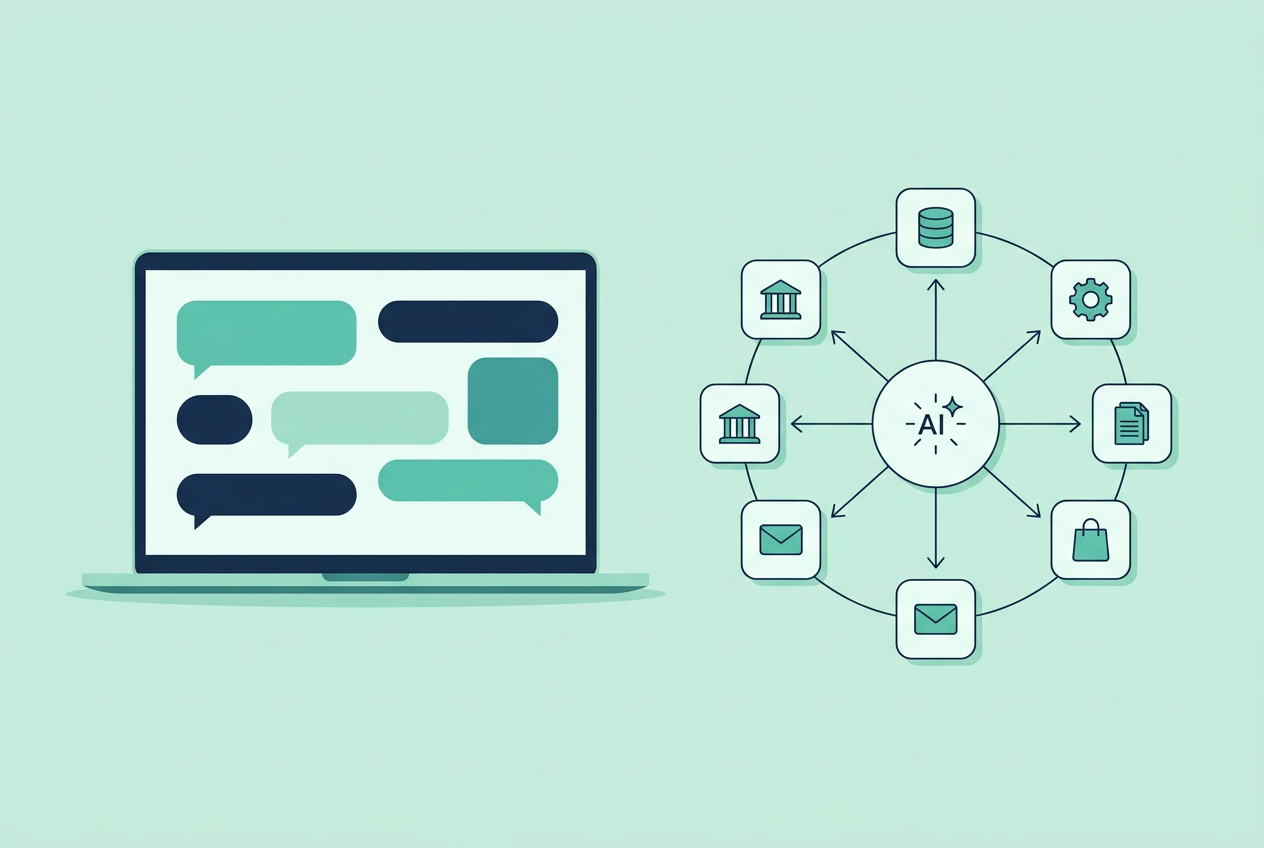
*At a talk I gave this week, the audience was made up entirely of entrepreneurs – all 40+, all successful, all daily AI users. Not just ChatGPT, but Claude, Gemini, Mistral too. But: every single one of them only via the chat interface in a browser. No architecture, no integration into their software landscape, no defined access for their employees. That is exactly what we need to talk about.*
If you're reading this, you probably feel like AI has clearly arrived. You have a ChatGPT Plus account, maybe a Claude Pro subscription, you use it daily for emails, proposals, research, drafts. You're already ahead of 80 % of your competitors.
And that's exactly the problem: you are ahead – your company is not.
The status quo: AI is everywhere, but stuck in a browser tab
The typical 2026 mid-market situation looks like this:
That is not "digital transformation". That is "shadow AI with a premium subscription". And the consequences are real: legal risks (GDPR, trade secrets), inconsistent results, double work, model sprawl – and most importantly: no single process measurably improves, because AI isn't structurally plugged in anywhere.
Why "chat only" is a dead-end setup
Chat is brilliant for getting to know AI. It is terrible for scaling AI. Three reasons:
1. Knowledge leaves the company the moment the tab is closed
Every conversation in which your sales lead just built a perfect proposal is gone after logout. No colleague, no second team, no new hire can build on it. It's as if you deleted every Excel sheet after using it.
2. Data doesn't flow back into your systems
The AI output gets copy-pasted into Word, Outlook, the CRM, the shop, accounting. Every one of those clicks is an error, time and compliance risk. A real integration would write structured results back to the right place – versioned, approved, traceable.
3. You use the same model for everything
ChatGPT Plus is a Swiss army knife. For 80 % of tasks it's overkill (too expensive per token), for 20 % it's too weak (very long contracts, sensitive EU data). Which model fits which task best is exactly what our interactive AI models price comparison shows – spoiler: it's almost never just one.
What a real "AI foundation architecture" actually means
This is not a giant IT project. A pragmatic AI architecture for a 20- to 500-person company has four building blocks:
1. One central access point for all employees.
Not everyone with a private ChatGPT account, but a central gateway that bundles the best models (OpenAI, Anthropic, Google, Mistral, local models). With SSO, roles, logging and cost control.
2. Smart model routing.
Standard requests go to cheap models. Sensitive EU data goes to EU-hosted models. Long contracts go to models with large context windows. The routing decides automatically – employees don't have to think about it.
3. A knowledge base (RAG).
Your own data – product information, manuals, contracts, proposals, FAQs – prepared so the AI answers with your knowledge, not from the open internet. That's the difference between "nicely worded" and "legally and technically correct".
4. Integrations into your core systems.
ERP, CRM, PIM, DMS, shop, mail. Not all at once – but at least one, so AI doesn't end in the browser but pushes processes through: from supplier document into the ERP, from product sheet into the shop, from customer mail into the CRM ticket.
The biggest lever: integration before new models
We see it in our projects all the time: companies debate for weeks which model to use – while zero integration exists. Wrong order.
Rule of thumb: Moving from "employee privately chats with GPT" to "AI writes structured data into your PIM/CRM" is worth 10x more ROI than moving from GPT-4 to GPT-5.
That is why we consult companies in exactly this order:
A concrete example: product data & content
A real one from our **DataNaicer** work: a wholesaler with 80,000 SKUs in PIM. Their head of purchasing privately uses ChatGPT to turn supplier PDFs into texts. Works for 10 articles per day – not for 80,000.
The moment AI sits directly on the PIM, structurally extracts supplier documents, normalises attributes and writes into the correct data model, nobody talks about "which model is better" anymore. People start talking about "we cut time-to-market in half".
That is the difference between chat AI and integrated AI.
What you can do this week
You don't have to draft a complete AI architecture tomorrow. Three steps are enough to start:
If you don't want to walk through step 2 or 3 alone: that is literally what we do. For years we have done nothing but integrate AI into real-world company landscapes – not in the browser, but where your employees already work.
Book 30 minutes of free initial consulting – by the end you'll know whether an architecture sketch, a PIM pilot or an employee gateway is the right next step for you.
Frequently Asked Questions (FAQ)
Ready for the next step?
Contact us for a no-obligation consultation about your data project.
Contact us now