%20--%3e%3cdefs%3e%3cstyle%3e%20.st0%20{%20fill:%20%23a5d028;%20}%20.st1%20{%20fill:%20%23fff;%20}%20.st2%20{%20fill:%20%231de2db;%20}%20.st3%20{%20fill:%20%2341bdf9;%20}%20%3c/style%3e%3c/defs%3e%3cg%20id='logo-unaice-line'%3e%3cpath%20class='st1'%20d='M143.3,36.1c-1.2,0-2.1-.9-2.1-2.1V12.2c0-1.2.9-2.1,2.1-2.1s2.1.9,2.1,2.1v21.8c0,1.2-.9,2.1-2.1,2.1ZM143.2,6.2c-1.3,0-2.4-1-2.4-2.4v-.8c0-1.3,1-2.4,2.4-2.4s2.4,1.1,2.4,2.4v.8c0,1.3-1.1,2.4-2.4,2.4Z'/%3e%3cpath%20class='st3'%20d='M23.7,36.1H2c-.5,0-1-.4-1-1V2.3c0-.5.4-1,1-1h21.7c.5,0,1,.4,1,1v32.9c0,.5-.4,1-1,1'/%3e%3cpath%20class='st2'%20d='M41.8,36.1h-14.4c-.5,0-1-.4-1-1v-14.5c0-.5.4-1,1-1h14.4c.5,0,1,.4,1,1v14.5c0,.5-.4,1-1,1'/%3e%3cpath%20class='st0'%20d='M41.8,17.9h-14.4c-.5,0-1-.4-1-1V2.2c0-.5.4-1,1-1h14.4c.5,0,1,.4,1,1v14.7c0,.5-.4,1-1,1'/%3e%3c/g%3e%3cpath%20class='st1'%20d='M196.4,29.2c-2.1,2.1-3.6,3.2-7.1,3.2s-7.4-2.3-8.2-7.4h16.7c2.7,0,2.9-1.9,2.7-4-.7-6.2-5.3-11.2-11.6-11.2s-12.3,5.1-12.3,13.4,5.4,13.3,12.6,13.3,8.3-2.6,10-4.3c1.8-2.1-1.2-4.7-2.8-3ZM188.9,13.7c4.7,0,7.3,4.1,7.6,7.3h-15.3c.7-4.3,3.4-7.3,7.7-7.3Z'/%3e%3cpath%20class='st1'%20d='M132.1,12.9c-1.9-1.9-5.4-2.9-8.2-2.9s-5.3.5-8.2,1.8c-2.4,1-.9,5,1.6,3.7,2.1-1,3.3-1.5,6.3-1.5s6.7,1.1,6.8,6.1c-1.8-.5-2.7-.8-6.9-.8-6.8,0-11.3,3.3-11.3,8.8s4.1,8.4,10.1,8.4,5.4-.6,8.3-2.9v.5c0,2.8,4.2,2.6,4.2,0v-13.8c0-3.1-.8-5.5-2.7-7.4ZM130.4,26.2c0,3.6-3.4,6.3-8,6.3s-5.9-1.7-5.9-4.6,2.5-4.6,6.8-4.6c0,0,4.8,0,7.1,1v1.9Z'/%3e%3cpath%20class='st1'%20d='M80,36.1c-1.2,0-2.1-.9-2.1-2.1V3.4c0-1.2,1-2.2,2.2-2.2h.4c.8,0,1.4.4,2,1.1l20.2,25.7V3.4c0-1.2.9-2.1,2.1-2.1s2.1.9,2.1,2.1v30.7c0,1.1-.5,2-1.9,2s-1.9-.8-2.2-1.2l-20.7-26.2v25.3c0,1.2-.9,2.1-2.1,2.1Z'/%3e%3cpath%20class='st1'%20d='M60.2,36.5c-5.1,0-10.5-4.3-10.5-10.7v-13.5c0-1.2.9-2.1,2.1-2.1s2.1.9,2.1,2.1v13.1c0,4.5,2.5,7.1,6.6,7.1s7.3-3.2,7.3-7.5v-12.7c0-1.2.9-2.1,2.1-2.1s2.1.9,2.1,2.1v21.8c0,2.8-4.2,2.7-4.2,0v-.5c-1.5,1.6-3.3,2.9-7.6,2.9Z'/%3e%3cpath%20class='st1'%20d='M163.8,36.5c-7.1,0-13.1-6-13.1-13.3s4.8-13.5,13.5-13.5c4.4,0,6.9,2,8.8,3.7,1.8,1.5-.8,5.1-2.8,3.3-.8-.8-3.3-3-6.4-3-4.8,0-8.6,4-8.6,9.2s3.8,9.3,8.6,9.4c3.7,0,4.9-1,7-3.1,1.6-1.8,4.6,1,3,2.8-3,3-5.7,4.5-10,4.5h0Z'/%3e%3c/svg%3e)
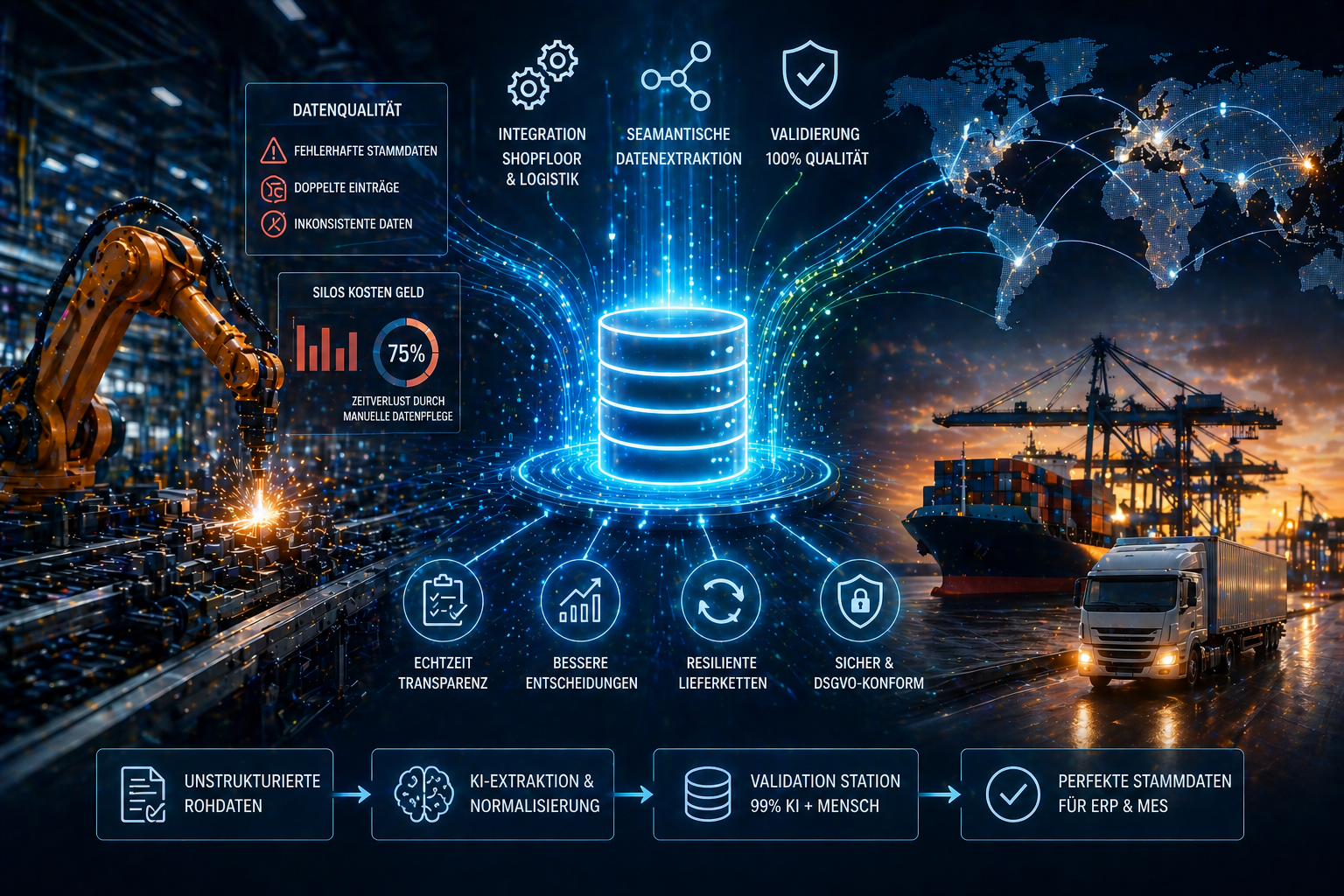
A look at the Analytics reveals: Most manufacturing companies fail in times of crisis not because of a lack of transport capacity, but because of inaccurate master data. Incorrect bill of materials, decentralized Excel catalogs, and missing system interfaces cause errors in planning. The moment you realize that your data quality isn’t sufficient for dynamic control usually comes when the container is already at the wrong port or the production line has come to a standstill.
The challenge for Supply Chain Managers has grown enormously. Supply networks that were once focused purely on cost efficiency must now cushion geopolitical fluctuations, new tariffs, and unforeseeable disruptions. But how can you manage proactively when your team spends half the day manually copying data from one system to another? The “human bottleneck” in data maintenance not only costs time but jeopardizes the company’s entire responsiveness.
In this expert guide, we’ll show you how to transform unstructured raw data into real data capital. uNaice analyzes system boundaries, data integration between the shop floor and logistics, and technologies for resilient supply chains.
Why do many industrial companies struggle to seamlessly link MES and supply chain data?
Unlike modern, integrated system architectures, legacy IT landscapes create a strict separation between production data (MES) and logistics data (supply chain). This fragmentation means that logistics planners are often unaware of short-term changes on the shop floor. According to a recent industry study by Alpega (2025), companies must fundamentally realign their supply chains in light of increasing risks from geopolitical volatility, which 56% of shippers cite as the primary threat.
In our practice, we often see that integration fails due to inconsistent data formats. A component is named differently in the production system than in the purchasing department’s ERP system. Without a logical translation layer, errors arise that must be corrected manually. When employees manually reconcile thousands of data records, the error rate increases exponentially and hinders strategic tasks.
How can isolated data silos between the shop floor and the ERP system be permanently eliminated?
Eliminating data silos enables cross-departmental real-time transparency by centralizing all material and process data in a Single Source of Truth. Deloitte’s Supply Chain Pulse Check (2025) clearly shows that IT infrastructure and data quality must be improved as a prerequisite for AI adoption. To date, only a minority of the companies surveyed have successfully integrated digital early warning systems into their supply chains.
To break down these silos, we rely on intelligent knowledge graphs (ontologies). Instead of forcing data into rigid tables, the system learns the logical relationships. A screw is not merely recognized as a text field, but is linked to all its physical properties and suppliers. With solutions like DataNaicer, you can automatically transform heterogeneous raw data into perfect master data that is seamlessly understood by all systems.
How does intelligent data management strengthen supply chain resilience for Supply Chain Managers in practice?
Intelligent data management is the systematic process of capturing, cleansing, and semantically analyzing logistics data to proactively prevent supply bottlenecks. The 2025 Supply Chain Planning Benchmark Report by Netstock demonstrates that the operational use of AI is driving a massive shift from reactive crisis mode to proactive planning. These technologies help SMEs assess demand, replenishment, and capacity proactively and simulate various scenarios in real time.
When we speak with production managers, frustration over inaccurate supplier data is often their biggest pain point. Intelligent systems eliminate this very obstacle. They standardize units, correct typos, and automatically populate missing attributes using external sources. The result is an error-free quality pipeline that remains stable even with millions of items, giving you the confidence to make decisions based on reliable facts.
What data structures are essential for calculating Overall Equipment Effectiveness (OEE) in real time?
Real-time OEE calculation requires standardized ontologies that logically and seamlessly link machine statuses, cycle times, and scrap rates. Without this clean underlying structure, even the best analytics tools produce nothing but junk data. The structure must be designed to process both historical machine data for predictive maintenance and live sensor data.
We strongly advise our customers against relying solely on “black-box AI,” which makes decisions based purely on statistical data patterns. Instead, we use a hybrid approach: 99% of data preparation is handled by rule-based AI automation, while the remaining exceptions are checked via a Validation Station. This combination guarantees 100% accuracy for your critical production metrics.
Would you like to see how clean data structures can accelerate your processes? Let’s analyze your current data quality in a brief conversation.
Which interface concepts are best suited for the real-time integration of external supplier data?
API-based interface concepts enable automated and secure data exchange between different corporate networks without any time delay. In its research on logistics resilience, the Fraunhofer IML (2025) emphasizes that digital security and the protection of sensitive logistics data through Privacy-by-Design are essential. Encrypted communication and the securing of digital freight documents (such as eCMR) form the backbone of modern supply chains.
The reality in many purchasing departments, however, is quite different: daily Excel battles to manually transfer price lists and specifications from dozens of suppliers into their own systems. Modern interface concepts combined with intelligent data processing take this work completely off your hands. You can reliably protect sensitive production data during direct data exchange with external suppliers, while the relevant product information is automatically extracted.
How can unstructured external logistics data be meaningfully integrated into existing Supply Chain Monitoring?
Semantic data extraction automatically converts unstructured formats such as PDF data sheets, emails, or complex Excel lists into machine-readable master data. This is the crucial step in identifying impending production bottlenecks early on through the intelligent analysis of supplier information.
Our software solution is specifically designed to address this issue. We specialize in extracting data from any supplier catalog. The system recognizes industry-specific terminology, assigns it to the correct categories, and translates it directly for international markets as needed. This allows external logistics data to flow seamlessly into your existing monitoring system without an employee having to manually enter a single line.
What are the key architectural requirements for a comprehensive digital twin of the supply chain?
A digital twin of the supply chain consists of three main components:
According to the Alpega study (2025), digital innovations are massively driving end-to-end visibility, with 79% of manufacturers already using dashboards for real-time monitoring of goods flows.
The most important requirement for this architecture is the scalability of the data models. Market leaders such as adidas, TUI, and Otto rely on systems that grow with them. If your product catalog expands from 10,000 to 5 million records, the architecture must not break down. This is exactly where our flat-rate model shines: We don’t charge per SKU. You can scale your data assets indefinitely without software costs skyrocketing or having to hire new staff.
When is edge computing preferable to a pure cloud solution for processing production data?
Unlike pure cloud processing, edge computing offers latency-free data analysis directly at the machine and prevents production downtime during short-term network outages. If you need to calculate Overall Equipment Effectiveness in milliseconds or adjust robot controls in real time, relying on external data centers is often too slow.
We recommend that companies adopt a hybrid strategy. Time-sensitive sensor data is processed locally via edge computing to ensure immediate responses on the shop floor. The aggregated results are then sent to the cloud, where they are linked with global supply chain data. This architecture also ensures seamless traceability of installed components across the entire supply chain.
How do you establish reliable data governance for extremely heterogeneous machine data in manufacturing?
Data governance is a company-wide framework for ensuring data quality, clear responsibilities, and adherence to compliance guidelines in production. Research by Fraunhofer IML (2025) shows that addressing regulatory requirements, such as compliance with data protection and security regulations (e.g., GDPR and NIS2), is essential for a resilient supply chain.
Strategic responsibility for the quality of the captured process data should always lie with Supply Chain Management in close coordination with IT. However, the operational implementation must not be left to the workforce. By using our “Made in Germany” software solutions, we guarantee the highest level of data security and GDPR compliance. You define the rules once, and the system enforces them fully automatically for every new data record.
Which cloud architectures are particularly suitable for the highly available scaling of global supply chain data?
Multi-cloud architectures enable fail-safe global scaling through the intelligent distribution of data loads across various, independent server infrastructures. If a node in Asia fails, a server in Europe seamlessly takes over, ensuring that your supply chain transparency is never interrupted.
For companies experiencing rapid growth, the predictability of IT costs is crucial. Our DataNaicer Pricing | Flat Rate is designed specifically for such high-scaling architectures. You pay a fixed amount and can run as many data points through the AI pipeline as you like. This removes the brakes on growth and turns intelligent data management into a real competitive advantage.
Conclusion: Resilience Starts with Data Quality
The past years of crisis have taught us an unmistakable lesson: A supply chain is only as resilient as the data on which it is based. Anyone still trying to manage complex global networks with flawed Excel spreadsheets and manual data maintenance today loses a massive amount of responsiveness. Intelligent data management is no longer purely an IT issue, but the key lever for Supply Chain Managers to identify risks early, automate processes, and safely navigate the company through volatile times.
The technology is now mature enough to eliminate the “human bottleneck” from routine data maintenance. With ontology-based AI systems, you can transform unstructured supplier information and isolated machine data into error-free, readily accessible data assets. This lays the foundation for digital twins, proactive risk management, and sustainable business growth.
Are you ready to take the quality of your master data to the next level? Schedule a free online demo now and see firsthand how our software solution tackles your specific data challenges. Take advantage of our no-obligation 100-record trial and see the quality of your own company data firsthand.
Frequently Asked Questions (FAQ)
Ready for the next step?
Contact us for a no-obligation consultation about your data project.
Contact us nowQuellen