%20--%3e%3cdefs%3e%3cstyle%3e%20.st0%20{%20fill:%20%23a5d028;%20}%20.st1%20{%20fill:%20%23fff;%20}%20.st2%20{%20fill:%20%231de2db;%20}%20.st3%20{%20fill:%20%2341bdf9;%20}%20%3c/style%3e%3c/defs%3e%3cg%20id='logo-unaice-line'%3e%3cpath%20class='st1'%20d='M143.3,36.1c-1.2,0-2.1-.9-2.1-2.1V12.2c0-1.2.9-2.1,2.1-2.1s2.1.9,2.1,2.1v21.8c0,1.2-.9,2.1-2.1,2.1ZM143.2,6.2c-1.3,0-2.4-1-2.4-2.4v-.8c0-1.3,1-2.4,2.4-2.4s2.4,1.1,2.4,2.4v.8c0,1.3-1.1,2.4-2.4,2.4Z'/%3e%3cpath%20class='st3'%20d='M23.7,36.1H2c-.5,0-1-.4-1-1V2.3c0-.5.4-1,1-1h21.7c.5,0,1,.4,1,1v32.9c0,.5-.4,1-1,1'/%3e%3cpath%20class='st2'%20d='M41.8,36.1h-14.4c-.5,0-1-.4-1-1v-14.5c0-.5.4-1,1-1h14.4c.5,0,1,.4,1,1v14.5c0,.5-.4,1-1,1'/%3e%3cpath%20class='st0'%20d='M41.8,17.9h-14.4c-.5,0-1-.4-1-1V2.2c0-.5.4-1,1-1h14.4c.5,0,1,.4,1,1v14.7c0,.5-.4,1-1,1'/%3e%3c/g%3e%3cpath%20class='st1'%20d='M196.4,29.2c-2.1,2.1-3.6,3.2-7.1,3.2s-7.4-2.3-8.2-7.4h16.7c2.7,0,2.9-1.9,2.7-4-.7-6.2-5.3-11.2-11.6-11.2s-12.3,5.1-12.3,13.4,5.4,13.3,12.6,13.3,8.3-2.6,10-4.3c1.8-2.1-1.2-4.7-2.8-3ZM188.9,13.7c4.7,0,7.3,4.1,7.6,7.3h-15.3c.7-4.3,3.4-7.3,7.7-7.3Z'/%3e%3cpath%20class='st1'%20d='M132.1,12.9c-1.9-1.9-5.4-2.9-8.2-2.9s-5.3.5-8.2,1.8c-2.4,1-.9,5,1.6,3.7,2.1-1,3.3-1.5,6.3-1.5s6.7,1.1,6.8,6.1c-1.8-.5-2.7-.8-6.9-.8-6.8,0-11.3,3.3-11.3,8.8s4.1,8.4,10.1,8.4,5.4-.6,8.3-2.9v.5c0,2.8,4.2,2.6,4.2,0v-13.8c0-3.1-.8-5.5-2.7-7.4ZM130.4,26.2c0,3.6-3.4,6.3-8,6.3s-5.9-1.7-5.9-4.6,2.5-4.6,6.8-4.6c0,0,4.8,0,7.1,1v1.9Z'/%3e%3cpath%20class='st1'%20d='M80,36.1c-1.2,0-2.1-.9-2.1-2.1V3.4c0-1.2,1-2.2,2.2-2.2h.4c.8,0,1.4.4,2,1.1l20.2,25.7V3.4c0-1.2.9-2.1,2.1-2.1s2.1.9,2.1,2.1v30.7c0,1.1-.5,2-1.9,2s-1.9-.8-2.2-1.2l-20.7-26.2v25.3c0,1.2-.9,2.1-2.1,2.1Z'/%3e%3cpath%20class='st1'%20d='M60.2,36.5c-5.1,0-10.5-4.3-10.5-10.7v-13.5c0-1.2.9-2.1,2.1-2.1s2.1.9,2.1,2.1v13.1c0,4.5,2.5,7.1,6.6,7.1s7.3-3.2,7.3-7.5v-12.7c0-1.2.9-2.1,2.1-2.1s2.1.9,2.1,2.1v21.8c0,2.8-4.2,2.7-4.2,0v-.5c-1.5,1.6-3.3,2.9-7.6,2.9Z'/%3e%3cpath%20class='st1'%20d='M163.8,36.5c-7.1,0-13.1-6-13.1-13.3s4.8-13.5,13.5-13.5c4.4,0,6.9,2,8.8,3.7,1.8,1.5-.8,5.1-2.8,3.3-.8-.8-3.3-3-6.4-3-4.8,0-8.6,4-8.6,9.2s3.8,9.3,8.6,9.4c3.7,0,4.9-1,7-3.1,1.6-1.8,4.6,1,3,2.8-3,3-5.7,4.5-10,4.5h0Z'/%3e%3c/svg%3e)
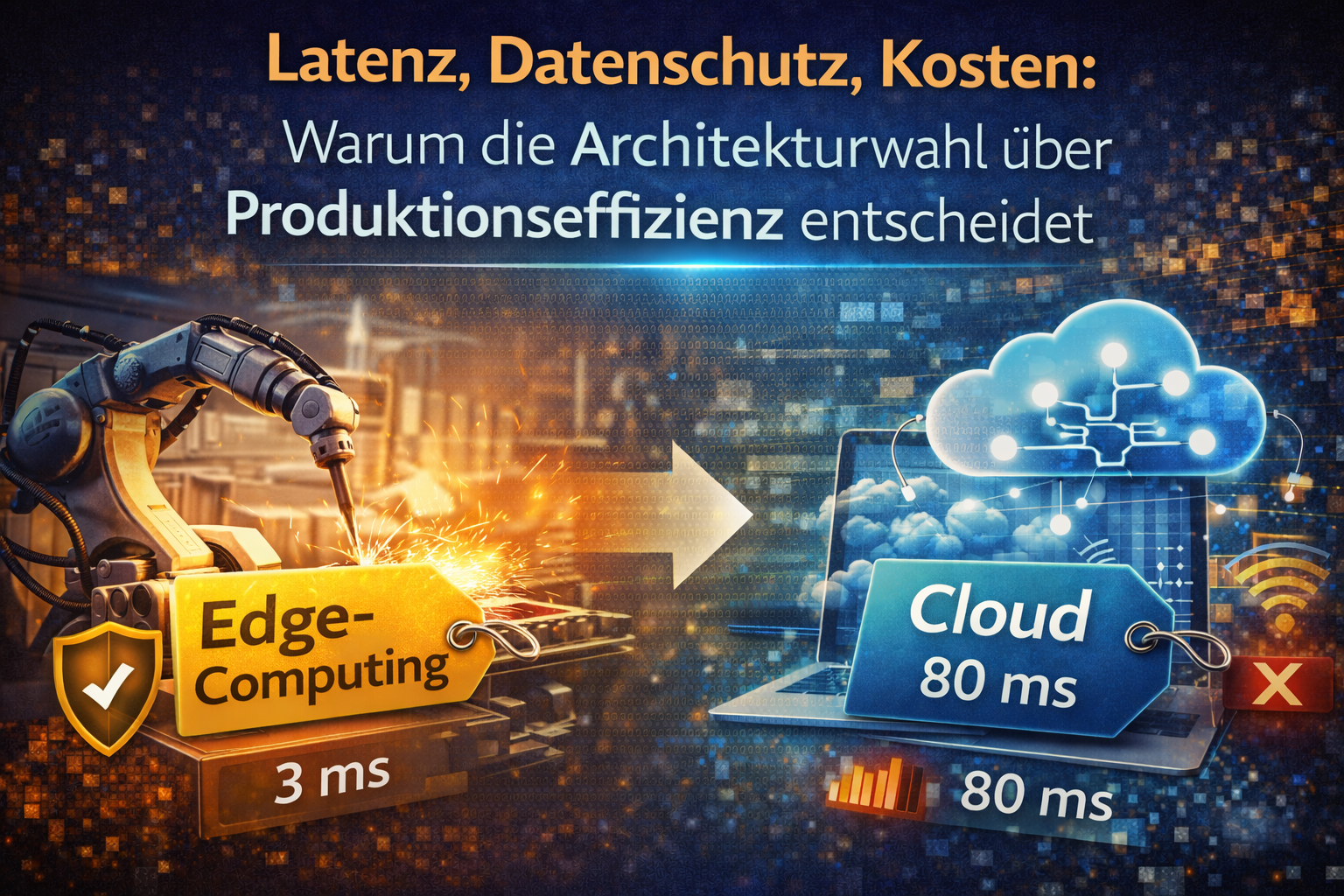
Latency, Data Privacy, Costs: Why the Choice of Architecture Determines Production Efficiency
Three milliseconds. That’s all the time quality control has in high-speed manufacturing to reject a defective component. Anyone trying to make that decision via a cloud connection with 80 to 120 milliseconds of latency will have long since let the component pass. This is precisely where the question arises: when is the use of edge computing preferable to a pure cloud solution for production data?
According to a market analysis by Verified Market Research, the market for edge computing devices was valued at $6.72 billion in 2022 and is projected to reach $19.45 billion by 2030—with an annual growth rate of 15%. This growth is primarily driven by the manufacturing industry, which requires real-time processing directly on the production line.
In this practical comparison, you’ll learn which specific scenarios make edge computing the right choice, where the cloud shines, and how to choose the right architecture for your industrial data management.
Which real-time scenarios make edge computing the better choice for production data?
Edge computing refers to data processing directly at the source—that is, at the machine, sensor, or robotic arm. Instead of sending raw data over the network to a remote data center, it is analyzed locally, and only aggregated results are transmitted to the cloud.
Predictive maintenance with real-time sensor data
Predictive maintenance requires the continuous evaluation of vibration, temperature, and pressure sensors. Historical machine data can be effectively utilized when a local edge device compares patterns in real time with trained models. This allows you to identify impending production bottlenecks through intelligent analysis of sensor data before a failure occurs. The cloud would cause a delay of seconds to minutes here—which is unacceptable in a production line with cycle times of less than a second.
OEE Calculation Directly on the Production Line
Overall Equipment Effectiveness (OEE) consists of three key metrics: availability, performance, and quality. For real-time calculation, structured data on machine status, production volumes, and scrap rates is essential. Edge servers process these data streams locally and deliver up-to-date OEE values without relying on the network. According to an analysis of the edge server hardware market, local processing enables more precise control and faster responses in manufacturing environments.
Why do pure cloud architectures fail when dealing with heterogeneous machine data in manufacturing?
Pure cloud solutions face three specific problems in manufacturing:
A typical production line generates between 1 and 5 GB of data per machine daily. With 50 machines, that amounts to up to 250 GB—every day.
Breaking down data silos between the shop floor and ERP
Isolated data silos between the shop floor and ERP systems can be permanently eliminated when edge devices act as a translation layer. They normalize heterogeneous machine protocols—from OPC UA to MQTT to proprietary formats—into a unified data model. Google Cloud describes this approach with the Manufacturing Data Engine: an edge platform that supports over 270 automation protocols and converts machine data into understandable datasets.
At uNaice, we’re familiar with this challenge from the world of product data. Transforming unstructured supplier data from PDFs, Excel spreadsheets, and catalogs into clean master data requires exactly this kind of translation work. Our experience shows that without clear data governance for heterogeneous data sources, both edge and cloud projects are doomed to fail.
Network Outages and Offline Capability
A pure cloud solution makes your production dependent on an internet connection. Edge computing enables autonomous continued operation even during network outages. Critical control decisions—such as shutting down an overheated system—are made locally in under 10 milliseconds. The cloud then serves as long-term storage and an overarching analytics platform.
Edge Computing for Production Data vs. the Cloud: A Decision Matrix for Production Managers
The question of when edge computing for production data is preferable to a pure cloud solution can be answered using five criteria:
Interface Concepts for Real-Time Integration of Supplier Data
API-based interfaces with edge gateways are suitable for the real-time integration of external supplier data. These receive supplier data, validate it locally, and forward only quality-checked information to the central system. This protects sensitive production data during data exchange with suppliers, as raw data does not leave the local network.
At uNaice, we rely on ontologies instead of rigid tables. These knowledge graphs make it possible to understand data logically—not just store it. The result: automated cleansing of inconsistent master data that would take weeks to resolve manually. Companies like adidas, TUI, and Otto are already using this approach for millions of data records.
Hybrid Architecture: How Edge and Cloud Work Together to Enable the Digital Twin
A comprehensive digital twin of the supply chain requires both local real-time data and global aggregation. The architectural requirements include an edge layer for data capture and preprocessing, a secure transmission layer, and a cloud platform for cross-system analytics.
Linking MES and Supply Chain Data
Many industrial companies struggle to link MES and supply chain data because both systems use different data models and cycle times. Edge computing solves this problem by preprocessing MES data in real time and transforming it into a cloud-compatible format. Unstructured logistics data can thus be integrated into existing supply chain monitoring.
Strategic responsibility for the quality of process data should not rest solely with IT. We recommend establishing a joint Data Governance Board comprising representatives from production, IT, and Supply Chain Management. This is the only way to create a reliable quality pipeline that delivers consistent data from the sensor all the way to the executive board report.
Cloud Architectures for Global Supply Chain Data
Multi-region cloud architectures with edge caching are well-suited for the highly available scaling of global supply chain data. According to industry analyses, the market for edge AI computing platforms is growing at a CAGR of 21.4% and is expected to reach approximately $8.5 billion by 2030. This trend shows that the future lies not in edge or cloud, but in the intelligent combination of both approaches.
Traceability and Data Protection: When Edge Computing Becomes the Only Option for Production Data
Seamless traceability of installed components requires a data management strategy that documents every manufacturing step. Edge devices capture batch numbers, process parameters, and quality data directly on the production line and store them in a tamper-proof manner.
When it comes to protecting sensitive production data, edge computing offers a key advantage: data never leaves the production site. This is particularly important when you exchange data with external suppliers. Local processing minimizes the risk of data breaches—an aspect that the GDPR also recognizes.
uNaice takes the same approach: Our solutions are “Made in Germany,” GDPR-compliant, and process your data with 99% AI automation. The Validation Station ensures 100% accuracy—without requiring you to hire new staff, even if your data volume grows from 10,000 to 5 million records.
Conclusion: The right architecture depends on your latency requirements
When is edge computing preferable to a pure cloud solution for production data? Whenever real-time decisions, offline capability, or data protection are critical. For cross-location analyses and long-term evaluations, the cloud remains the better choice. The most robust architecture combines both approaches into a hybrid solution.
The quality of your production data is crucial. Without clean master data, consistent data models, and clear data governance, neither the edge nor the cloud can deliver usable results. This is exactly where uNaice comes in: We eliminate the “human bottleneck” in data maintenance and transform your data assets into actionable insights—fully automatically and at no cost per SKU. Schedule a free demo with 100 of your own data records and experience the difference.
Frequently Asked Questions
Ready for the next step?
Contact us for a no-obligation consultation about your data project.
Contact us nowSources