%20--%3e%3cdefs%3e%3cstyle%3e%20.st0%20{%20fill:%20%23a5d028;%20}%20.st1%20{%20fill:%20%23fff;%20}%20.st2%20{%20fill:%20%231de2db;%20}%20.st3%20{%20fill:%20%2341bdf9;%20}%20%3c/style%3e%3c/defs%3e%3cg%20id='logo-unaice-line'%3e%3cpath%20class='st1'%20d='M143.3,36.1c-1.2,0-2.1-.9-2.1-2.1V12.2c0-1.2.9-2.1,2.1-2.1s2.1.9,2.1,2.1v21.8c0,1.2-.9,2.1-2.1,2.1ZM143.2,6.2c-1.3,0-2.4-1-2.4-2.4v-.8c0-1.3,1-2.4,2.4-2.4s2.4,1.1,2.4,2.4v.8c0,1.3-1.1,2.4-2.4,2.4Z'/%3e%3cpath%20class='st3'%20d='M23.7,36.1H2c-.5,0-1-.4-1-1V2.3c0-.5.4-1,1-1h21.7c.5,0,1,.4,1,1v32.9c0,.5-.4,1-1,1'/%3e%3cpath%20class='st2'%20d='M41.8,36.1h-14.4c-.5,0-1-.4-1-1v-14.5c0-.5.4-1,1-1h14.4c.5,0,1,.4,1,1v14.5c0,.5-.4,1-1,1'/%3e%3cpath%20class='st0'%20d='M41.8,17.9h-14.4c-.5,0-1-.4-1-1V2.2c0-.5.4-1,1-1h14.4c.5,0,1,.4,1,1v14.7c0,.5-.4,1-1,1'/%3e%3c/g%3e%3cpath%20class='st1'%20d='M196.4,29.2c-2.1,2.1-3.6,3.2-7.1,3.2s-7.4-2.3-8.2-7.4h16.7c2.7,0,2.9-1.9,2.7-4-.7-6.2-5.3-11.2-11.6-11.2s-12.3,5.1-12.3,13.4,5.4,13.3,12.6,13.3,8.3-2.6,10-4.3c1.8-2.1-1.2-4.7-2.8-3ZM188.9,13.7c4.7,0,7.3,4.1,7.6,7.3h-15.3c.7-4.3,3.4-7.3,7.7-7.3Z'/%3e%3cpath%20class='st1'%20d='M132.1,12.9c-1.9-1.9-5.4-2.9-8.2-2.9s-5.3.5-8.2,1.8c-2.4,1-.9,5,1.6,3.7,2.1-1,3.3-1.5,6.3-1.5s6.7,1.1,6.8,6.1c-1.8-.5-2.7-.8-6.9-.8-6.8,0-11.3,3.3-11.3,8.8s4.1,8.4,10.1,8.4,5.4-.6,8.3-2.9v.5c0,2.8,4.2,2.6,4.2,0v-13.8c0-3.1-.8-5.5-2.7-7.4ZM130.4,26.2c0,3.6-3.4,6.3-8,6.3s-5.9-1.7-5.9-4.6,2.5-4.6,6.8-4.6c0,0,4.8,0,7.1,1v1.9Z'/%3e%3cpath%20class='st1'%20d='M80,36.1c-1.2,0-2.1-.9-2.1-2.1V3.4c0-1.2,1-2.2,2.2-2.2h.4c.8,0,1.4.4,2,1.1l20.2,25.7V3.4c0-1.2.9-2.1,2.1-2.1s2.1.9,2.1,2.1v30.7c0,1.1-.5,2-1.9,2s-1.9-.8-2.2-1.2l-20.7-26.2v25.3c0,1.2-.9,2.1-2.1,2.1Z'/%3e%3cpath%20class='st1'%20d='M60.2,36.5c-5.1,0-10.5-4.3-10.5-10.7v-13.5c0-1.2.9-2.1,2.1-2.1s2.1.9,2.1,2.1v13.1c0,4.5,2.5,7.1,6.6,7.1s7.3-3.2,7.3-7.5v-12.7c0-1.2.9-2.1,2.1-2.1s2.1.9,2.1,2.1v21.8c0,2.8-4.2,2.7-4.2,0v-.5c-1.5,1.6-3.3,2.9-7.6,2.9Z'/%3e%3cpath%20class='st1'%20d='M163.8,36.5c-7.1,0-13.1-6-13.1-13.3s4.8-13.5,13.5-13.5c4.4,0,6.9,2,8.8,3.7,1.8,1.5-.8,5.1-2.8,3.3-.8-.8-3.3-3-6.4-3-4.8,0-8.6,4-8.6,9.2s3.8,9.3,8.6,9.4c3.7,0,4.9-1,7-3.1,1.6-1.8,4.6,1,3,2.8-3,3-5.7,4.5-10,4.5h0Z'/%3e%3c/svg%3e)
Imagine this: You invest a lot of money in a new e-commerce platform. Yet your visibility on Google suddenly drops. You have great products and fast loading times. Still, your most important pages no longer rank. Here at uNaice, we see this problem almost every day.
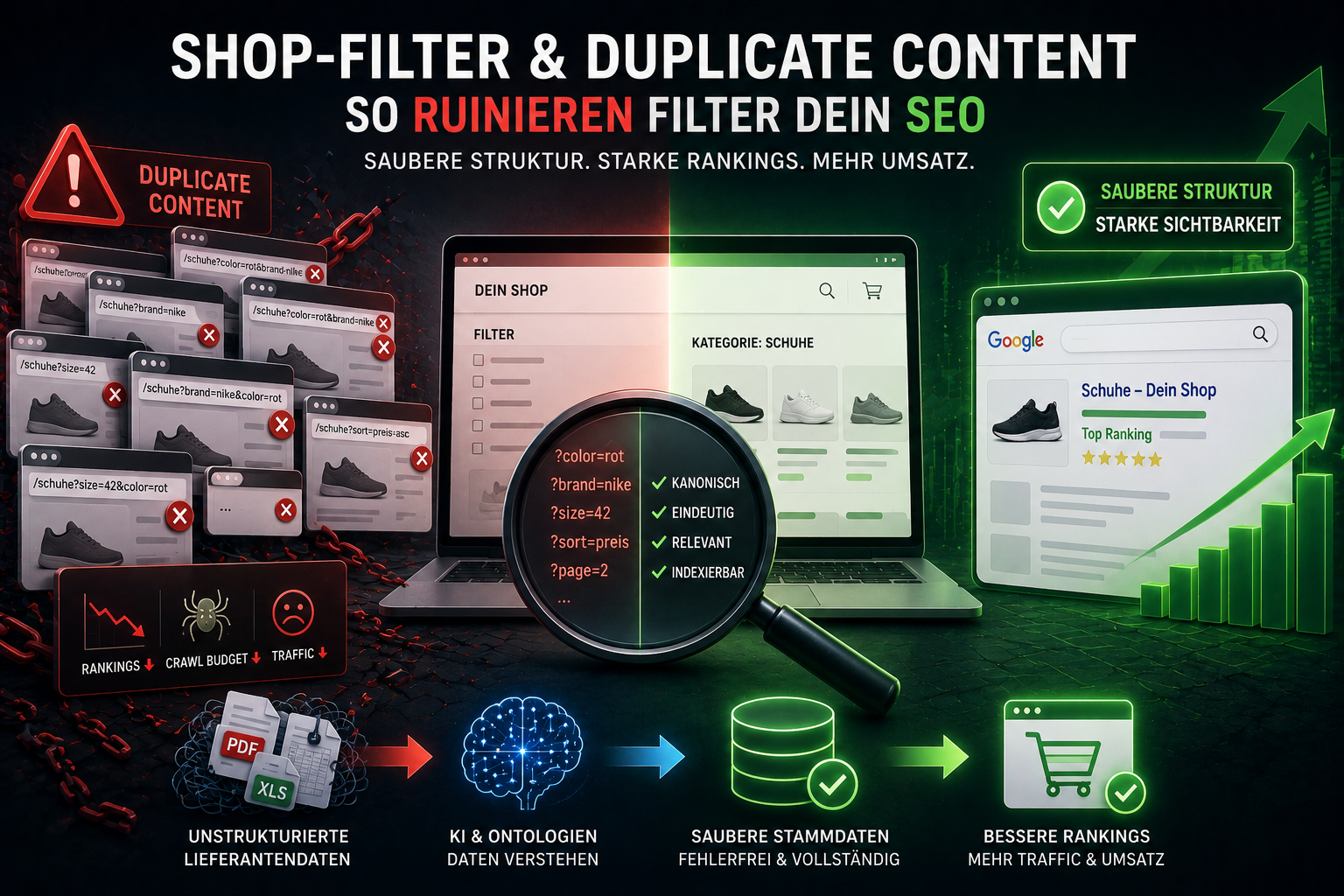
The invisible enemy is often hiding in the navigation. Many site owners underestimate a major risk. They don’t realize how shop filters ruin their SEO through Duplicate Content. This often seems like a minor technical detail. But it quickly grows into a massive problem.
Do you want to optimize your product data, improve your online store’s rankings, and generate more traffic? Then you need to understand the architecture of your filters. We’ll show you specific strategies from our work with market leaders like Otto. This is how you ensure long-term data quality.
What Is Duplicate Content in E-Commerce?
Duplicate content refers to identical or very similar text content that can be accessed via multiple different URLs within a website. Search engines like Google have a major problem with this. According to analyses by Feller Systems (2025), Google often doesn’t know which version should appear in the search results. In online stores, this problem usually arises due to the technical architecture.
Unlike an actual Google penalty, duplicate content is primarily an efficiency issue. A study by Weventure (2025) provides clear figures: Each duplicate page reduces performance by up to 30 percent. Users find the website confusing. This leads to higher bounce rates.
You need to understand the technical implications thoroughly. This is the only way to prevent shop filters from ruining your SEO due to duplicate content. The most significant consequences are:
Why shop filters can ruin your SEO due to duplicate content
Optimizing shop filters enables search engines to index important categories without errors. Without this control, systems generate massive amounts of redundant URLs. If you don’t pay attention here, you’ll quickly fall behind the competition. The impact on your visibility is severe.
You often don’t immediately realize how shop filters are ruining your SEO due to duplicate content. The problems only become apparent in technical metrics. According to current data, affected shops lose up to 40 percent of their organic traffic. Google classifies the entire domain as less relevant.
Watch out for these three warning signs:
The core problem when shop filters ruin your SEO through duplicate content
Keyword cannibalization refers to direct competition between your own URLs for the same ranking positions in search engines. Link power, keywords, and user signals are distributed across different variants. This is confirmed by experts at Weventure (2025). They no longer support a single, strong page. The result: You aren’t truly well-represented with any version.
A study by Experics (2025) reveals dramatic consequences. Small online stores, in particular, suffer immediate ranking drops of up to 50 percent. For highly competitive search terms, this makes the difference between page 1 and page 3 on Google.
This is a classic real-world example. It shows exactly how shop filters ruin your SEO through duplicate content. You often don’t even notice it in your day-to-day operations.
Diluted Crawl Budget Due to Redundant URLs
The Crawl Budget refers to the limited number of pages a search engine analyzes on a website per day. Duplicate content wastes this valuable time. Crawlers then end up searching only useless filter pages. Weventure (2025) warns: As a result, important content is often indexed weeks later.
A crawler often has to check over 10,000 irrelevant filter combinations. This drastically reduces the efficiency of your entire website. We therefore advise our clients to implement strict controls. This is the only way to prevent shop filters from ruining your SEO due to duplicate content.
A clean structure helps guide the crawler. It then uses its resources efficiently to focus on your top-selling products.
The most important measures include:
How Shop Filters Ruin Your SEO with Duplicate Content: The Technical Causes
A dynamic shop system consists of databases and filters that automatically generate thousands of URL combinations. Online stores are particularly susceptible to this phenomenon due to their large number of products. Without a clear structure, over 5,000 nearly identical pages can quickly accumulate.
These pages differ very little in content. The search engine sees no added value in these duplicates. It penalizes the domain with lower rankings.
The most common technical causes are:
Product Variants and Faceted Search as Drivers
A faceted search allows users to combine multiple filter attributes—such as size, color, and brand—in a single search query. Users love this feature. For search engines, however, it is highly critical. A real-world example from Weventure (2025) illustrates the problem with a sneaker store.
The selection generates two URLs: “/sneaker?color=red&brand=nike” and “/sneaker?brand=nike&color=red”. Both pages are 100 percent identical. To Google, however, they look like two completely different URLs. If you don’t intervene here, your system demonstrates how store filters can ruin your SEO through duplicate content.
Product variants are often created as separate URLs. A T-shirt available in 5 colors generates 5 pages. However, the text changes only minimally. This creates what is known as “near duplicate content.”
Sorting Options and Pagination in Categories
Pagination refers to the division of long category pages into several numbered subpages. Sorting functions such as “Price ascending” are also dangerous. Each of these options generates a new URL. It displays exactly the same products, just in a different order.
Feller Systems (2025) highlights the consequences. This leads to a massive dilution of rankings by up to 60 percent. Pages 1, 2, and 3 of a category also confuse the Google bot. They have nearly identical meta titles and description text.
Want to understand how store filters ruin your SEO with duplicate content? Then you need to check these dynamic pages. Be sure to include them in your technical analysis!
Optimizing Product Data for Your Online Store: The Solution to Duplicate Content
Systematic data preparation enables a clear information architecture without redundant filter URLs. If you want to solve the problem permanently, you have to go back to basics. When it comes to optimizing product data for online store systems, you need to structure everything cleanly from the ground up.
Incomplete supplier data is often the main cause of the chaos. It generates incorrect or duplicate filter pages. At uNaice, we know that manually maintaining thousands of items is extremely time-consuming. It is the absolute bottleneck in e-commerce.
When you optimize your product data, streamline your online store filters, and refine your categories, you come out ahead. You’re laying the foundation for error-free quality. With our technology, you can save up to 75 percent of manual labor time.
The Role of Ontologies and Clean Master Data
Unlike rigid tables, an ontology organizes product data as a logical, machine-readable network of relationships. We use this advanced AI method to ensure your success. It enables natural search queries and error-free automated text. Our technology doesn’t just cobble together text blocks. It understands the true relationships between your products.
Use an ontology! By optimizing your product data, building online store structures, and separating attributes, you prevent redundant pages. We normalize units and automatically correct typos. We supplement missing attributes using external sources.
uNaice transforms unstructured raw data into perfect datasets. The system scales effortlessly. It works just as well for 10,000 records as it does for 5 million.
Automation with uNaice's DataNaicer
The DataNaicer consists of an AI-powered pipeline for extracting, normalizing, and enriching unstructured raw data. This solution frees you from slow manual work. A key advantage for you: uNaice does not charge per item. We offer a predictable flat rate.
We combine 99 percent AI automation with our Validation Station. This allows us to guarantee 100 percent accuracy. Put an end to frustrating Excel battles within your team.
If you optimize your product data, generate online store copy, and manage filters in this way, the problem will disappear. You no longer have to worry about store filters ruining your SEO due to duplicate content.
Strategies for Avoiding Ranking Losses
A clean indexing strategy allows you to direct search engine crawlers to relevant category pages. It prevents dynamic search results from entering the Google index. In addition to clean data from DataNaicer, you need technical guidelines.
Experics (2025) recommends regular content audits. Check your store at least every 3 months. Clean up duplicate content immediately. This is the only way to stop this dangerous process. Otherwise, you’ll see how store filters ruin your SEO due to duplicate content.
The most important strategies include:
Avoid pitfalls so that store filters don’t ruin your SEO with duplicate content
Consistent parameter control allows you to reduce indexable URLs by up to 90 percent. You need to set clear rules for Google. Indicate which filters are important (e.g., “Red Sneakers”). Also define which ones should be ignored (e.g., “Red Sneakers Size 42 Price Ascending”).
If you make mistakes here, your traffic will drop drastically. uNaice develops custom filter architectures for you. These are perfectly tailored to your specific shop system.
Feel free to contact us. We’ll work with you to analyze your current situation. We’ll identify potential risks and secure your master data.
Using Canonical Tags and robots.txt Correctly
A Canonical tag is an HTML element used to direct search engines to a page’s preferred original URL. It consolidates valuable link equity. For example: You offer a product in three colors. Only the main variant should be indexed. The others use a Canonical tag to point to the original.
This is your most effective technical tool. It prevents shop filters from ruining your SEO due to duplicate content. Additionally, you should use robots.txt. This allows you to block the crawling of certain filter parameters from the start.
Disabling sorting options can save up to 40 percent of your crawl budget. The combination of technical SEO and uNaice data processing is ideal. It creates the perfect synergy for maximum visibility.
Conclusion
Duplicate content caused by store filters is a creeping process that systematically destroys hard-earned Google rankings. Faceted searches, sorting options, and product variants generate massive amounts of redundant URLs. This significantly dilutes your crawl budget. The solution lies not only in technical tags.
The key to success is the quality of your base data. If you professionally optimize your product data, clean up your online store structures, and rely on AI, you win. You make your data capital efficiently usable and increase your revenue by up to 25 percent.
Don’t leave your visibility to chance. Release the handbrake on your e-commerce. Schedule your free 100-data-record trial. We’ll show you in a potential analysis how we’ll perfect your master data.
Frequently Asked Questions (FAQ)
Ready for the next step?
Contact us for a no-obligation consultation about your data project.
Contact us nowSources