%20--%3e%3cdefs%3e%3cstyle%3e%20.st0%20{%20fill:%20%23a5d028;%20}%20.st1%20{%20fill:%20%23fff;%20}%20.st2%20{%20fill:%20%231de2db;%20}%20.st3%20{%20fill:%20%2341bdf9;%20}%20%3c/style%3e%3c/defs%3e%3cg%20id='logo-unaice-line'%3e%3cpath%20class='st1'%20d='M143.3,36.1c-1.2,0-2.1-.9-2.1-2.1V12.2c0-1.2.9-2.1,2.1-2.1s2.1.9,2.1,2.1v21.8c0,1.2-.9,2.1-2.1,2.1ZM143.2,6.2c-1.3,0-2.4-1-2.4-2.4v-.8c0-1.3,1-2.4,2.4-2.4s2.4,1.1,2.4,2.4v.8c0,1.3-1.1,2.4-2.4,2.4Z'/%3e%3cpath%20class='st3'%20d='M23.7,36.1H2c-.5,0-1-.4-1-1V2.3c0-.5.4-1,1-1h21.7c.5,0,1,.4,1,1v32.9c0,.5-.4,1-1,1'/%3e%3cpath%20class='st2'%20d='M41.8,36.1h-14.4c-.5,0-1-.4-1-1v-14.5c0-.5.4-1,1-1h14.4c.5,0,1,.4,1,1v14.5c0,.5-.4,1-1,1'/%3e%3cpath%20class='st0'%20d='M41.8,17.9h-14.4c-.5,0-1-.4-1-1V2.2c0-.5.4-1,1-1h14.4c.5,0,1,.4,1,1v14.7c0,.5-.4,1-1,1'/%3e%3c/g%3e%3cpath%20class='st1'%20d='M196.4,29.2c-2.1,2.1-3.6,3.2-7.1,3.2s-7.4-2.3-8.2-7.4h16.7c2.7,0,2.9-1.9,2.7-4-.7-6.2-5.3-11.2-11.6-11.2s-12.3,5.1-12.3,13.4,5.4,13.3,12.6,13.3,8.3-2.6,10-4.3c1.8-2.1-1.2-4.7-2.8-3ZM188.9,13.7c4.7,0,7.3,4.1,7.6,7.3h-15.3c.7-4.3,3.4-7.3,7.7-7.3Z'/%3e%3cpath%20class='st1'%20d='M132.1,12.9c-1.9-1.9-5.4-2.9-8.2-2.9s-5.3.5-8.2,1.8c-2.4,1-.9,5,1.6,3.7,2.1-1,3.3-1.5,6.3-1.5s6.7,1.1,6.8,6.1c-1.8-.5-2.7-.8-6.9-.8-6.8,0-11.3,3.3-11.3,8.8s4.1,8.4,10.1,8.4,5.4-.6,8.3-2.9v.5c0,2.8,4.2,2.6,4.2,0v-13.8c0-3.1-.8-5.5-2.7-7.4ZM130.4,26.2c0,3.6-3.4,6.3-8,6.3s-5.9-1.7-5.9-4.6,2.5-4.6,6.8-4.6c0,0,4.8,0,7.1,1v1.9Z'/%3e%3cpath%20class='st1'%20d='M80,36.1c-1.2,0-2.1-.9-2.1-2.1V3.4c0-1.2,1-2.2,2.2-2.2h.4c.8,0,1.4.4,2,1.1l20.2,25.7V3.4c0-1.2.9-2.1,2.1-2.1s2.1.9,2.1,2.1v30.7c0,1.1-.5,2-1.9,2s-1.9-.8-2.2-1.2l-20.7-26.2v25.3c0,1.2-.9,2.1-2.1,2.1Z'/%3e%3cpath%20class='st1'%20d='M60.2,36.5c-5.1,0-10.5-4.3-10.5-10.7v-13.5c0-1.2.9-2.1,2.1-2.1s2.1.9,2.1,2.1v13.1c0,4.5,2.5,7.1,6.6,7.1s7.3-3.2,7.3-7.5v-12.7c0-1.2.9-2.1,2.1-2.1s2.1.9,2.1,2.1v21.8c0,2.8-4.2,2.7-4.2,0v-.5c-1.5,1.6-3.3,2.9-7.6,2.9Z'/%3e%3cpath%20class='st1'%20d='M163.8,36.5c-7.1,0-13.1-6-13.1-13.3s4.8-13.5,13.5-13.5c4.4,0,6.9,2,8.8,3.7,1.8,1.5-.8,5.1-2.8,3.3-.8-.8-3.3-3-6.4-3-4.8,0-8.6,4-8.6,9.2s3.8,9.3,8.6,9.4c3.7,0,4.9-1,7-3.1,1.6-1.8,4.6,1,3,2.8-3,3-5.7,4.5-10,4.5h0Z'/%3e%3c/svg%3e)
Why traditional PR Processes are Reaching their Limits in the Industrial Sector
Three press releases per quarter, a neglected blog, and a LinkedIn profile that’s been gathering dust for months—this is the reality at many industrial companies. Not because there’s a lack of topics, but because the “human bottleneck” dictates the pace. According to the B2B social media study by the Erster Arbeitskreises Social Media in der B2B-Kommunikation (First Working Group on Social Media in B2B Communication), around 76 percent of the companies surveyed already use AI-based tools for text generation. So the question is no longer whether automated B2B industrial PR makes sense, but which tools are actually suitable for the job.
This article shows you, as a communications manager or PR professional, what tool categories are available, what you need to look for when making a selection, and how a fully automated editorial workflow works in practice—including quality assurance, corporate language control, and multichannel distribution.
Which tool categories fully cover automated B2B industry PR?
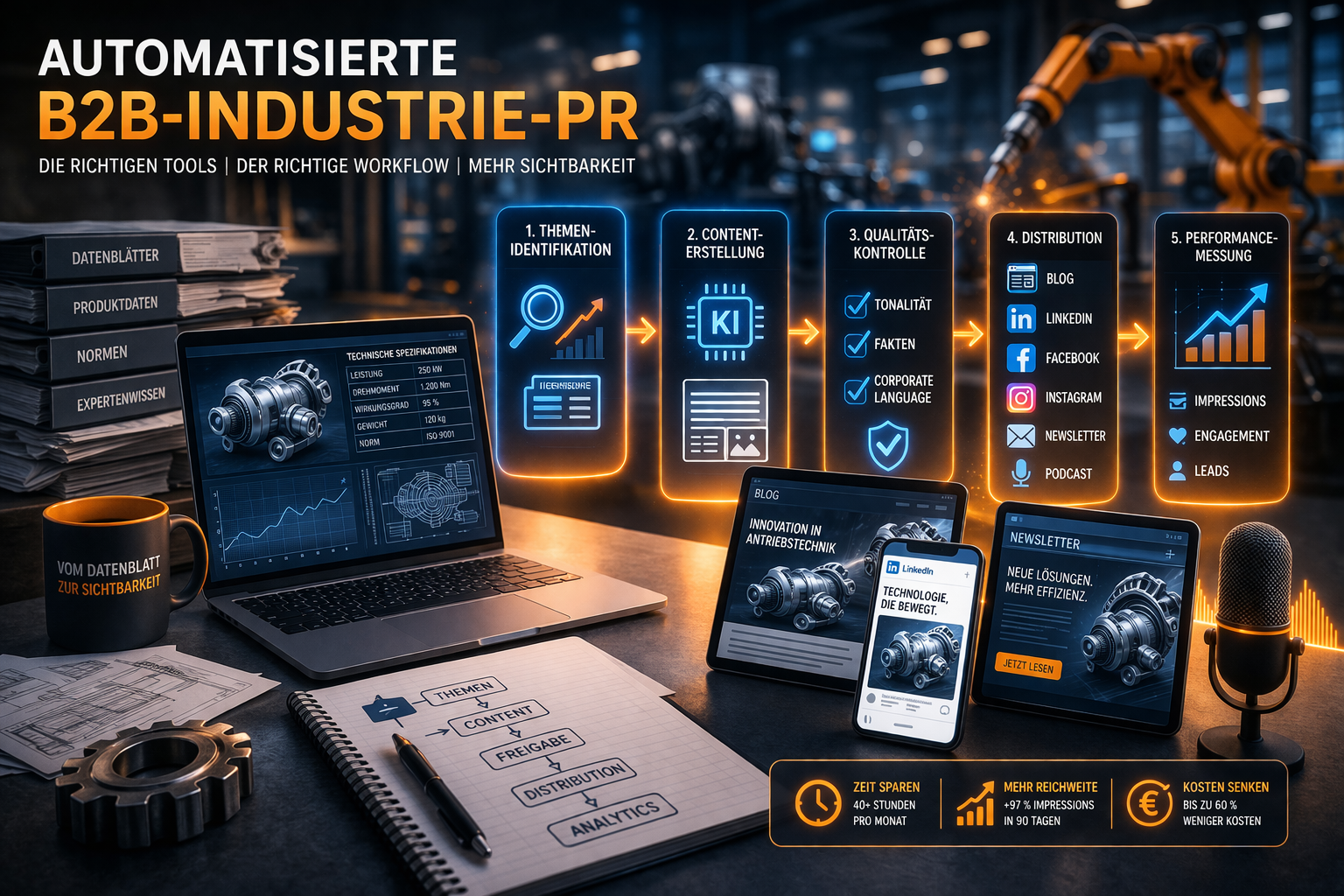
Automated B2B industry PR encompasses five functional areas:
No single standard tool covers all areas. As a result, in practice, organizations either end up with tool stacks made up of individual solutions or integrated platforms that bundle the entire workflow.
Standalone Solutions vs. Integrated Platforms
Unlike standalone solutions such as separate social media planners, AI text generators, and monitoring tools, integrated platforms offer a seamless workflow without media breaks. Standalone solutions require manual handoffs between systems. This takes time and creates opportunities for errors. Integrated systems combine topic research, content creation, approval, and publication into a single pipeline. According to Thunderbit, automation saves about 2.3 hours per campaign—with daily publishing, that adds up to over 40 hours per month.
An Overview of the Five Functional Areas
How do automated workflows translate complex product data into PR content tailored to specific audiences?
Content automation for industrial companies starts with the data source. Technical data sheets, CAD specifications, and references to standards form the raw material. AI systems extract the relevant key messages from this data and transform them into understandable technical texts for different target audiences—from purchasing managers to design engineers.
At uNaice, we’ve systematized this process across more than 80 projects. The key to success is separating expert input from content output. In a one-time video interview lasting 15 to 20 minutes, our computational linguists capture your core topics and brand voice. The team then invests 30 to 40 hours in configuring your personal News Stream, which subsequently produces expert content on its own.
From Data Sheet to Multichannel Campaign
The transformation of technical product data into PR texts takes place in three steps:
A single data sheet can provide content for a blog post, three Social Media posts, a newsletter teaser, and a podcast episode. Our experience at uNaice shows that marketing teams can achieve an increase in impressions of approximately 97 percent within the first 90 days.
What quality controls ensure tone and corporate language in automated industrial PR?
uNaice checks AI-generated technical content on three levels: linguistic consistency, technical accuracy, and brand-appropriate tone. Without these mechanisms, industrial companies risk reputational damage due to incorrect technical statements or generic-sounding content.
System instructions for different target audiences
Specific system instructions define tone, technical vocabulary, and complexity level for each target audience. Different linguistic parameters apply to engineers than to buyers or CEOs. At uNaice, computational linguists configure these profiles individually. In a quality review meeting, you work together to fine-tune the first 40 drafts—you only pay once the quality meets your standards.
Automated Corporate Language Check
Automated corporate language check includes terminology databases, style guidelines, and blacklists for undesirable phrasing. These rules are stored within the system and applied every time text is generated. A common mistake we see in projects: Companies rely on manually crafting prompts in ChatGPT instead of using system-level automation that bundles SEO keywords, CI-compliant AI images, and distribution into a single workflow.
If you’d like to know what such an automated quality process might look like for your company, we’d be happy to show you the fully automated editorial plan for your field in a free setup consultation.
When is it worth switching from manual editing to AI-driven content orchestration?
AI-driven content orchestration is used when manual processes reduce the publication rate to fewer than three posts per week. According to Thunderbit, companies using marketing automation generate 80 percent more leads and achieve 77 percent higher conversion rates than companies without automation.
In our industry, we’re seeing a trend toward Automated Authority: Companies that provide daily updates on market trends, regulatory changes, or technological developments are gaining the Share of Mind. Algorithms like LinkedIn’s reward consistency over occasional brilliance. Daily presence across three to four channels with zero minutes of effort required for content creation—that is the essence of zero-work visibility, as enabled by the uNaice News Stream.
How can localization costs for global PR campaigns be reduced through automation?
Automated content workflows reduce localization costs by bundling translation, cultural adaptation, and local distribution into a single system. Instead of hiring external translation agencies for every single text, automation handles the base translation. Native-speaking proofreaders then review only the finer details. According to Thunderbit, nearly 70 percent of PPC experts already use AI-based solutions for dynamic, personalized content—including translation and localization.
For large corporations with PIM and CRM systems, seamless integration is crucial. Automated pipelines pull product data directly from the PIM, enrich it with market-specific information from the CRM, and generate localized PR content—without the need for manual data transfer.
What metrics demonstrate the ROI of automated PR to C-level executives?
ROI metrics for automated B2B industry PR encompass five key areas: publication frequency, reach, engagement, lead generation, and cost savings per content unit.
According to Thunderbit, every dollar invested in marketing automation yields an average return of $5.44. Companies that use automation increase their revenue by an average of 34 percent.
Reference clients of uNaice, such as SAC GmbH, demonstrate that dormant blogs can be transformed into vibrant knowledge platforms within a few months—with an increase in reached users of up to 170 percent.
Conclusion: How to Find the Right Tools for Automated B2B Industry PR
The question of which tools are suitable for automated B2B industry PR cannot be answered with a single software solution. What matters is a seamless workflow that seamlessly connects topic identification, content creation, quality assurance, and multichannel distribution. Integrated platforms like the uNaice News Stream solve the central problem: the “human bottleneck” in industry communication.
Visibility isn’t a creative problem—it’s a logistical one. If you want to maintain a daily presence across multiple channels, you need systems that automatically translate expert knowledge into brand-compliant content. Schedule a free setup consultation now to see your fully automated editorial calendar in action. We take the risk—you see the results before you pay.
Frequently Asked Questions
Agency alternative: content from €399/month — automated.
News Stream creates blog posts, social posts and newsletters for your field — AI-powered, human-reviewed, without agency fees. Start free with your website URL and see real posts in under 60 seconds.
Start free setupQuellen