%20--%3e%3cdefs%3e%3cstyle%3e%20.st0%20{%20fill:%20%23a5d028;%20}%20.st1%20{%20fill:%20%23fff;%20}%20.st2%20{%20fill:%20%231de2db;%20}%20.st3%20{%20fill:%20%2341bdf9;%20}%20%3c/style%3e%3c/defs%3e%3cg%20id='logo-unaice-line'%3e%3cpath%20class='st1'%20d='M143.3,36.1c-1.2,0-2.1-.9-2.1-2.1V12.2c0-1.2.9-2.1,2.1-2.1s2.1.9,2.1,2.1v21.8c0,1.2-.9,2.1-2.1,2.1ZM143.2,6.2c-1.3,0-2.4-1-2.4-2.4v-.8c0-1.3,1-2.4,2.4-2.4s2.4,1.1,2.4,2.4v.8c0,1.3-1.1,2.4-2.4,2.4Z'/%3e%3cpath%20class='st3'%20d='M23.7,36.1H2c-.5,0-1-.4-1-1V2.3c0-.5.4-1,1-1h21.7c.5,0,1,.4,1,1v32.9c0,.5-.4,1-1,1'/%3e%3cpath%20class='st2'%20d='M41.8,36.1h-14.4c-.5,0-1-.4-1-1v-14.5c0-.5.4-1,1-1h14.4c.5,0,1,.4,1,1v14.5c0,.5-.4,1-1,1'/%3e%3cpath%20class='st0'%20d='M41.8,17.9h-14.4c-.5,0-1-.4-1-1V2.2c0-.5.4-1,1-1h14.4c.5,0,1,.4,1,1v14.7c0,.5-.4,1-1,1'/%3e%3c/g%3e%3cpath%20class='st1'%20d='M196.4,29.2c-2.1,2.1-3.6,3.2-7.1,3.2s-7.4-2.3-8.2-7.4h16.7c2.7,0,2.9-1.9,2.7-4-.7-6.2-5.3-11.2-11.6-11.2s-12.3,5.1-12.3,13.4,5.4,13.3,12.6,13.3,8.3-2.6,10-4.3c1.8-2.1-1.2-4.7-2.8-3ZM188.9,13.7c4.7,0,7.3,4.1,7.6,7.3h-15.3c.7-4.3,3.4-7.3,7.7-7.3Z'/%3e%3cpath%20class='st1'%20d='M132.1,12.9c-1.9-1.9-5.4-2.9-8.2-2.9s-5.3.5-8.2,1.8c-2.4,1-.9,5,1.6,3.7,2.1-1,3.3-1.5,6.3-1.5s6.7,1.1,6.8,6.1c-1.8-.5-2.7-.8-6.9-.8-6.8,0-11.3,3.3-11.3,8.8s4.1,8.4,10.1,8.4,5.4-.6,8.3-2.9v.5c0,2.8,4.2,2.6,4.2,0v-13.8c0-3.1-.8-5.5-2.7-7.4ZM130.4,26.2c0,3.6-3.4,6.3-8,6.3s-5.9-1.7-5.9-4.6,2.5-4.6,6.8-4.6c0,0,4.8,0,7.1,1v1.9Z'/%3e%3cpath%20class='st1'%20d='M80,36.1c-1.2,0-2.1-.9-2.1-2.1V3.4c0-1.2,1-2.2,2.2-2.2h.4c.8,0,1.4.4,2,1.1l20.2,25.7V3.4c0-1.2.9-2.1,2.1-2.1s2.1.9,2.1,2.1v30.7c0,1.1-.5,2-1.9,2s-1.9-.8-2.2-1.2l-20.7-26.2v25.3c0,1.2-.9,2.1-2.1,2.1Z'/%3e%3cpath%20class='st1'%20d='M60.2,36.5c-5.1,0-10.5-4.3-10.5-10.7v-13.5c0-1.2.9-2.1,2.1-2.1s2.1.9,2.1,2.1v13.1c0,4.5,2.5,7.1,6.6,7.1s7.3-3.2,7.3-7.5v-12.7c0-1.2.9-2.1,2.1-2.1s2.1.9,2.1,2.1v21.8c0,2.8-4.2,2.7-4.2,0v-.5c-1.5,1.6-3.3,2.9-7.6,2.9Z'/%3e%3cpath%20class='st1'%20d='M163.8,36.5c-7.1,0-13.1-6-13.1-13.3s4.8-13.5,13.5-13.5c4.4,0,6.9,2,8.8,3.7,1.8,1.5-.8,5.1-2.8,3.3-.8-.8-3.3-3-6.4-3-4.8,0-8.6,4-8.6,9.2s3.8,9.3,8.6,9.4c3.7,0,4.9-1,7-3.1,1.6-1.8,4.6,1,3,2.8-3,3-5.7,4.5-10,4.5h0Z'/%3e%3c/svg%3e)
Why Inconsistent Master Data Slows Down Materials Management
Three out of four digitalization projects in procurement fail not because of the software—but because of the underlying data quality. Material master data with inconsistent spellings, missing attributes, and orphaned duplicates create a silent domino effect: incorrect order quantities, excessive inventory levels, and manual corrections that keep teams busy for days.
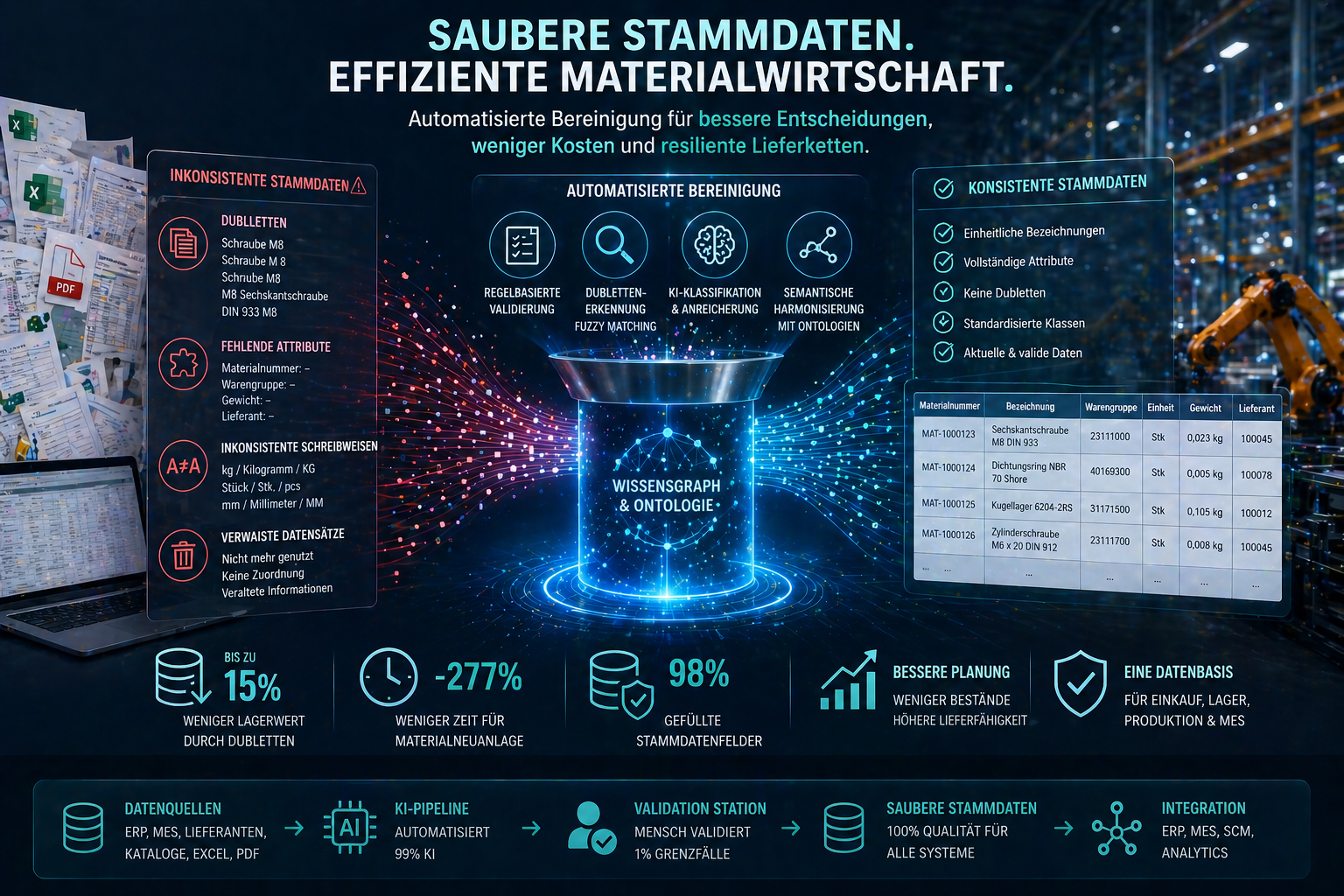
According to an analysis by the AI Training Center , duplicates in master data cost companies up to 15% of their inventory value. At the same time, real-world experience at companies like ElringKlinger shows that systematic cleansing can raise the rate of filled master data fields to nearly 98%. So the question isn’t whether, but how you can automatically clean up inconsistent master data in materials management.
This article shows you the most effective methods—from rule-based validation to ontology-driven AI—and explains how to build a sustainable quality pipeline for your industrial data management.
What specific methods help with the automated cleansing of inconsistent master data?
Automated master data cleansing encompasses four key methods: rule-based validation, duplicate detection, AI-supported classification, and semantic harmonization. Each of these methods addresses a specific data quality issue and only achieves its full potential when used in combination.
Rule-Based Validation and Normalization
Rule-based validation refers to the automatic checking of master data fields against predefined format specifications and value lists. Typical use cases include the normalization of units of measurement (e.g., “kg” vs. “kilogram”), the correction of typos in material descriptions, and the verification of mandatory field completeness.
SAP users can centrally define such rules using the Master Data Governance module. Validation rules ensure automatic checks for inconsistencies, as documented by Mind-Logistik in a process analysis.
Automated duplicate detection via Fuzzy Matching
Duplicate detection via fuzzy matching is a method in which algorithms identify similar—but not identical—data records based on text similarity, phonetic coding, and attribute comparisons. Instead of an exact match, the system recognizes that “Hewlett Packard,” “HP Inc.,” and “H.P.” refer to the same supplier.
Using this approach, ElringKlinger was able to identify duplicates that accounted for 7% of all material numbers—with an immediate reduction in corresponding inventory, as demonstrated by a SpareTech case study. Fuzzy matching typically combines Levenshtein distance, Jaro-Winkler similarity, and domain-specific rules.
AI-powered classification and data enrichment
AI-powered classification enables the automatic mapping of unstructured free-text descriptions to standardized product categories such as ECLASS or UNSPSC. According to an expert analysis by kiimeinkauf.de, AI algorithms detect duplicates, classify free-text orders, and standardize supplier names—tasks that would take weeks to complete manually.
At uNaice, we rely on ontologies rather than pure text pattern recognition. An ontology is a knowledge graph that logically maps materials, their properties, and their relationships to one another. Unlike “black-box AI,” the system understands that an “M8 hexagon head screw DIN 933” and a “screw, hexagon head, M8, fully threaded” describe the same component. This semantic data extraction is what distinguishes superficial text cleansing from true master data transformation.
Semantic Harmonization via Ontologies
Semantic harmonization refers to the process of converting data from different sources and formats into a uniform, meaningful structure. Instead of organizing data in rigid table fields, an ontology maps the logical relationships between materials, attributes, and suppliers.
Our experience at uNaice shows that simply cleaning up master data syntactically—that is, standardizing spellings—only solves half the problem. The other half stems from missing semantic links. If your system doesn’t understand that “NBR 70 Shore sealing ring” and “O-ring, nitrile rubber, hardness 70” are functionally identical, duplicates and incorrect orders will persist.
Why do manual data cleansing projects in materials management regularly fail?
Manual master data cleansing fails due to three structural problems: lack of scalability, the relapse effect, and loss of knowledge when staff changes. Data cleansing is only the first step—without automated quality assurance, duplicates and erroneous data find their way back into the system, as SpareTech documents in a process analysis.
The “human bottleneck” becomes a particular risk factor for companies with multiple plants and hundreds of material transactions per month. WEPA, for example, faced the challenge of keeping 150,000 data records consistent across various plants and 500 monthly material transactions—a volume that cannot be managed manually.
How do you establish a sustainable quality pipeline for master data in materials management?
A sustainable quality pipeline for master data consists of three pillars: automated ingestion checks, continuous lifecycle management, and clear data governance. One-time cleanup projects fizzle out if the material creation process does not include quality checks.
Automated Inbound Validation During Material Creation
Automated inbound validation during material creation prevents erroneous data records from entering the system in the first place. Every new material undergoes a live duplicate check, mandatory field validation, and automatic classification before it is released.
At uNaice, we combine 99% AI automation with a Validation Station to ensure 100% accuracy. This means: AI handles the heavy lifting—normalization, classification, enrichment—and a human validates only borderline cases. This synergy is crucial because pure AI systems reach their limits when dealing with ambiguous material descriptions.
Continuous Data Lifecycle Management
Data lifecycle management refers to the ongoing monitoring, updating, and cleansing of master data throughout its entire lifecycle. Unlike one-time cleansing, a lifecycle approach detects outdated records, discontinued materials, and creeping quality losses in real time.
The key components of effective lifecycle management include:
Defining Data Governance and Responsibilities
Data governance for master data defines who is responsible for the quality of which data fields, which sources are considered authoritative, and how conflicts between plants or departments are resolved. Without clear governance, inconsistencies arise even with the best automation—for example, when two plants create the same supplier under different names.
Who should bear strategic responsibility for process data quality in an industrial setting depends on the organizational structure. A central master data team that defines rules and manages automation has proven effective, while decentralized business units handle domain-specific validation.
How does automated master data cleansing scale from 10,000 to 5 million records?
Scalable master data cleansing requires an architecture that delivers consistent quality regardless of data volume—without the need to hire proportionally more staff. The decisive factor here is not computing power, but the quality of the underlying ontology and rule sets.
uNaice solves exactly this scalability problem: Our solution scales with your business from 10,000 to 5 million data records without requiring you to hire new staff for data maintenance. We don’t charge per SKU—instead, we use a flat-rate model that makes the ROI increasingly attractive as your data volume grows. Market leaders such as adidas, TUI, and OTTO rely on this approach to make efficient use of their data assets. Want to test the quality of your own data? Then get started with our free 100-data-record trial.
What role do interfaces between ERP, MES, and supplier systems play?
Interface concepts for the real-time integration of supplier data are essential to ensure that cleaned-up master data does not become inconsistent again at system boundaries. If your ERP maintains clean data but the supplier delivers via an Excel list with differing designations, the problem arises once more.
A central data hub from uNaice consolidates isolated data silos between the shop floor and the ERP system into a unified database. This hub receives data from MES, supplier portals, and sensors, automatically normalizes it, and sends the cleaned-up data back to all connected systems. This also enables the integration of MES and supply chain data—a challenge many companies struggle with.
For sensitive production data exchanged with suppliers, encrypted API connections with role-based access control are recommended. GDPR-compliant solutions—as guaranteed by uNaice as a “Made in Germany” provider—ensure that master data remains protected even when integrating external sources.
Conclusion: Automated Master Data Cleansing as a Strategic Lever
The automated cleansing of inconsistent master data in materials management is not a one-time IT project, but a continuous process. The most effective methods—rule-based validation, fuzzy matching duplicate detection, AI-supported classification, and semantic harmonization—only achieve their full potential when combined with clear data governance and a lifecycle management approach.
The key is to eliminate the “human bottleneck” in data maintenance and establish a
quality pipeline that scales with the volume of data. Companies that take this step reduce inventory costs, accelerate procurement processes, and lay the foundation for predictive maintenance, digital twins, and real-time OEE calculation.
Want to see how automated master data cleansing works with your own data? Book a free online demo with uNaice—or start right away with the 100-data-record test to evaluate the quality of our ontology-based solution on your material master data.
Frequently Asked Questions
Ready for the next step?
Contact us for a no-obligation consultation about your data project.
Contact us nowSources