%20--%3e%3cdefs%3e%3cstyle%3e%20.st0%20{%20fill:%20%23a5d028;%20}%20.st1%20{%20fill:%20%23fff;%20}%20.st2%20{%20fill:%20%231de2db;%20}%20.st3%20{%20fill:%20%2341bdf9;%20}%20%3c/style%3e%3c/defs%3e%3cg%20id='logo-unaice-line'%3e%3cpath%20class='st1'%20d='M143.3,36.1c-1.2,0-2.1-.9-2.1-2.1V12.2c0-1.2.9-2.1,2.1-2.1s2.1.9,2.1,2.1v21.8c0,1.2-.9,2.1-2.1,2.1ZM143.2,6.2c-1.3,0-2.4-1-2.4-2.4v-.8c0-1.3,1-2.4,2.4-2.4s2.4,1.1,2.4,2.4v.8c0,1.3-1.1,2.4-2.4,2.4Z'/%3e%3cpath%20class='st3'%20d='M23.7,36.1H2c-.5,0-1-.4-1-1V2.3c0-.5.4-1,1-1h21.7c.5,0,1,.4,1,1v32.9c0,.5-.4,1-1,1'/%3e%3cpath%20class='st2'%20d='M41.8,36.1h-14.4c-.5,0-1-.4-1-1v-14.5c0-.5.4-1,1-1h14.4c.5,0,1,.4,1,1v14.5c0,.5-.4,1-1,1'/%3e%3cpath%20class='st0'%20d='M41.8,17.9h-14.4c-.5,0-1-.4-1-1V2.2c0-.5.4-1,1-1h14.4c.5,0,1,.4,1,1v14.7c0,.5-.4,1-1,1'/%3e%3c/g%3e%3cpath%20class='st1'%20d='M196.4,29.2c-2.1,2.1-3.6,3.2-7.1,3.2s-7.4-2.3-8.2-7.4h16.7c2.7,0,2.9-1.9,2.7-4-.7-6.2-5.3-11.2-11.6-11.2s-12.3,5.1-12.3,13.4,5.4,13.3,12.6,13.3,8.3-2.6,10-4.3c1.8-2.1-1.2-4.7-2.8-3ZM188.9,13.7c4.7,0,7.3,4.1,7.6,7.3h-15.3c.7-4.3,3.4-7.3,7.7-7.3Z'/%3e%3cpath%20class='st1'%20d='M132.1,12.9c-1.9-1.9-5.4-2.9-8.2-2.9s-5.3.5-8.2,1.8c-2.4,1-.9,5,1.6,3.7,2.1-1,3.3-1.5,6.3-1.5s6.7,1.1,6.8,6.1c-1.8-.5-2.7-.8-6.9-.8-6.8,0-11.3,3.3-11.3,8.8s4.1,8.4,10.1,8.4,5.4-.6,8.3-2.9v.5c0,2.8,4.2,2.6,4.2,0v-13.8c0-3.1-.8-5.5-2.7-7.4ZM130.4,26.2c0,3.6-3.4,6.3-8,6.3s-5.9-1.7-5.9-4.6,2.5-4.6,6.8-4.6c0,0,4.8,0,7.1,1v1.9Z'/%3e%3cpath%20class='st1'%20d='M80,36.1c-1.2,0-2.1-.9-2.1-2.1V3.4c0-1.2,1-2.2,2.2-2.2h.4c.8,0,1.4.4,2,1.1l20.2,25.7V3.4c0-1.2.9-2.1,2.1-2.1s2.1.9,2.1,2.1v30.7c0,1.1-.5,2-1.9,2s-1.9-.8-2.2-1.2l-20.7-26.2v25.3c0,1.2-.9,2.1-2.1,2.1Z'/%3e%3cpath%20class='st1'%20d='M60.2,36.5c-5.1,0-10.5-4.3-10.5-10.7v-13.5c0-1.2.9-2.1,2.1-2.1s2.1.9,2.1,2.1v13.1c0,4.5,2.5,7.1,6.6,7.1s7.3-3.2,7.3-7.5v-12.7c0-1.2.9-2.1,2.1-2.1s2.1.9,2.1,2.1v21.8c0,2.8-4.2,2.7-4.2,0v-.5c-1.5,1.6-3.3,2.9-7.6,2.9Z'/%3e%3cpath%20class='st1'%20d='M163.8,36.5c-7.1,0-13.1-6-13.1-13.3s4.8-13.5,13.5-13.5c4.4,0,6.9,2,8.8,3.7,1.8,1.5-.8,5.1-2.8,3.3-.8-.8-3.3-3-6.4-3-4.8,0-8.6,4-8.6,9.2s3.8,9.3,8.6,9.4c3.7,0,4.9-1,7-3.1,1.6-1.8,4.6,1,3,2.8-3,3-5.7,4.5-10,4.5h0Z'/%3e%3c/svg%3e)
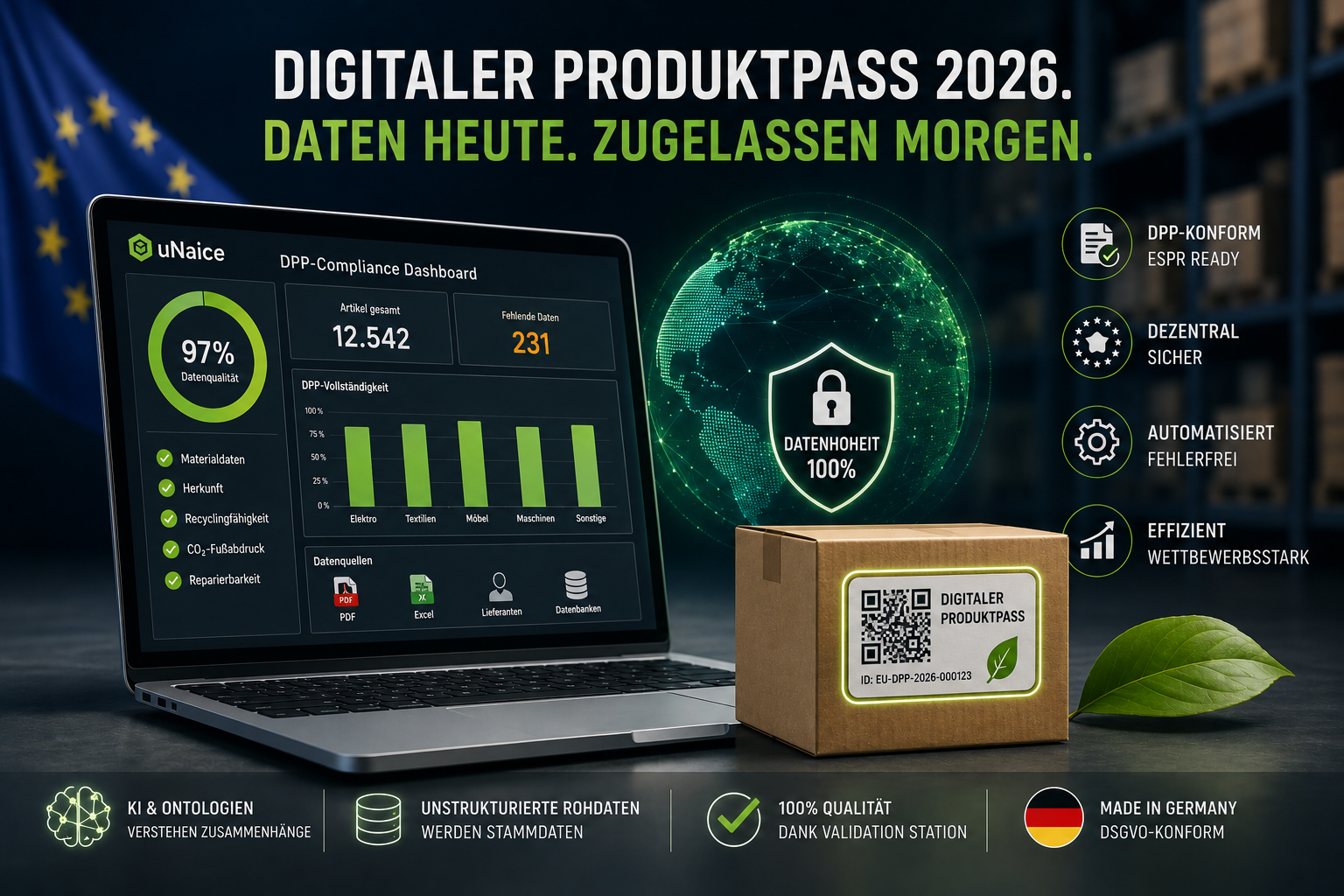
Imagine opening your dashboard and seeing thousands of products that will have to be taken off the market without warning starting in 2026. This is exactly the scenario many online retailers face due to the EU’s new Ecodesign Regulation (ESPR). Most companies invest heavily in modern PIM systems, but in practice they struggle with incomplete supplier data and tedious manual Excel tasks.
The legal framework is forcing industry and commerce to take action. An analysis by the Federal Environment Agency (2025) shows that many of the 1,500 companies surveyed fear rising costs and bureaucracy. Nevertheless, there is no grandfather clause for goods newly placed on the market. In the future, the quality of your master data will no longer determine just your SEO ranking, but your market authorization.
In this article, we’ll share practical insights on how to eliminate the “human bottleneck” in data maintenance. You’ll learn how to transform unstructured raw data into an error-free quality pipeline and efficiently prepare your data assets for upcoming EU regulations.
Why will the Digital Product Passport 2026 change the requirements for e-commerce databases?
The Digital Product Passport (DPP) is a standardized, machine-readable dataset that makes key information about a product accessible throughout its entire lifecycle. The ESPR Regulation, which took effect on July 18, 2024, makes this digital passport mandatory for nearly all physical products. According to a report by GM Insights (2025), this puts companies under massive pressure to meet new standards for origin, material sourcing, and recyclability.
In our experience, we often see that this requirement poses enormous challenges for e-commerce systems. Product data is frequently scattered across different departments or exists only as unstructured PDFs from suppliers. The manual effort required to compile this information for tens of thousands of SKUs far exceeds the capacity of traditional content teams.
Optimizing your product data for the DPP therefore requires a paradigm shift. It is no longer enough to simply maintain commercial attributes for Google Shopping. You must integrate environmental metrics seamlessly and in a machine-readable format into your shop architecture.
The Organizational Challenge of Data Consolidation
Preparing for the Digital Product Passport consists of three essential phases:
A recent study by Fraunhofer IAO (2025) as part of the “EcoPass3D” project shows that while companies recognize the potential of the circular economy, they are failing on a massive scale due to barriers to data access and technical implementation.
We recommend that our customers establish a scalable data model early on. If you manually enter attributes such as recyclability or carbon footprint into your PIM system, you’re wasting valuable resources. The solution lies in automated data extraction from PDFs, Excel files, and other sources to convert unstructured supplier information directly into clean master data.
How does decentralized data storage for the EU Product Passport work in practice?
Unlike a centralized European government database, the digital product passport uses a decentralized system with a unique identifier in the EU register. This means that the actual data content is stored on the manufacturer’s servers or with a certified service provider. The EU Commission plans to establish this overarching product passport register by July 2026.
Technically, this architecture is based on open standards. According to analyses by Fluxy (2025), the DPP will be built on GS1 Digital Link and JSON-LD. This structure ensures that the data can be seamlessly processed by machines, apps, and search engines. For your online store, this means: If your structured data (schema markups) is already properly formatted, you have a massive technological advantage.
Decentralized storage shifts the responsibility for data accuracy directly to you as the distributor. You must ensure that all fields are not only filled out once, but kept up to date throughout the product’s entire lifecycle.
Role-Based Access and Data Transparency
A role-based authorization concept enables the targeted control of product information according to the strict need-to-know principle. The uNaice system provides repair instructions and sustainability data for consumers, as well as material composition information for waste management companies, via QR code.
For your product data management, this means you need to tag and classify attributes accurately. A flat Excel spreadsheet cannot handle these multidimensional access rights. You need smart logic that understands which information is intended for which stakeholder.
What specific steps should online store owners take now for data maintenance?
Implementing a future-proof data strategy can save up to 75% of the manual labor involved in product maintenance. The first step is to thoroughly review your current data architecture. Identify where your suppliers store certificates and which required fields are still entirely missing from your current PIM system.
When we analyze what the Digital Product Passport 2026 means for data maintenance, it quickly becomes clear: without automation, the workload is unmanageable. Instead of hiring new staff for data entry, you should rely on intelligent systems that grow with your product range—whether you manage 10,000 or 5 million data records.
Use this preparation period to build your quality pipeline. If you clean up your data today, you’ll immediately benefit from better filtering options in your store, fewer abandoned carts, and higher visibility in organic search results!
AI-powered master data perfection as a solution
The uNaice technology consists of two core components: 99% AI automation for scaling and a Validation Station for 100% accuracy. Unlike simple “black-box AIs” that merely string texts together statistically, we use ontologies (knowledge graphs). The AI understands the logical relationships within a product.
This approach removes the roadblock in e-commerce. We automatically normalize units, correct suppliers’ typos, and enrich missing attributes using external sources. The key benefit for you: Thanks to our flat-rate model, we don’t charge per SKU. This way, the digital product passport doesn’t become a cost driver, but rather an enabler for more efficient processes.
Major players such as adidas, TUI, and Otto are already relying on these state-of-the-art solutions “Made in Germany” to leverage their data capital in compliance with the GDPR.
Conclusion: The DPP as an Opportunity for Your Data Assets
The introduction of the GDPR marks a turning point in e-commerce. The requirement for complete documentation forces companies to clean up their historically accumulated, often messy databases. Implementing this measure meets legal requirements, enables filtering functions, automates SEO processes, and reduces return rates.
The key to success lies in moving away from manual data maintenance. With ontology-based AI, you can transform unstructured supplier PDFs into perfect master data at the click of a button. This allows you to effortlessly meet regulatory requirements and gain a real competitive advantage.
Would you like to see firsthand how our software transforms your unstructured supplier data into e-commerce-compliant master data? Schedule a free initial consultation today and take advantage of our no-obligation “100-data-record trial” to test the quality directly on your own product data!
Frequently Asked Questions
Ready for the next step?
Contact us for a no-obligation consultation about your data project.
Contact us nowSources