%20--%3e%3cdefs%3e%3cstyle%3e%20.st0%20{%20fill:%20%23a5d028;%20}%20.st1%20{%20fill:%20%23fff;%20}%20.st2%20{%20fill:%20%231de2db;%20}%20.st3%20{%20fill:%20%2341bdf9;%20}%20%3c/style%3e%3c/defs%3e%3cg%20id='logo-unaice-line'%3e%3cpath%20class='st1'%20d='M143.3,36.1c-1.2,0-2.1-.9-2.1-2.1V12.2c0-1.2.9-2.1,2.1-2.1s2.1.9,2.1,2.1v21.8c0,1.2-.9,2.1-2.1,2.1ZM143.2,6.2c-1.3,0-2.4-1-2.4-2.4v-.8c0-1.3,1-2.4,2.4-2.4s2.4,1.1,2.4,2.4v.8c0,1.3-1.1,2.4-2.4,2.4Z'/%3e%3cpath%20class='st3'%20d='M23.7,36.1H2c-.5,0-1-.4-1-1V2.3c0-.5.4-1,1-1h21.7c.5,0,1,.4,1,1v32.9c0,.5-.4,1-1,1'/%3e%3cpath%20class='st2'%20d='M41.8,36.1h-14.4c-.5,0-1-.4-1-1v-14.5c0-.5.4-1,1-1h14.4c.5,0,1,.4,1,1v14.5c0,.5-.4,1-1,1'/%3e%3cpath%20class='st0'%20d='M41.8,17.9h-14.4c-.5,0-1-.4-1-1V2.2c0-.5.4-1,1-1h14.4c.5,0,1,.4,1,1v14.7c0,.5-.4,1-1,1'/%3e%3c/g%3e%3cpath%20class='st1'%20d='M196.4,29.2c-2.1,2.1-3.6,3.2-7.1,3.2s-7.4-2.3-8.2-7.4h16.7c2.7,0,2.9-1.9,2.7-4-.7-6.2-5.3-11.2-11.6-11.2s-12.3,5.1-12.3,13.4,5.4,13.3,12.6,13.3,8.3-2.6,10-4.3c1.8-2.1-1.2-4.7-2.8-3ZM188.9,13.7c4.7,0,7.3,4.1,7.6,7.3h-15.3c.7-4.3,3.4-7.3,7.7-7.3Z'/%3e%3cpath%20class='st1'%20d='M132.1,12.9c-1.9-1.9-5.4-2.9-8.2-2.9s-5.3.5-8.2,1.8c-2.4,1-.9,5,1.6,3.7,2.1-1,3.3-1.5,6.3-1.5s6.7,1.1,6.8,6.1c-1.8-.5-2.7-.8-6.9-.8-6.8,0-11.3,3.3-11.3,8.8s4.1,8.4,10.1,8.4,5.4-.6,8.3-2.9v.5c0,2.8,4.2,2.6,4.2,0v-13.8c0-3.1-.8-5.5-2.7-7.4ZM130.4,26.2c0,3.6-3.4,6.3-8,6.3s-5.9-1.7-5.9-4.6,2.5-4.6,6.8-4.6c0,0,4.8,0,7.1,1v1.9Z'/%3e%3cpath%20class='st1'%20d='M80,36.1c-1.2,0-2.1-.9-2.1-2.1V3.4c0-1.2,1-2.2,2.2-2.2h.4c.8,0,1.4.4,2,1.1l20.2,25.7V3.4c0-1.2.9-2.1,2.1-2.1s2.1.9,2.1,2.1v30.7c0,1.1-.5,2-1.9,2s-1.9-.8-2.2-1.2l-20.7-26.2v25.3c0,1.2-.9,2.1-2.1,2.1Z'/%3e%3cpath%20class='st1'%20d='M60.2,36.5c-5.1,0-10.5-4.3-10.5-10.7v-13.5c0-1.2.9-2.1,2.1-2.1s2.1.9,2.1,2.1v13.1c0,4.5,2.5,7.1,6.6,7.1s7.3-3.2,7.3-7.5v-12.7c0-1.2.9-2.1,2.1-2.1s2.1.9,2.1,2.1v21.8c0,2.8-4.2,2.7-4.2,0v-.5c-1.5,1.6-3.3,2.9-7.6,2.9Z'/%3e%3cpath%20class='st1'%20d='M163.8,36.5c-7.1,0-13.1-6-13.1-13.3s4.8-13.5,13.5-13.5c4.4,0,6.9,2,8.8,3.7,1.8,1.5-.8,5.1-2.8,3.3-.8-.8-3.3-3-6.4-3-4.8,0-8.6,4-8.6,9.2s3.8,9.3,8.6,9.4c3.7,0,4.9-1,7-3.1,1.6-1.8,4.6,1,3,2.8-3,3-5.7,4.5-10,4.5h0Z'/%3e%3c/svg%3e)
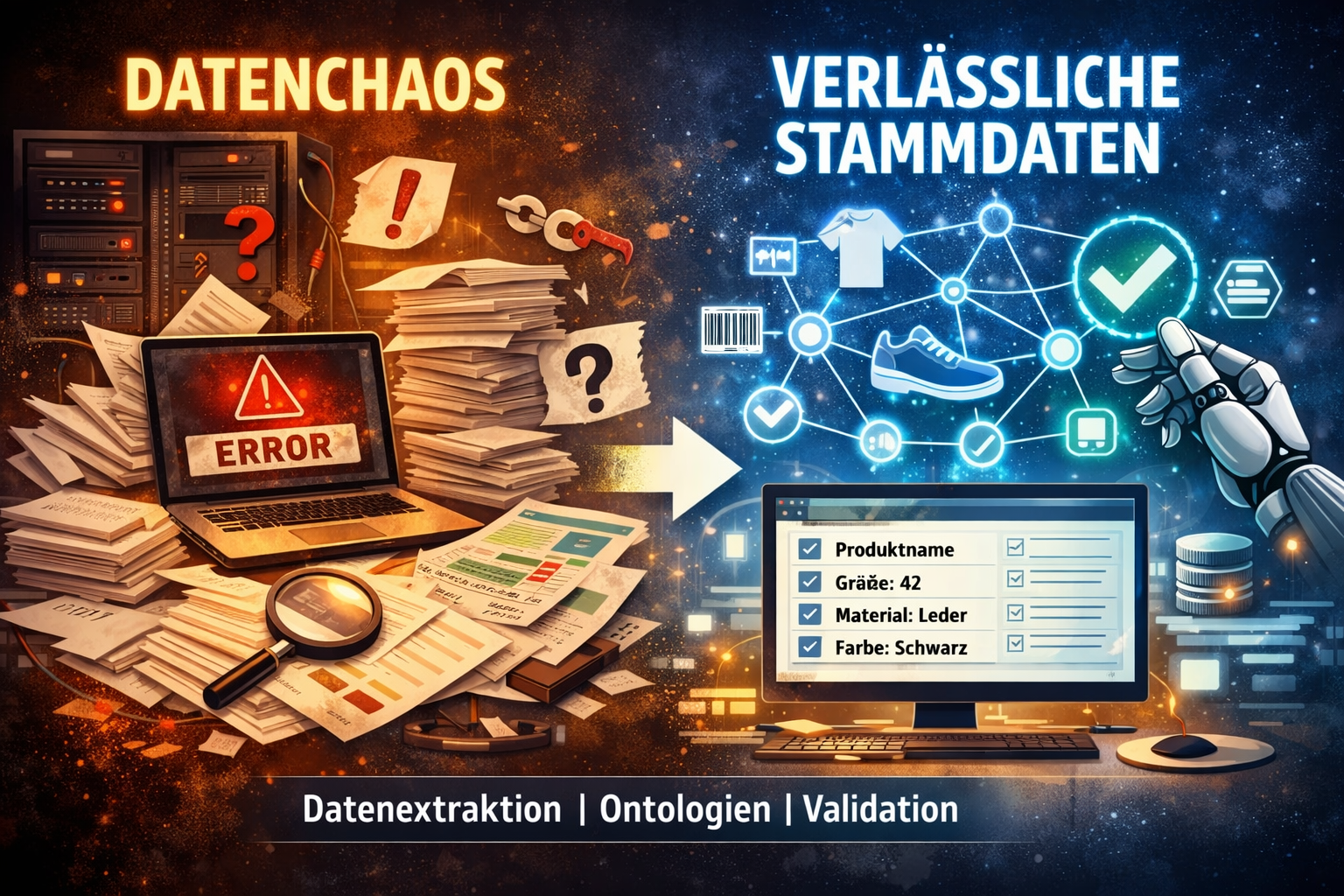
Why do many PIM Systems fail due to poor data?
Data chaos refers to the state of inaccurate and unstructured information within corporate systems. Companies often invest over 50,000 euros in a new PIM system. Yet the search function in the online store still returns incorrect results. The reason for this is often incorrect supplier data. This data flows into your systems unchecked.
Manual maintenance of product data is no longer scalable today. Employees spend days comparing Excel spreadsheets. This ties up important resources and leads to errors. Market leaders therefore rely on automated processes. They transform unstructured raw data into usable data capital.
The right technology can dramatically boost your efficiency. It generates error-free master data for your entire company. The key benefits are:
What causes data chaos in German companies?
Poor data quality is the result of silos that have developed over time and a lack of quality standards. This situation severely slows down operational processes. A recent survey by Splunk from 2025 polled 500 IT managers. The result: 99 percent of respondents give data-driven decisions high priority. However, implementation often fails due to practical realities.
Data volumes are growing exponentially. At the same time, there is a lack of clear strategies. Companies are leaving enormous potential untapped.
Data-driven approaches deliver concrete benefits:
You need to understand the root causes to solve the problem. Different supplier formats prevent a clean database. Only clear rules can remedy this.
Which DataNaicer features can permanently solve your data chaos?
The DataNaicer software consists of three main components: data extraction, semantic structuring, and automated quality control. This combination digitizes the entire data preparation process, reducing manual effort by up to 80 percent.
Many companies try to manage poor-quality data by hiring more staff. This is expensive and inefficient. Only the use of targeted AI tools solves this problem. The software takes over repetitive tasks. It works quickly and with extreme precision.
Below, we’ll show you the most important features in detail. You’ll learn how your daily work with product data becomes significantly easier.
How does semantic data extraction work?
Semantic data extraction enables the automatic conversion of unstructured text into standardized master data. You no longer have to laboriously copy product specifications. The AI recognizes important attributes completely on its own. These include colors, dimensions, materials, and technical standards.
A key challenge is the wide variety of formats used in supplier catalogs. The software accurately parses PDFs and Excel spreadsheets. It standardizes different units of measurement. For example, it automatically converts inches to centimeters. The AI also automatically corrects typos.
This feature saves you up to 75 percent of your manual work time. This extraction is the foundation for all subsequent steps in data processing.
How does the software prevent duplicate data records?
Automatic data deduplication is an AI-powered process for cleaning up duplicate or conflicting entries. The AI analyzes large datasets using intelligent pattern recognition. It reliably identifies sources of error. In practice, AI models achieve a precision of over 98 percent.
The software compares new data records with the existing inventory in real time. This usually takes less than 2 seconds. This prevents a common problem: a product being created under different SKUs in the ERP system.
The benefits of automatic deduplication include:
Why is an ontology better than rigid tables?
Unlike relational databases, an ontology uses logical knowledge graphs to link information. The AI understands the contextual relationship between terms. For example, it knows that a sneaker is a shoe. This shoe must have the attribute shoe size.
Structured data is extremely important for algorithms. AI only works reliably when the data is 100% consistent. The software converts text into structured attributes. You can then use these attributes for filters, search functions, and reporting.
This is the key difference from traditional AI. Standard AI often merely strings text together statistically. Ontology technology ensures true data understanding.
How the Validation Station eliminates errors
The Validation Station consists of two levels: automated preliminary processing and human approval. This control mechanism ensures that your data is 100% error-free. The AI handles 99% of the structuring completely automatically. The system specifically forwards unclear exceptions to a human expert.
This hybrid approach is particularly secure. It ensures that no incorrect data makes its way into your live systems. Major companies such as adidas, TUI, and Otto rely on this quality pipeline. They use it to securely manage millions of items.
The software learns from every manual correction. It becomes more precise with each run. We’d be happy to analyze your specific potential during an initial consultation.
Why good master data management boosts revenue
Efficient master data management enables a measurable increase in process efficiency and higher conversion rates. New products go live in the store significantly faster. Items have complete attributes right away. This reduces return rates by an average of 15 percent. Customers receive more accurate product information.
Investing in clean data pays off quickly. You’ll often reach the break-even point within the first 6 months. You no longer have to pay expensive agencies for manual data maintenance. Instead, you build up internal data capital.
The key benefits for your e-commerce business:
How does the flat-rate model work?
Unlike transaction-based systems, the flat-rate model offers unlimited scalability without variable unit costs. Many providers charge fees per item. With growing product ranges, this quickly leads to a cost explosion. The flat-rate model protects you from these unpredictable expenses.
Whether you’re processing 10,000 or 5 million records, the costs always remain transparent. Your business can grow without software costs increasing proportionally. This licensing model is particularly budget-friendly.
The flat-rate model offers the following benefits:
How do you get started with data optimization?
Implementing intelligent data pipelines enables the immediate transformation of manual lists into automated workflows. A solid data foundation isn’t just a technical gimmick. It’s an essential prerequisite for reliable analysis. You need clean data for successful automation.
This is the only way to scale your business model. You turn complex data sets into a real competitive advantage. This directly boosts your revenue. The combination of semantic extraction and ontology solves your data chaos. The Validation Station provides the necessary assurance.
Just try the software yourself. Take advantage of our free trial for 100 data records. Experience the quality of AI-powered data cleansing firsthand. Schedule a no-obligation initial consultation now.
Frequently Asked Questions
Ready for the next step?
Contact us for a no-obligation consultation about your data project.
Contact us nowQuellen