%20--%3e%3cdefs%3e%3cstyle%3e%20.st0%20{%20fill:%20%23a5d028;%20}%20.st1%20{%20fill:%20%23fff;%20}%20.st2%20{%20fill:%20%231de2db;%20}%20.st3%20{%20fill:%20%2341bdf9;%20}%20%3c/style%3e%3c/defs%3e%3cg%20id='logo-unaice-line'%3e%3cpath%20class='st1'%20d='M143.3,36.1c-1.2,0-2.1-.9-2.1-2.1V12.2c0-1.2.9-2.1,2.1-2.1s2.1.9,2.1,2.1v21.8c0,1.2-.9,2.1-2.1,2.1ZM143.2,6.2c-1.3,0-2.4-1-2.4-2.4v-.8c0-1.3,1-2.4,2.4-2.4s2.4,1.1,2.4,2.4v.8c0,1.3-1.1,2.4-2.4,2.4Z'/%3e%3cpath%20class='st3'%20d='M23.7,36.1H2c-.5,0-1-.4-1-1V2.3c0-.5.4-1,1-1h21.7c.5,0,1,.4,1,1v32.9c0,.5-.4,1-1,1'/%3e%3cpath%20class='st2'%20d='M41.8,36.1h-14.4c-.5,0-1-.4-1-1v-14.5c0-.5.4-1,1-1h14.4c.5,0,1,.4,1,1v14.5c0,.5-.4,1-1,1'/%3e%3cpath%20class='st0'%20d='M41.8,17.9h-14.4c-.5,0-1-.4-1-1V2.2c0-.5.4-1,1-1h14.4c.5,0,1,.4,1,1v14.7c0,.5-.4,1-1,1'/%3e%3c/g%3e%3cpath%20class='st1'%20d='M196.4,29.2c-2.1,2.1-3.6,3.2-7.1,3.2s-7.4-2.3-8.2-7.4h16.7c2.7,0,2.9-1.9,2.7-4-.7-6.2-5.3-11.2-11.6-11.2s-12.3,5.1-12.3,13.4,5.4,13.3,12.6,13.3,8.3-2.6,10-4.3c1.8-2.1-1.2-4.7-2.8-3ZM188.9,13.7c4.7,0,7.3,4.1,7.6,7.3h-15.3c.7-4.3,3.4-7.3,7.7-7.3Z'/%3e%3cpath%20class='st1'%20d='M132.1,12.9c-1.9-1.9-5.4-2.9-8.2-2.9s-5.3.5-8.2,1.8c-2.4,1-.9,5,1.6,3.7,2.1-1,3.3-1.5,6.3-1.5s6.7,1.1,6.8,6.1c-1.8-.5-2.7-.8-6.9-.8-6.8,0-11.3,3.3-11.3,8.8s4.1,8.4,10.1,8.4,5.4-.6,8.3-2.9v.5c0,2.8,4.2,2.6,4.2,0v-13.8c0-3.1-.8-5.5-2.7-7.4ZM130.4,26.2c0,3.6-3.4,6.3-8,6.3s-5.9-1.7-5.9-4.6,2.5-4.6,6.8-4.6c0,0,4.8,0,7.1,1v1.9Z'/%3e%3cpath%20class='st1'%20d='M80,36.1c-1.2,0-2.1-.9-2.1-2.1V3.4c0-1.2,1-2.2,2.2-2.2h.4c.8,0,1.4.4,2,1.1l20.2,25.7V3.4c0-1.2.9-2.1,2.1-2.1s2.1.9,2.1,2.1v30.7c0,1.1-.5,2-1.9,2s-1.9-.8-2.2-1.2l-20.7-26.2v25.3c0,1.2-.9,2.1-2.1,2.1Z'/%3e%3cpath%20class='st1'%20d='M60.2,36.5c-5.1,0-10.5-4.3-10.5-10.7v-13.5c0-1.2.9-2.1,2.1-2.1s2.1.9,2.1,2.1v13.1c0,4.5,2.5,7.1,6.6,7.1s7.3-3.2,7.3-7.5v-12.7c0-1.2.9-2.1,2.1-2.1s2.1.9,2.1,2.1v21.8c0,2.8-4.2,2.7-4.2,0v-.5c-1.5,1.6-3.3,2.9-7.6,2.9Z'/%3e%3cpath%20class='st1'%20d='M163.8,36.5c-7.1,0-13.1-6-13.1-13.3s4.8-13.5,13.5-13.5c4.4,0,6.9,2,8.8,3.7,1.8,1.5-.8,5.1-2.8,3.3-.8-.8-3.3-3-6.4-3-4.8,0-8.6,4-8.6,9.2s3.8,9.3,8.6,9.4c3.7,0,4.9-1,7-3.1,1.6-1.8,4.6,1,3,2.8-3,3-5.7,4.5-10,4.5h0Z'/%3e%3c/svg%3e)
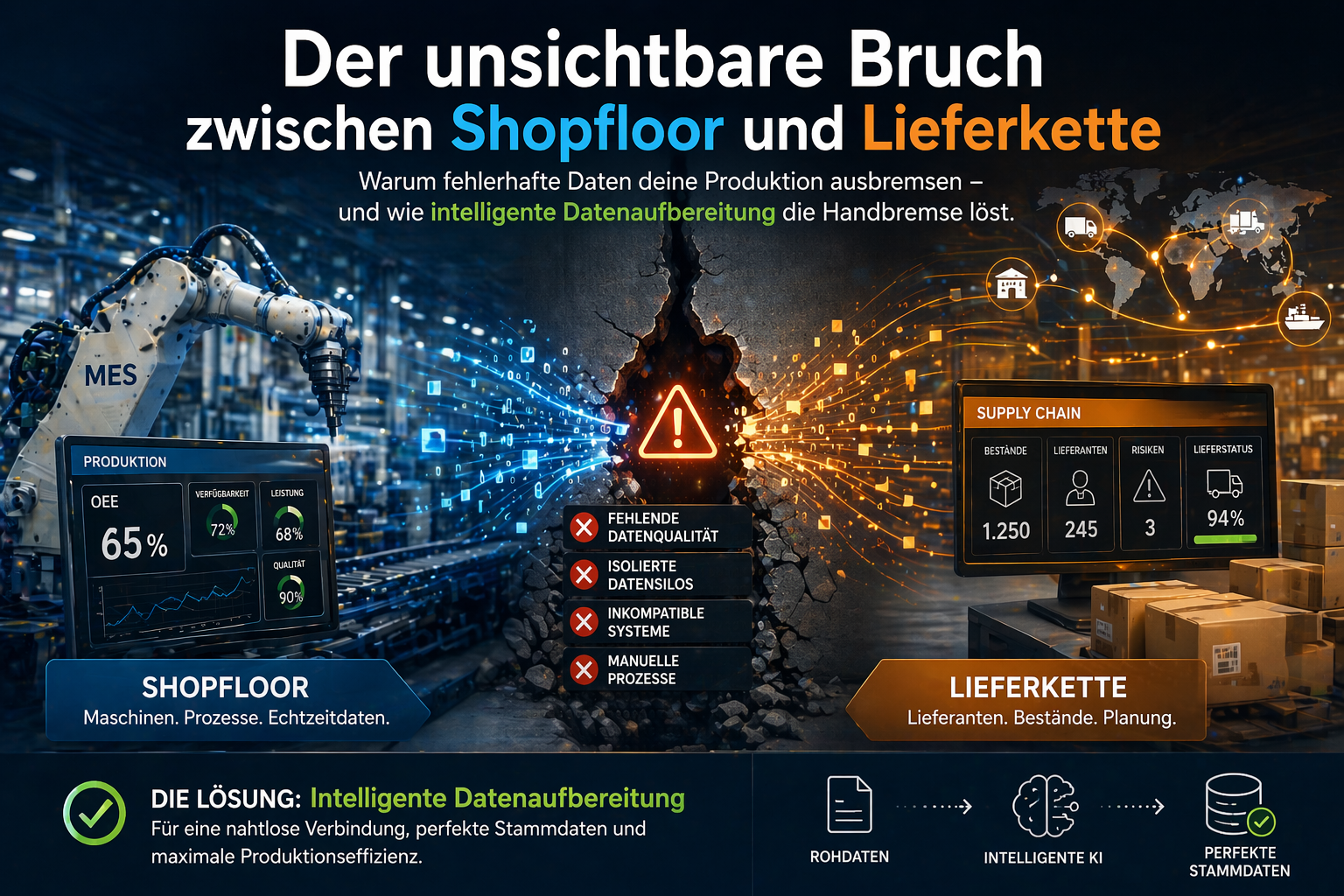
The Invisible Gap Between the Shop Floor and the Supply Chain
Your production is running at full speed, the machines are reporting record figures—and yet the assembly line suddenly comes to a standstill because a critical component is missing. How can this be? The setup is in place, the technology is working, but the supply chain’s performance is disappointing. The problem usually lies not in the physical processes, but in the invisible barrier between the shop floor and materials management.
Three months of work and large budgets invested in a modern software system often go to waste if the data foundation remains flawed. If the Manufacturing Execution System (MES) doesn’t understand the language of external supplier catalogs, employees inevitably fall back on manual Excel spreadsheets. This is precisely where the critical breakdown occurs.
In this guide, you’ll learn what architectural hurdles are blocking seamless integration and how you can finally remove the brakes on your production through intelligent data preparation. We’ll show you practical ways to break down isolated data silos and make efficient use of your data assets.
Why do industrial companies fail to link MES and supply chain data in practice?
Poor data quality as the main cause
Studies show that currently only 25 percent of German industrial companies effectively use their existing data for business decisions. A recent analysis by Dun & Bradstreet (2025) confirms that poor data quality severely hinders seamless communication between Manufacturing Execution Systems (MES) and supply chain networks. When master data is flawed, any automation effort inevitably fails at its very foundation.
The lack of integration is particularly evident in day-to-day operations. Only 10 percent of the companies surveyed have fully automated core processes. The most common pain points include:
Without consolidated data sources, there is no foundation for responding flexibly to market changes or regulatory requirements. uNaice’s automated quality pipeline transforms unstructured raw data into structured master data.
Complex Integration of Legacy Systems
System integration enables seamless data exchange between modern cloud platforms and existing production facilities. In reality, however, nearly 48 percent of manufacturers report massive difficulties connecting MES software to outdated machines and existing ERP systems, as data from Global Growth Insights (2026) shows.
The convergence of operational technology (OT) and information technology (IT) presents many companies with architectural challenges. Outdated machines often deliver extremely heterogeneous machine data. Around 46 percent of industrial companies express specific concerns regarding data migration. These interoperability issues result in significantly longer deployment times for about 44 percent of companies.
The solution lies in intelligent interface concepts that effectively harness historical machine data for predictive maintenance. uNaice’s centralized semantic data processing standardizes incompatible data formats and integrates isolated data silos.
How do isolated data silos affect Overall Equipment Effectiveness (OEE)?
OEE calculation requires real-time data
Overall Equipment Effectiveness (OEE) is a key metric for measuring plant productivity that balances availability, performance, and quality. To calculate this metric in real time, consistent data structures between the shop floor and the external supply chain are essential.
If material shortages are not immediately reported to the MES, actual equipment availability drops drastically, even though the machine itself is not defective. Recent market research shows that companies want to invest specifically in real-time inventory tracking and demand forecasting to eliminate precisely these blind spots.
Impending production bottlenecks can only be identified early through the intelligent analysis of sensor data if this data is immediately reconciled with inventory levels in the ERP system. A functional digital twin of the supply chain requires precisely these synchronized information flows.
The “Human Bottleneck” in Data Maintenance
Automated data processing enables an error-free quality pipeline and eliminates error-prone manual intervention in critical production data. When maintaining millions of items or specific components, manual processes quickly reach their physical limits.
The “human bottleneck” inevitably leads to typos, inconsistent units of measurement, and missing attributes when transferring supplier data. This significantly jeopardizes the seamless traceability of installed components. To solve this problem, market leaders rely on intelligent software solutions.
With comprehensive systems like the DataNaicer software, unstructured external logistics data can be effectively integrated into your existing supply chain monitoring system. This technology scales seamlessly from 10,000 to 5 million data records without requiring you to hire new staff for data maintenance.
Which interface concepts ensure secure data exchange with external suppliers?
Digital Collaboration Platforms vs. Email
Unlike secure digital collaboration platforms, traditional email offers insufficient protection for sensitive design and compliance data. Nevertheless, according to a survey by Aras (2025), 52 percent of industrial companies still rely on insecure email and file-sharing services when exchanging data with suppliers.
Traditional communication methods no longer meet the requirements of agile supply chain networks. Only 43 percent of companies use dedicated digital platforms. Yet secure exchange is of paramount importance, as companies share highly sensitive information:
Companies need cloud architectures that guarantee a precise and tamper-proof flow of information. Would you like to know how secure, fully automated data exchange works in your company? Contact us!
Ontologies for Semantic Data Extraction
An ontology is a structured knowledge graph in artificial intelligence that understands data logically and establishes deep semantic relationships between different pieces of information. Unlike pure black-box AI, which merely shuffles text blocks, the ontological approach enables precise data extraction from PDFs, Excel lists, or complex supplier catalogs.
This is crucial for seamlessly transferring unstructured external supplier data into your own MES. The AI automatically normalizes units, corrects common typos, and enriches missing attributes using external sources.
By integrating a Validation Station, 100% accuracy is guaranteed, as the 99% AI automation is supplemented by a final, targeted quality assurance process. This master data perfection is an absolute prerequisite for successfully linking MES and the supply chain.
How do you establish reliable data governance for heterogeneous machine data?
Standardized interfaces reduce data silos
Standardized interfaces enable seamless communication between isolated IT systems and prevent costly data silos in manufacturing. The lack of uniform standards leads to significant efficiency losses in many digitalization projects.
A recent SupplyX Barometer (2025) shows that 82 percent of logistics managers view digitalization as a strategic necessity, but only 9 percent have a fully digitally integrated supply chain. The biggest hurdles to practical implementation include:
Clear data governance precisely defines who bears strategic responsibility for the quality of captured process data in an industrial setting. This is essential for creating a reliable single source of truth for the entire production process.
AI-powered master data perfection without hidden costs
A transparent flat-rate model enables unlimited processing of product data without incurring unpredictable costs per individual SKU (Stock Keeping Unit). Strategic responsibility for data quality requires reliable and, above all, scalable tools.
When you need to clean up historical machine data or complex supplier catalogs, costs often skyrocket with traditional providers due to volume-based billing. Modern solutions, on the other hand, rely on absolute cost certainty. The automated cleaning of inconsistent master data in materials management has been proven to save up to 75 percent of manual labor time.
With clear pricing & flat rates, the system scales flexibly with your needs, whether you manage ten thousand or five million items. This frees your team from repetitive tasks and ensures your competitiveness.
Conclusion: The Path to an Integrated Value Chain
The seamless integration of MES and supply chain data is not merely an IT issue, but the absolute foundation of resilient and future-proof production. As current industry data shows, most initiatives fail not because of hardware, but due to poor data quality, missing interfaces, and extremely error-prone manual processes in materials management.
Those who overcome these architectural hurdles immediately benefit from clear real-time transparency, precise OEE calculation, and a tamper-proof supply chain. The sustainable solution lies in the automated transformation of unstructured raw data into perfect master data through the use of ontology-based artificial intelligence.
Free your teams from tedious manual Excel battles and eliminate the bottleneck in your data maintenance once and for all. Schedule a free initial consultation now, or see for yourself the quality of our solution with our no-obligation trial using 100 of your own data records.
Frequently Asked Questions
Ready for the next step?
Contact us for a no-obligation consultation about your data project.
Contact us nowSources