%20--%3e%3cdefs%3e%3cstyle%3e%20.st0%20{%20fill:%20%23a5d028;%20}%20.st1%20{%20fill:%20%23fff;%20}%20.st2%20{%20fill:%20%231de2db;%20}%20.st3%20{%20fill:%20%2341bdf9;%20}%20%3c/style%3e%3c/defs%3e%3cg%20id='logo-unaice-line'%3e%3cpath%20class='st1'%20d='M143.3,36.1c-1.2,0-2.1-.9-2.1-2.1V12.2c0-1.2.9-2.1,2.1-2.1s2.1.9,2.1,2.1v21.8c0,1.2-.9,2.1-2.1,2.1ZM143.2,6.2c-1.3,0-2.4-1-2.4-2.4v-.8c0-1.3,1-2.4,2.4-2.4s2.4,1.1,2.4,2.4v.8c0,1.3-1.1,2.4-2.4,2.4Z'/%3e%3cpath%20class='st3'%20d='M23.7,36.1H2c-.5,0-1-.4-1-1V2.3c0-.5.4-1,1-1h21.7c.5,0,1,.4,1,1v32.9c0,.5-.4,1-1,1'/%3e%3cpath%20class='st2'%20d='M41.8,36.1h-14.4c-.5,0-1-.4-1-1v-14.5c0-.5.4-1,1-1h14.4c.5,0,1,.4,1,1v14.5c0,.5-.4,1-1,1'/%3e%3cpath%20class='st0'%20d='M41.8,17.9h-14.4c-.5,0-1-.4-1-1V2.2c0-.5.4-1,1-1h14.4c.5,0,1,.4,1,1v14.7c0,.5-.4,1-1,1'/%3e%3c/g%3e%3cpath%20class='st1'%20d='M196.4,29.2c-2.1,2.1-3.6,3.2-7.1,3.2s-7.4-2.3-8.2-7.4h16.7c2.7,0,2.9-1.9,2.7-4-.7-6.2-5.3-11.2-11.6-11.2s-12.3,5.1-12.3,13.4,5.4,13.3,12.6,13.3,8.3-2.6,10-4.3c1.8-2.1-1.2-4.7-2.8-3ZM188.9,13.7c4.7,0,7.3,4.1,7.6,7.3h-15.3c.7-4.3,3.4-7.3,7.7-7.3Z'/%3e%3cpath%20class='st1'%20d='M132.1,12.9c-1.9-1.9-5.4-2.9-8.2-2.9s-5.3.5-8.2,1.8c-2.4,1-.9,5,1.6,3.7,2.1-1,3.3-1.5,6.3-1.5s6.7,1.1,6.8,6.1c-1.8-.5-2.7-.8-6.9-.8-6.8,0-11.3,3.3-11.3,8.8s4.1,8.4,10.1,8.4,5.4-.6,8.3-2.9v.5c0,2.8,4.2,2.6,4.2,0v-13.8c0-3.1-.8-5.5-2.7-7.4ZM130.4,26.2c0,3.6-3.4,6.3-8,6.3s-5.9-1.7-5.9-4.6,2.5-4.6,6.8-4.6c0,0,4.8,0,7.1,1v1.9Z'/%3e%3cpath%20class='st1'%20d='M80,36.1c-1.2,0-2.1-.9-2.1-2.1V3.4c0-1.2,1-2.2,2.2-2.2h.4c.8,0,1.4.4,2,1.1l20.2,25.7V3.4c0-1.2.9-2.1,2.1-2.1s2.1.9,2.1,2.1v30.7c0,1.1-.5,2-1.9,2s-1.9-.8-2.2-1.2l-20.7-26.2v25.3c0,1.2-.9,2.1-2.1,2.1Z'/%3e%3cpath%20class='st1'%20d='M60.2,36.5c-5.1,0-10.5-4.3-10.5-10.7v-13.5c0-1.2.9-2.1,2.1-2.1s2.1.9,2.1,2.1v13.1c0,4.5,2.5,7.1,6.6,7.1s7.3-3.2,7.3-7.5v-12.7c0-1.2.9-2.1,2.1-2.1s2.1.9,2.1,2.1v21.8c0,2.8-4.2,2.7-4.2,0v-.5c-1.5,1.6-3.3,2.9-7.6,2.9Z'/%3e%3cpath%20class='st1'%20d='M163.8,36.5c-7.1,0-13.1-6-13.1-13.3s4.8-13.5,13.5-13.5c4.4,0,6.9,2,8.8,3.7,1.8,1.5-.8,5.1-2.8,3.3-.8-.8-3.3-3-6.4-3-4.8,0-8.6,4-8.6,9.2s3.8,9.3,8.6,9.4c3.7,0,4.9-1,7-3.1,1.6-1.8,4.6,1,3,2.8-3,3-5.7,4.5-10,4.5h0Z'/%3e%3c/svg%3e)
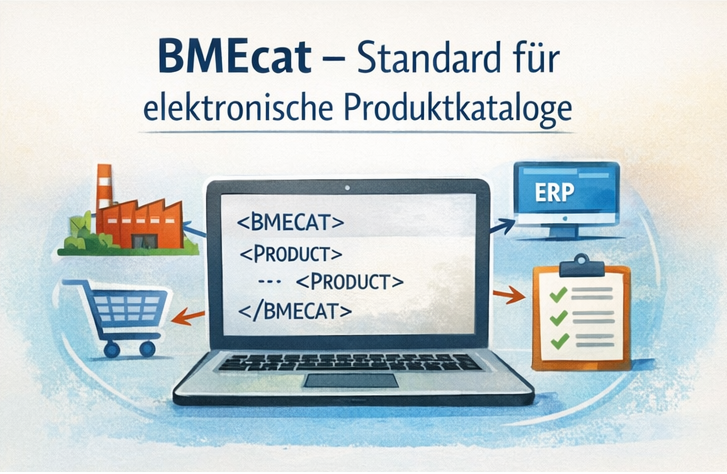
Companies in B2B commerce need to exchange large amounts of product information between different systems. Manufacturers supply data to retailers, retailers to marketplaces or purchasing systems. Without standardized formats, this exchange often leads to manual post-processing, data loss, or inconsistencies.
An important standard for solving this problem is BMEcat. The standard defines a structured format for electronic product catalogs and enables the automated exchange of product data between different IT systems.
BMEcat has established itself as the standard for electronic catalog exchange, particularly in German-speaking countries, and is supported by many ERP, PIM, and e-procurement systems.
What is the BMEcat standard?
The BMEcat standard is an XML-based exchange format for electronic product catalogs in the B2B environment. It defines how product information must be structured so that different systems can process it automatically.
The standard was initiated by the German Association for Materials Management, Purchasing and Logistics (BME) and developed in collaboration with industrial companies and research institutions. Further information can be found at Wikipedia or at Mittelstand Digital.
The central goal of BMEcat is to standardize the electronic exchange of product catalogs between suppliers and purchasing systems. This enables companies to automatically transfer product data and process it further in their systems.
Typical data transferred via BMEcat includes item numbers, product descriptions, technical characteristics, prices, delivery information, and references to images or documents.
Background and development of the BMEcat standard
The development of BMEcat began in the late 1990s, when companies were increasingly introducing electronic procurement processes. At that time, digital product catalogs already existed, but there was no uniform standard for exchanging this data.
The German Federal Association for Materials Management, Purchasing and Logistics therefore launched an initiative to develop a standardized catalog format. Among others, companies from industry and software development as well as research institutions such as the Fraunhofer Institute were involved.
The most important versions of the standard are shown in the following overview:
| Version | Publication | Significance |
|---|---|---|
| BMEcat 1.0 | 1999 | first version of the standard |
| BMEcat 1.2 | 2001 | extensions for classifications |
| BMEcat 2005 | 2005 | extensions for complex product and price structures |
In practice, BMEcat 1.2 and BMEcat 2005 are primarily used today.
Technical basis: BMEcat and XML
The BMEcat standard is based on XML (Extensible Markup Language). XML is a structured markup language that can be used to clearly define data and store it in a machine-readable format. XML enables systems to automatically interpret, import, and validate data.
A greatly simplified example of a BMEcat entry looks like this:
<PRODUCT>
   <PRODUCT_ID>12345</PRODUCT_ID>
   <PRODUCT_NAME>Industrial drill bit 10 mm</PRODUCT_NAME>
   <DESCRIPTION_SHORT>Drill bit for metal</DESCRIPTION_SHORT>
   <PRICE_AMOUNT>12.50</PRICE_AMOUNT>
</PRODUCT>
In real catalogs, the structures are much more extensive and contain numerous additional fields for technical characteristics, logistics data, or classifications.
Structure of a BMEcat catalog
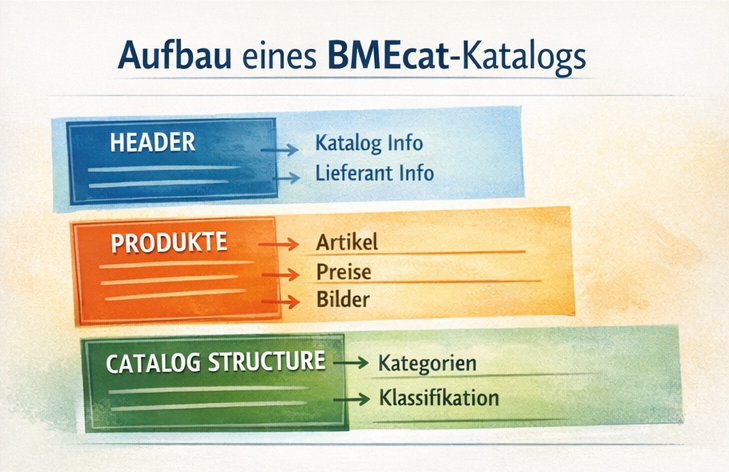
A BMEcat document follows a clearly defined structure. This structure ensures that systems can interpret the information contained therein unambiguously.
Header
The header contains metadata about the entire catalog. This includes, for example, the name of the catalog, the language, the currency used, and information about the supplier and recipient of the catalog.
It may also contain information about the date of creation or the validity of the catalog. This information helps the receiving systems to classify the catalog correctly.
Product information
The main part of a BMEcat document contains the actual product data.
| Category | Examples |
|---|---|
| product identification | item number, manufacturer ID |
| scalability | growth without system change |
| product description | product name, short description, long text |
| price information | unit price, graduated prices |
| logistics data | packaging units, delivery times |
| technical features | material, dimensions, technical properties |
Additional fields can be added depending on the industry.
Multimedia data
In addition to structured product information, additional content can also be transferred, such as product images, technical data sheets, assembly instructions, or certificates. This content is usually stored in the BMEcat catalog as references.
Schema: Structure of a BMEcat catalog
A BMEcat catalog follows a clearly defined XML structure, which can be simplified as follows:
BMECAT
│
├── HEADER
│     ├── Catalog Information
│     ├── Supplier Information
│     └── Buyer Information
│
├── CATALOG STRUCTURE
│     ├── Product Categories
│     └── Classification References
│
├── PRODUCT
│     ├── Product Identification
│     ├── Product Description
│     ├── Product Features
│     ├── Prices
│     ├── Logistics Data
│     └── Multimedia References
│
└── USER_DEFINED_EXTENSIONS
      └── Optional custom attributes
The most important elements can be summarized as follows:
| Area | Content |
|---|---|
| HEADER | metadata for the catalog, supplier, language, currency |
| CATALOG STRUCTURE | categories and classification systems |
| PRODUCT | actual product data |
| USER_DEFINED_EXTENSIONS | additional, customer-specific fields |
This structure makes it possible to transfer complete product catalogs in a single file.
BMEcat in conjunction with classifications
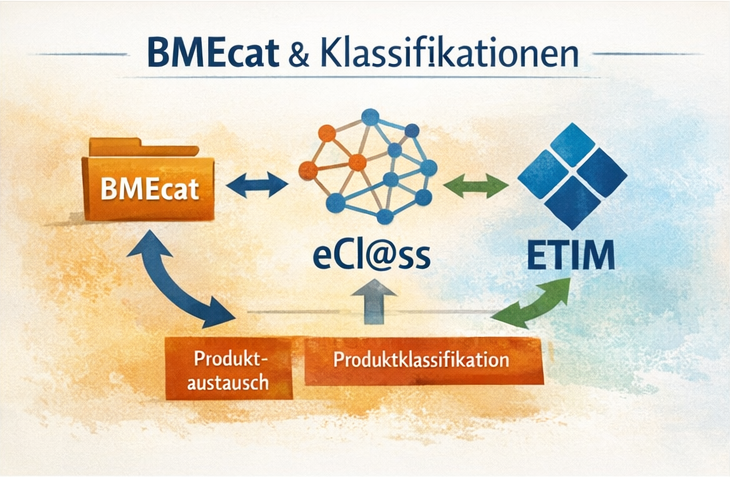
The BMEcat standard primarily describes the structure of a product catalog, but not the semantic classification of products. Additional classification systems are therefore often used to classify products.
The most important classifications include:
| Classification | Area of application |
|---|---|
| ECLASS (eCl@ss) | cross-industry product classification |
| ETIM | electrical engineering and technical products |
| UNSPSC | international classification system for procurement |
By combining BMEcat with such classifications, products can be clearly described and identified across systems. For more information, see our articles on ECLASS and ETIM.
Classification is usually stored in the BMEcat catalog via corresponding references. This allows systems to automatically categorize and compare products.
BMEcat vs. ECLASS vs. ETIM – Differences between the standards
BMEcat is often used in conjunction with classification standards such as ECLASS (eCl@ss) or ETIM. These standards fulfill different tasks in product data management.
While BMEcat describes the exchange of product catalogs, ECLASS and ETIM define the classification and structure of technical characteristics of products.
| Standard | Type | Purpose | Example |
|---|---|---|---|
| BMEcat | data exchange format | transfer of complete product catalogs | catalog export from a manufacturer |
| ECLASS (eCl@ss) | classification standard | structured product classification | classification of technical products |
| ETIM | classification standard | standardized product features | electrical engineering products |
A typical scenario looks like this:
A manufacturer creates its product catalog in BMEcat format. Within this catalog, products are assigned an ECLASS or ETIM classification. This enables a retailer's purchasing system not only to import the catalog, but also to automatically categorize products and compare technical features.
Typical areas of application for BMEcat
The BMEcat standard is primarily used in the B2B environment, where large product catalogs are regularly exchanged between companies.
E-procurement
Many companies use electronic procurement systems. Suppliers provide their product catalogs in BMEcat format so that they can be automatically imported into the purchasing system. Purchasers can then order directly from these electronic catalogs.
B2B marketplaces
B2B marketplaces also frequently use BMEcat as an import format for product data. Retailers can provide their product catalogs in a standardized format so that marketplaces can automatically integrate the data.
PIM and ERP systems
Product information management (PIM) and ERP systems often use BMEcat as an exchange format for product data.
Typical challenges with BMEcat data
Although BMEcat is a clearly defined standard, challenges often arise in practice when creating or processing BMEcat catalogs.
A common reason for this is that although the standard specifies the structure, many fields are optional. Companies sometimes interpret these fields differently or use individual extensions.
| Challenge | Description |
|---|---|
| inconsistent product attributes | different names for the same characteristics |
| missing classification | products are not classified with ECLASS or ETIM |
| incomplete data | missing technical characteristics or descriptions |
| individual extensions | additional fields outside the standard |
| different BMEcat versions | e.g., mixture of BMEcat 1.2 and BMEcat 2005 |
These challenges often mean that imported catalogs must first be normalized, structured, or enriched before they can be used in target systems.
You can find out why data preparation is so important in our articles Data preparation explained simply and Data quality: Definition, consistency, and data integrity in practice for companies.
BMEcat and Product Information Management (PIM)
In many companies, BMEcat is closely linked to Product Information Management (PIM). PIM systems are used to centrally manage and structure product data and make it available for various channels.
A typical process looks like this:
The BMEcat format is often used in this process as an export or exchange format for transferring product catalogs to partner companies or purchasing systems.
Importance of BMEcat for modern product data processes
With the increasing digitization of supply chains and procurement processes, the structured exchange of product data is becoming increasingly important.
Standards such as BMEcat play a central role in this because they create a common technical basis for data exchange between companies.
In combination with classifications such as ECLASS or ETIM and PIM systems, this creates an infrastructure that enables companies to efficiently manage, exchange, and process product data.
Especially in the B2B environment with large product catalogs, BMEcat therefore often forms an important building block for scalable data processes and automated procurement systems.
Automated preparation of product data for BMEcat
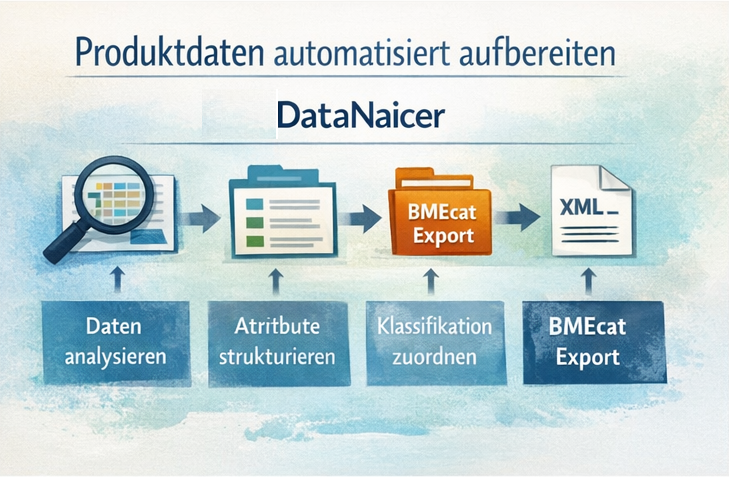
In practice, product data is often available in different formats—for example, in Excel files, ERP systems, or databases. Before this data can be exported to a BMEcat catalog, it usually first needs to be structured, normalized, and enriched.
This is exactly where DataNaicer comes in.
DataNaicer is a software solution for the automated preparation of product data. It supports companies in analyzing existing data sources, structuring product attributes, and supplementing missing information. The aim is to prepare product data in such a way that it can be reused consistently and in a standardized manner.
In the context of BMEcat, this means, for example:
This allows product data to be efficiently transferred into a structure that can then be used for BMEcat exports or other exchange formats.
If you want to check how your product data can be automatically structured and prepared for standards such as BMEcat, you can test DataNaicer for 100 data records free of charge!
Conclusion
The BMEcat standard is an established format for the exchange of electronic product catalogs in B2B commerce. Its XML-based structure enables automated data exchange between manufacturers, retailers, marketplaces, and purchasing systems.
The standard supports not only basic product information, but also technical features, price structures, multimedia data, and classifications. This allows complete product catalogs to be transferred across systems.
For companies that manage large amounts of product data or regularly exchange it with partners, BMEcat forms an important basis for efficient and scalable data processes.
DataNaicer can also help companies prepare their data for BMEcat so that they are well positioned for the future.
Ready for the next step?
Contact us for a no-obligation consultation about your data project.
Contact us now