%20--%3e%3cdefs%3e%3cstyle%3e%20.st0%20{%20fill:%20%23a5d028;%20}%20.st1%20{%20fill:%20%23fff;%20}%20.st2%20{%20fill:%20%231de2db;%20}%20.st3%20{%20fill:%20%2341bdf9;%20}%20%3c/style%3e%3c/defs%3e%3cg%20id='logo-unaice-line'%3e%3cpath%20class='st1'%20d='M143.3,36.1c-1.2,0-2.1-.9-2.1-2.1V12.2c0-1.2.9-2.1,2.1-2.1s2.1.9,2.1,2.1v21.8c0,1.2-.9,2.1-2.1,2.1ZM143.2,6.2c-1.3,0-2.4-1-2.4-2.4v-.8c0-1.3,1-2.4,2.4-2.4s2.4,1.1,2.4,2.4v.8c0,1.3-1.1,2.4-2.4,2.4Z'/%3e%3cpath%20class='st3'%20d='M23.7,36.1H2c-.5,0-1-.4-1-1V2.3c0-.5.4-1,1-1h21.7c.5,0,1,.4,1,1v32.9c0,.5-.4,1-1,1'/%3e%3cpath%20class='st2'%20d='M41.8,36.1h-14.4c-.5,0-1-.4-1-1v-14.5c0-.5.4-1,1-1h14.4c.5,0,1,.4,1,1v14.5c0,.5-.4,1-1,1'/%3e%3cpath%20class='st0'%20d='M41.8,17.9h-14.4c-.5,0-1-.4-1-1V2.2c0-.5.4-1,1-1h14.4c.5,0,1,.4,1,1v14.7c0,.5-.4,1-1,1'/%3e%3c/g%3e%3cpath%20class='st1'%20d='M196.4,29.2c-2.1,2.1-3.6,3.2-7.1,3.2s-7.4-2.3-8.2-7.4h16.7c2.7,0,2.9-1.9,2.7-4-.7-6.2-5.3-11.2-11.6-11.2s-12.3,5.1-12.3,13.4,5.4,13.3,12.6,13.3,8.3-2.6,10-4.3c1.8-2.1-1.2-4.7-2.8-3ZM188.9,13.7c4.7,0,7.3,4.1,7.6,7.3h-15.3c.7-4.3,3.4-7.3,7.7-7.3Z'/%3e%3cpath%20class='st1'%20d='M132.1,12.9c-1.9-1.9-5.4-2.9-8.2-2.9s-5.3.5-8.2,1.8c-2.4,1-.9,5,1.6,3.7,2.1-1,3.3-1.5,6.3-1.5s6.7,1.1,6.8,6.1c-1.8-.5-2.7-.8-6.9-.8-6.8,0-11.3,3.3-11.3,8.8s4.1,8.4,10.1,8.4,5.4-.6,8.3-2.9v.5c0,2.8,4.2,2.6,4.2,0v-13.8c0-3.1-.8-5.5-2.7-7.4ZM130.4,26.2c0,3.6-3.4,6.3-8,6.3s-5.9-1.7-5.9-4.6,2.5-4.6,6.8-4.6c0,0,4.8,0,7.1,1v1.9Z'/%3e%3cpath%20class='st1'%20d='M80,36.1c-1.2,0-2.1-.9-2.1-2.1V3.4c0-1.2,1-2.2,2.2-2.2h.4c.8,0,1.4.4,2,1.1l20.2,25.7V3.4c0-1.2.9-2.1,2.1-2.1s2.1.9,2.1,2.1v30.7c0,1.1-.5,2-1.9,2s-1.9-.8-2.2-1.2l-20.7-26.2v25.3c0,1.2-.9,2.1-2.1,2.1Z'/%3e%3cpath%20class='st1'%20d='M60.2,36.5c-5.1,0-10.5-4.3-10.5-10.7v-13.5c0-1.2.9-2.1,2.1-2.1s2.1.9,2.1,2.1v13.1c0,4.5,2.5,7.1,6.6,7.1s7.3-3.2,7.3-7.5v-12.7c0-1.2.9-2.1,2.1-2.1s2.1.9,2.1,2.1v21.8c0,2.8-4.2,2.7-4.2,0v-.5c-1.5,1.6-3.3,2.9-7.6,2.9Z'/%3e%3cpath%20class='st1'%20d='M163.8,36.5c-7.1,0-13.1-6-13.1-13.3s4.8-13.5,13.5-13.5c4.4,0,6.9,2,8.8,3.7,1.8,1.5-.8,5.1-2.8,3.3-.8-.8-3.3-3-6.4-3-4.8,0-8.6,4-8.6,9.2s3.8,9.3,8.6,9.4c3.7,0,4.9-1,7-3.1,1.6-1.8,4.6,1,3,2.8-3,3-5.7,4.5-10,4.5h0Z'/%3e%3c/svg%3e)

Anyone looking to structure product data in a business will sooner or later come across two terms: taxonomy and ontology. Both help to bring order to data, but they do so in different ways. While a taxonomy primarily describes categories and hierarchies, an ontology also maps meanings, properties, and relationships between objects.
This difference is particularly important when it comes to product data and large product ranges. The more complex a product range becomes, the less sufficient it is to simply classify products into categories. Companies must also understand how products are described in technical terms, which attributes belong together, and what relationships exist between pieces of information.
Why this Topic is relevant for Companies
In many companies, product data accumulates over the years. New items are added, existing ranges are expanded, categories change, and new markets and channels emerge. What was initially clear and organized quickly becomes confusing:
The result: Product data becomes difficult to maintain, hard to compare, and of limited use. This is exactly where structured models such as taxonomies and ontologies come in.
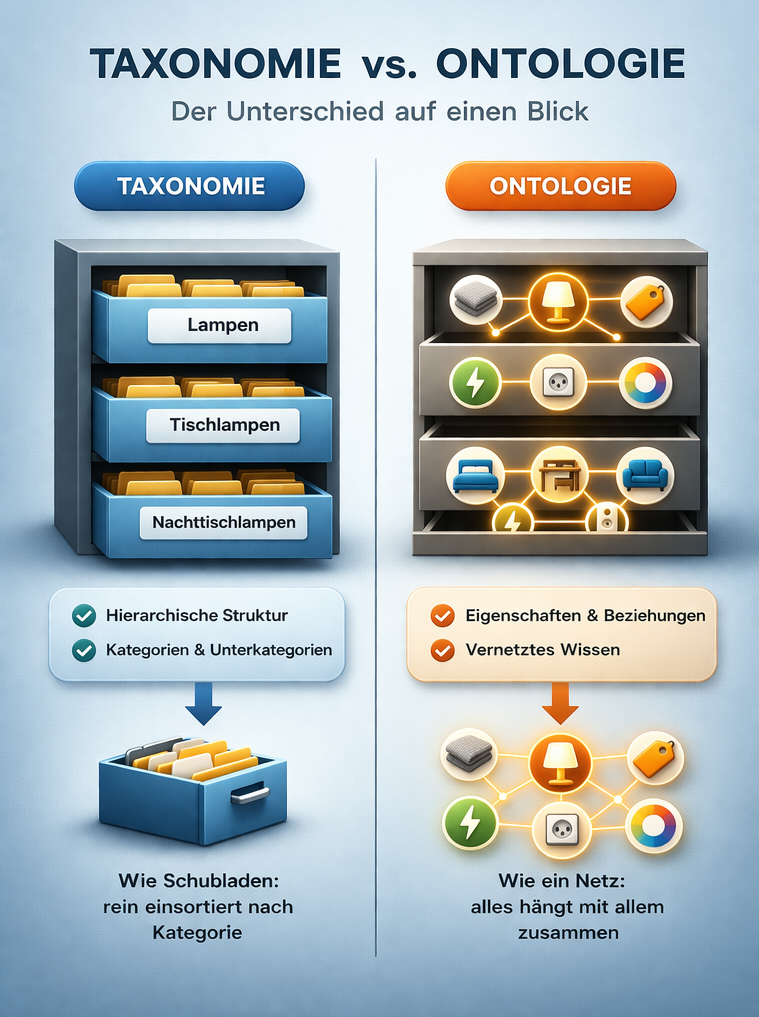
What is a Taxonomy?
A taxonomy is a classification system that structures terms or objects into superordinate and subordinate categories. Typically, this involves hierarchical relationships between more general and more specific terms. (see: Link)
A simple example from the field of product ranges:
This structure is easy to understand. It shows which category a product belongs to and how a product range can be broadly organized using more general and more specific terms.

What a Taxonomy does well
A taxonomy is particularly useful when companies want to:
Above all, it answers the question: Where does this product belong?
For many use cases, this is a very good starting point.
Where a Taxonomy reaches its Limits
As soon as products need to be described in greater detail, a simple category structure is often no longer sufficient.
An office chair is not just a product in the “office chairs” category. It also has features such as:
A taxonomy can effectively organize terms and products, but it has limited ability to capture technical characteristics and more complex relationships between pieces of information.
Feel free to check out our article on taxonomy.
What is an Ontology?
An ontology describes the concepts, properties, and relationships relevant to a specific domain in a formal, machine-readable format. (see: Link)
In the context of product data, this means: An ontology does not merely describe that an office chair belongs to the “office furniture” category. It also describes that it possesses specific attributes, is related to other objects, and has a defined meaning within a domain model.

Example: Ontology for an Office Chair
An ontology could model the following:
Thus, an ontology answers not only the question: Where does the product belong?, but also: What exactly is the product, and how is it related to other information?
The Difference between Taxonomy and Ontology
The difference can be summarized simply:
A taxonomy structures terms and products through categories and hierarchical relationships. An ontology, in addition, describes properties, meanings, and relationships between these objects.
Taxonomy
A taxonomy is useful when companies primarily:
Ontology
An ontology is useful when companies also:
A real-world example: Lighting
Let’s take a product range in the lighting sector.
Taxonomic View
This is clear and useful for navigation and categorization.
Ontological Perspective
Additionally, the following can be modeled:
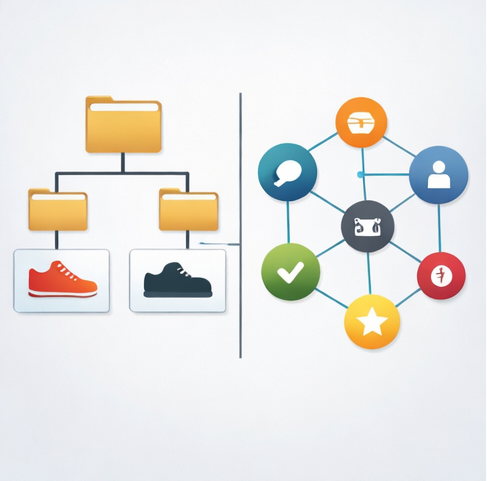
Here it becomes clear: The ontology creates a semantic model that goes significantly deeper than a mere category structure.
Why Ontologies are becoming increasingly important for Product Data
When companies need to bring together a large number of products, attributes, and data sources, a common problem arises: While the data exists, it is not described in a consistent manner.
This applies, for example, to:
In such situations, a simple hierarchy is often no longer sufficient. Companies then need a model that not only defines categories but also clearly defines meanings and relationships between data points.
This is precisely why ontologies are gaining importance: They help structure product knowledge in a systematic and machine-readable way.
Does every Company need an Ontology right away?
No. Not every company needs to start with an ontology right away.
For many use cases, a good taxonomy is sufficient at first, for example:
However, as product portfolios grow, multiple systems interact, and data quality becomes strategically important, a taxonomy alone quickly reaches its limits.
In practice, therefore, the rule is often: Taxonomy first, ontology as the next step.
This is usually the most sensible approach. First, clearly define categories, then add attributes, relationships, and rules.

The Bridge to Practice: what this Means for Businesses—and where DataNaicer comes in
This is precisely where the topic becomes operationally relevant for businesses. That’s because there is often a significant gap between the theoretical understanding of taxonomy and ontology and the actual maintenance of product data in day-to-day operations. This is also where the practical relevance of DataNaicer comes into play.
Companies often already know that their data needs to be better structured. The challenge, however, lies in turning distributed, inconsistent information into a consistent and usable database. This is precisely where the connection to DataNaicer is not merely theoretical, but practical.
This is where DataNaicer comes into play.
What makes DataNaicer interesting in this context
When companies want to consolidate and standardize product data from various sources, simply sorting products into categories is often not enough. They also need a clear logic for attributes, characteristics, and relationships.
In practice, DataNaicer can help companies:
This is particularly valuable for companies with larger or more complex product ranges, where data quality has a direct impact on sales, visibility, search, and operational processes.
Thus, the theoretical question “Taxonomy or ontology?” becomes a very practical task of data organization.
Conclusion
Taxonomy and ontology share a common goal: they bring order to data. The difference lies in the depth.
For companies in the B2B sector that want to neatly structure product data and product ranges, this difference is crucial. Those who want to classify products first should start with a taxonomy. Those who want to use product knowledge systematically, consistently, and scalably will sooner or later need an ontological view.
Especially in growing data landscapes, this is not a theoretical side issue, but a concrete prerequisite for better data quality. And this is exactly where DataNaicer comes into play: as a bridge between confusing product information and a structured, usable database.
FAQ
Ready for the next step?
Contact us for a no-obligation consultation about your data project.
Contact us now