%20--%3e%3cdefs%3e%3cstyle%3e%20.st0%20{%20fill:%20%23a5d028;%20}%20.st1%20{%20fill:%20%23fff;%20}%20.st2%20{%20fill:%20%231de2db;%20}%20.st3%20{%20fill:%20%2341bdf9;%20}%20%3c/style%3e%3c/defs%3e%3cg%20id='logo-unaice-line'%3e%3cpath%20class='st1'%20d='M143.3,36.1c-1.2,0-2.1-.9-2.1-2.1V12.2c0-1.2.9-2.1,2.1-2.1s2.1.9,2.1,2.1v21.8c0,1.2-.9,2.1-2.1,2.1ZM143.2,6.2c-1.3,0-2.4-1-2.4-2.4v-.8c0-1.3,1-2.4,2.4-2.4s2.4,1.1,2.4,2.4v.8c0,1.3-1.1,2.4-2.4,2.4Z'/%3e%3cpath%20class='st3'%20d='M23.7,36.1H2c-.5,0-1-.4-1-1V2.3c0-.5.4-1,1-1h21.7c.5,0,1,.4,1,1v32.9c0,.5-.4,1-1,1'/%3e%3cpath%20class='st2'%20d='M41.8,36.1h-14.4c-.5,0-1-.4-1-1v-14.5c0-.5.4-1,1-1h14.4c.5,0,1,.4,1,1v14.5c0,.5-.4,1-1,1'/%3e%3cpath%20class='st0'%20d='M41.8,17.9h-14.4c-.5,0-1-.4-1-1V2.2c0-.5.4-1,1-1h14.4c.5,0,1,.4,1,1v14.7c0,.5-.4,1-1,1'/%3e%3c/g%3e%3cpath%20class='st1'%20d='M196.4,29.2c-2.1,2.1-3.6,3.2-7.1,3.2s-7.4-2.3-8.2-7.4h16.7c2.7,0,2.9-1.9,2.7-4-.7-6.2-5.3-11.2-11.6-11.2s-12.3,5.1-12.3,13.4,5.4,13.3,12.6,13.3,8.3-2.6,10-4.3c1.8-2.1-1.2-4.7-2.8-3ZM188.9,13.7c4.7,0,7.3,4.1,7.6,7.3h-15.3c.7-4.3,3.4-7.3,7.7-7.3Z'/%3e%3cpath%20class='st1'%20d='M132.1,12.9c-1.9-1.9-5.4-2.9-8.2-2.9s-5.3.5-8.2,1.8c-2.4,1-.9,5,1.6,3.7,2.1-1,3.3-1.5,6.3-1.5s6.7,1.1,6.8,6.1c-1.8-.5-2.7-.8-6.9-.8-6.8,0-11.3,3.3-11.3,8.8s4.1,8.4,10.1,8.4,5.4-.6,8.3-2.9v.5c0,2.8,4.2,2.6,4.2,0v-13.8c0-3.1-.8-5.5-2.7-7.4ZM130.4,26.2c0,3.6-3.4,6.3-8,6.3s-5.9-1.7-5.9-4.6,2.5-4.6,6.8-4.6c0,0,4.8,0,7.1,1v1.9Z'/%3e%3cpath%20class='st1'%20d='M80,36.1c-1.2,0-2.1-.9-2.1-2.1V3.4c0-1.2,1-2.2,2.2-2.2h.4c.8,0,1.4.4,2,1.1l20.2,25.7V3.4c0-1.2.9-2.1,2.1-2.1s2.1.9,2.1,2.1v30.7c0,1.1-.5,2-1.9,2s-1.9-.8-2.2-1.2l-20.7-26.2v25.3c0,1.2-.9,2.1-2.1,2.1Z'/%3e%3cpath%20class='st1'%20d='M60.2,36.5c-5.1,0-10.5-4.3-10.5-10.7v-13.5c0-1.2.9-2.1,2.1-2.1s2.1.9,2.1,2.1v13.1c0,4.5,2.5,7.1,6.6,7.1s7.3-3.2,7.3-7.5v-12.7c0-1.2.9-2.1,2.1-2.1s2.1.9,2.1,2.1v21.8c0,2.8-4.2,2.7-4.2,0v-.5c-1.5,1.6-3.3,2.9-7.6,2.9Z'/%3e%3cpath%20class='st1'%20d='M163.8,36.5c-7.1,0-13.1-6-13.1-13.3s4.8-13.5,13.5-13.5c4.4,0,6.9,2,8.8,3.7,1.8,1.5-.8,5.1-2.8,3.3-.8-.8-3.3-3-6.4-3-4.8,0-8.6,4-8.6,9.2s3.8,9.3,8.6,9.4c3.7,0,4.9-1,7-3.1,1.6-1.8,4.6,1,3,2.8-3,3-5.7,4.5-10,4.5h0Z'/%3e%3c/svg%3e)

What does the core update involve and what are its consequences?
Google announced two new updates this week: the “March 2024 Core Update” and the “March 2024 Spam Update.” Unlike usual, the core update is expected to last four weeks and lead to major fluctuations in search results. In any case, it already promises to be a particularly significant update.
The new Google Core Update will be one of the most important in recent years and is seen as a response to widespread criticism from SEO circles.
Does this mean that anyone who has worked with ChatGPT now has to worry about their ranking?
The update is specifically aimed at penalizing low-quality texts (created by AI?). Google aims to achieve a 40% reduction in “low-quality, unoriginal content” in search results.
However, not all text created with the help of AI is automatically spam. Google defines spam as follows:
Our long-standing spam policy states that the use of automation, including generative AI, is considered spam if its primary purpose is to manipulate search result rankings.
However, the question remains as to how Google intends to identify this purpose.
Speak with one of our experts to learn how this update will affect you and whether you should take action now.
The update identifies three main sources of error:
🔗 The misuse of expired domains
This is unlikely to affect many of us. The misuse of expired domains is not a random occurrence, but a planned tactic in which the reputation of an old website is used to successfully place one's own, often dubious or questionable content. The aim is to allow inferior products to benefit from the good reputation of the old domain. The search intentions for the old domain often differ from those for the new content.
The use of an old domain name for one's product and to increase added value remains permitted.
🗟 Abuse of scaled content
Now it gets interesting. This is a further development of Google's existing spam policy. With the core update, Google wants to take particular action against the mass creation of poor content.
What does scaled content mean?
Scaled content is content that serves solely to manipulate search results without offering any real added value for users. It often consists of a large amount of content that offers little to no benefit.
According to Google, it is irrelevant whether this content was created through automation, human labor, or a combination of both.
📄 Abuse of website reputation
The third change concerns abuse of website reputation. Anyone who uses so-called parasite SEO should be wary here. This refers to pages such as advertising pages or partner pages that are “independent of the main purpose of the host site (...) and offer little to no value to users.”
According to Google, the updates will not take effect until May 5. This is likely a clever move, because what could be more effective than having patterns revealed directly by the main players themselves?
Does this apply to all types of automated content?
The proliferation of poor content has become increasingly significant since the end of 2022, particularly due to the rapid spread of AI tools such as ChatGPT and Aleph Alpha. Therefore, the update is likely to target this type of text in particular.
But does that also mean that all text that has been created automatically will be marked as spam?
Let's take Text Robot as an example. The Text Robot works with a deterministic data-to-text concept, among other things, and refers to the automated creation of NLG texts based on a specific, structured data set, meaning that it is not identified as AI text by Google.
Because data-to-text is based on user reality through the input of individual data, precision and the exclusion of false statements are guaranteed. Data enrichment also adds further informative aspects to the text, so that the texts always offer added value for the user – one of the main criteria for Google.
Possible courses of action
What is becoming clear is the growing importance of unique content with added value, also known as helpful, reliable, people-first content, in terms of placement. Information on how to create such content in line with Google's guidelines can be found at Google itself.
However, it is not only the content itself that counts, but also its presentation on the website. This should not be impaired by distracting elements or excessive advertising and should ensure a good user experience. In addition, third-party content should be carefully reviewed in this context.
But what if the content has already been created using AI? Given the large number of ChatGPT users—around 180.5 million—a great many pages have already been created with the help of AI tools, either to assist with or even to create entire posts. In this case, there are several options.
One option is the AI check: there are now a variety of tools on the market that check text to see how likely it is to have been created by AI. For example, Scribbr offers such a service. English texts up to 500 characters can be tested free of charge, while a fee is charged for longer text.
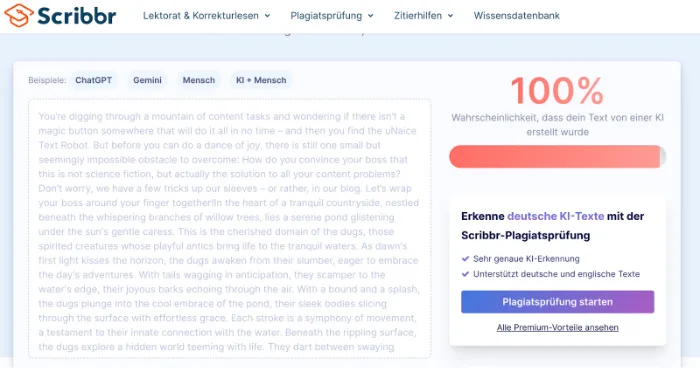
Depending on the result, it is advisable to revise your texts yourself. There are also many tools available in this area that can rewrite AI text. However, it is essential to review the revised text again.
If you have already published a large amount of content that lacks substance, it is advisable to consider reducing your content. One thing is clear – high-quality content is useful for everyone, even without the Google Core Update.
Are texts from uNaice also at risk?
Have you created content with uNaice? Then you don't need to worry, we saw this update coming and took measures to secure the content in advance. If you are still unsure, please feel free to make an appointment with us to clarify your questions.
Outlook: What can we expect?
If Google achieves its announced goals, we can expect numerous penalties. However, for those who have focused on high-quality content and adhered to Google's guidelines, there could also be new opportunities to achieve a better ranking and overtake spam sites.
However, there is no guarantee—ultimately, it is up to Google to decide whether content is classified as spam or not. This is done using a series of parameters that cannot always be checked accurately in a text. And so we remain dependent on the goodwill of a search engine.
One thing is certain: this update promises to be different from previous ones, and it feels as if we have been transported back to spring 2023 – everyone is talking about AI text.