%20--%3e%3cdefs%3e%3cstyle%3e%20.st0%20{%20fill:%20%23a5d028;%20}%20.st1%20{%20fill:%20%23fff;%20}%20.st2%20{%20fill:%20%231de2db;%20}%20.st3%20{%20fill:%20%2341bdf9;%20}%20%3c/style%3e%3c/defs%3e%3cg%20id='logo-unaice-line'%3e%3cpath%20class='st1'%20d='M143.3,36.1c-1.2,0-2.1-.9-2.1-2.1V12.2c0-1.2.9-2.1,2.1-2.1s2.1.9,2.1,2.1v21.8c0,1.2-.9,2.1-2.1,2.1ZM143.2,6.2c-1.3,0-2.4-1-2.4-2.4v-.8c0-1.3,1-2.4,2.4-2.4s2.4,1.1,2.4,2.4v.8c0,1.3-1.1,2.4-2.4,2.4Z'/%3e%3cpath%20class='st3'%20d='M23.7,36.1H2c-.5,0-1-.4-1-1V2.3c0-.5.4-1,1-1h21.7c.5,0,1,.4,1,1v32.9c0,.5-.4,1-1,1'/%3e%3cpath%20class='st2'%20d='M41.8,36.1h-14.4c-.5,0-1-.4-1-1v-14.5c0-.5.4-1,1-1h14.4c.5,0,1,.4,1,1v14.5c0,.5-.4,1-1,1'/%3e%3cpath%20class='st0'%20d='M41.8,17.9h-14.4c-.5,0-1-.4-1-1V2.2c0-.5.4-1,1-1h14.4c.5,0,1,.4,1,1v14.7c0,.5-.4,1-1,1'/%3e%3c/g%3e%3cpath%20class='st1'%20d='M196.4,29.2c-2.1,2.1-3.6,3.2-7.1,3.2s-7.4-2.3-8.2-7.4h16.7c2.7,0,2.9-1.9,2.7-4-.7-6.2-5.3-11.2-11.6-11.2s-12.3,5.1-12.3,13.4,5.4,13.3,12.6,13.3,8.3-2.6,10-4.3c1.8-2.1-1.2-4.7-2.8-3ZM188.9,13.7c4.7,0,7.3,4.1,7.6,7.3h-15.3c.7-4.3,3.4-7.3,7.7-7.3Z'/%3e%3cpath%20class='st1'%20d='M132.1,12.9c-1.9-1.9-5.4-2.9-8.2-2.9s-5.3.5-8.2,1.8c-2.4,1-.9,5,1.6,3.7,2.1-1,3.3-1.5,6.3-1.5s6.7,1.1,6.8,6.1c-1.8-.5-2.7-.8-6.9-.8-6.8,0-11.3,3.3-11.3,8.8s4.1,8.4,10.1,8.4,5.4-.6,8.3-2.9v.5c0,2.8,4.2,2.6,4.2,0v-13.8c0-3.1-.8-5.5-2.7-7.4ZM130.4,26.2c0,3.6-3.4,6.3-8,6.3s-5.9-1.7-5.9-4.6,2.5-4.6,6.8-4.6c0,0,4.8,0,7.1,1v1.9Z'/%3e%3cpath%20class='st1'%20d='M80,36.1c-1.2,0-2.1-.9-2.1-2.1V3.4c0-1.2,1-2.2,2.2-2.2h.4c.8,0,1.4.4,2,1.1l20.2,25.7V3.4c0-1.2.9-2.1,2.1-2.1s2.1.9,2.1,2.1v30.7c0,1.1-.5,2-1.9,2s-1.9-.8-2.2-1.2l-20.7-26.2v25.3c0,1.2-.9,2.1-2.1,2.1Z'/%3e%3cpath%20class='st1'%20d='M60.2,36.5c-5.1,0-10.5-4.3-10.5-10.7v-13.5c0-1.2.9-2.1,2.1-2.1s2.1.9,2.1,2.1v13.1c0,4.5,2.5,7.1,6.6,7.1s7.3-3.2,7.3-7.5v-12.7c0-1.2.9-2.1,2.1-2.1s2.1.9,2.1,2.1v21.8c0,2.8-4.2,2.7-4.2,0v-.5c-1.5,1.6-3.3,2.9-7.6,2.9Z'/%3e%3cpath%20class='st1'%20d='M163.8,36.5c-7.1,0-13.1-6-13.1-13.3s4.8-13.5,13.5-13.5c4.4,0,6.9,2,8.8,3.7,1.8,1.5-.8,5.1-2.8,3.3-.8-.8-3.3-3-6.4-3-4.8,0-8.6,4-8.6,9.2s3.8,9.3,8.6,9.4c3.7,0,4.9-1,7-3.1,1.6-1.8,4.6,1,3,2.8-3,3-5.7,4.5-10,4.5h0Z'/%3e%3c/svg%3e)
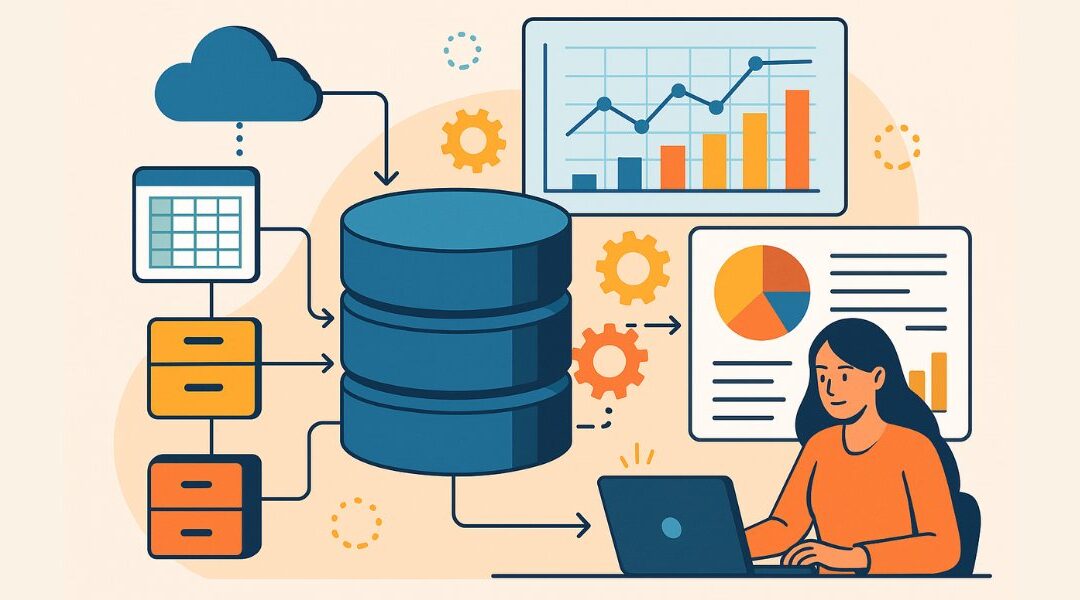
An integrated database describes a central solution that brings together different data sources and systems. The aim is to make information usable more quickly and to ensure quality. In a world where companies process millions of data points every day, it is clear that efficient processes are hardly possible without well-designed database integration.
Why an integrated database is the key to better decisions
Today's companies are faced with huge amounts of data: enterprise data, big data, data warehouses, and data lakes—information is generated everywhere. But many companies struggle with the fact that this information is distributed across different databases.
This is where an integrated database comes in. It connects heterogeneous databases in a common structure. The result: a uniform view of data that enables better database processes and lays the foundation for business intelligence.
A practical example: DataNaicer can be used to automatically convert unstructured data sources into clearly structured attributes. This creates consistent information that can be transferred directly into a database management system (DBMS).

The most important benefits of database integration
The advantages of database integration can be divided into three categories:
| Benefit | Effect | Example |
|---|---|---|
| uniform data | consistency across all systems | fewer errors in goods information |
| efficiency | less manual work | faster data extraction |
| scalability | process higher data volumes | integration of enterprise data |
These benefits show that an integrated database not only increases productivity but also reduces costs. Many companies report that even small automations pay off massively. This is exactly the effect shown by the case study from uNaice: with only 1% automated data maintenance, the wholesaler for home technology saved several hundred hours per month.
Data sources and their role in the company
An integrated database can only be as good as its data sources. Companies draw on a wide variety of sources: relational databases, NoSQL databases, value stores, and even classic local data storage.
The challenge: these systems differ in their architecture and the database engine used. One example is Berkeley DB, which has been used in applications for many years, while modern solutions such as eXtremeDB are optimized for embedded systems.
Tools such as DataNaicer take care of the tedious work of data transformation: unstructured manufacturer information is converted into structured formats. This creates a basis that can be used immediately for database systems and integration.

How database integration combines different sources
One of the biggest challenges in companies is dealing with different sources. Customer data is often available in different formats and applications – from CRM to email marketing to ERP systems. This is exactly where the idea of database integration creating a unified view from different data sources comes in.
Through customer data integration, companies can develop a holistic picture of their customers. All relevant data points, such as orders, support requests, or payment behavior, are brought together in an integrated database. This not only facilitates analysis but also ensures better decisions in everyday business.
From a technical perspective, various data integration tools and data integration platforms come into play. Classic systems such as SQL Server, Oracle, and MySQL are used when it comes to relational data. Modern alternatives such as RocksDB and Apache Cassandra demonstrate their strengths particularly when dealing with big data and flexible structures.
The migration of existing data to a new solution requires clean data migration processes. This is not only about transferring the data, but also about its quality. Incorrect values, duplicate entries, or missing attributes must be cleaned up before integration.
Another aspect is the cloud: Many companies use hybrid approaches, where some data is stored locally while other data is stored in a cloud environment. Compliance also plays a role here, as different countries have different data protection standards.
Those who choose this path embark on a true database integration journey – with clear goals and a roadmap that leads to greater efficiency and transparency in the long term.
Overview of database integration tools and platforms
To implement data integration efficiently, companies rely on specialized database integration tools or a comprehensive data integration platform.
Some well-known providers explain the basics in great detail. For example, Talend describes how companies merge different data sources. GigaSpaces also emphasizes the importance of speed and scalability in such projects.
A key point is choosing the right technology:
Which tool is best suited depends heavily on the amount of data and the existing architecture.

Benefits and use cases from practice
The benefits and use cases of an integrated database can be observed in many industries:
One example is provided by the WTO with its global Integrated Database approach, which makes trade data comparable across countries.
This is exactly where uNaice comes in: with solutions such as DataNaicer for your business, companies can optimize their data management and make it usable internationally.

Implementing integration step by step
The path to successful integration usually follows a clear process:
This is exactly where DataNaicer comes in: it converts manufacturer data, PDFs, or Excel spreadsheets into machine-readable formats. Teams can then use the Validation Station to check the results, striking a balance between automation and human control.
You can find more details on this topic in the article Data preparation explained simply.
Business Intelligence and the value of Integrated Data
An integrated database is not an end in itself—it forms the basis for business intelligence. Only when data from different sources is consolidated can trends be identified and better decisions be made.
Many companies rely on data warehouses connected to a data integration platform. Others use a data lake to store unstructured data and evaluate it later.
One example is provided by Wikipedia, which shows how an embedded database can be integrated into applications to use local data for analysis.

Performance and advantages of modern database solutions
Successful data integration depends not only on processes, but also on the performance of the systems used. Modern database solutions are designed to process large amounts of data in a short time while offering high reliability.
The issue of improved performance is evident, for example, in real-time queries: A system database can search millions of data records in parallel if the right storage and memory management is used.
In addition, database models play an important role. While relational models are suitable for structured data, document store approaches and databases such as graph models offer new possibilities. Embeddable databases, which can be integrated directly into an application or device without the need for a large external infrastructure, are particularly exciting.
The advantages of such solutions are obvious:
At the same time, hardware must be taken into account: fast servers, reliable hardware, and efficient networks contribute significantly to performance.
The variety of technologies—from RocksDB to Oracle to Apache Cassandra—shows that companies must choose their solution individually. Ultimately, it is about finding a database solution that optimally supports your own data integration requirements.
This makes it clear that modern systems not only deliver better performance, but also lay the foundation for sustainable and future-proof data integration.

Conclusion: Data integration as a competitive advantage
An integrated database is more than just an IT project—it is the foundation for efficiency, scalability, and transparency. Whether through data extraction, data transformation, or the use of specialized database integration tools, consolidating your enterprise data creates the basis for digital competitiveness.
The case studies relating to DataNaicer show that automation combined with human control ensures quality and trust. Companies save time, reduce costs, and increase customer satisfaction.
In other words, good data integration turns complex database systems into an engine for growth and innovation.